
Guidance
Guidance to licensing authorities
The Gambling Commission's guidance for licensing authorities.
Contents
- Legislative changes and Changes to the Guidance to Licensing Authorities (GLA) - 1 April 2021
- Part 1: General guidance on the role and responsibilities of licensing authorities in gambling regulation
-
- Introduction
- Partnership working between the Commission and licensing authorities – shared regulation
- Co-ordination and contact
- Primary legislation
- Statutory aim to permit gambling
- The licensing objectives
- Codes of practice
- Licensing authority discretion (s.153 of the Act)
- Local risk assessments
- Licensing authority policy statement
- Limits on licensing authority discretion
- Other powers
- Part 2: The licensing framework
- Part 3: The Gambling Commission
- Part 4: Licensing authorities
- Part 5: Principles to be applied by licensing authorities
- Part 6: Licensing authority policy statement
- Part 7: Premises licences
- Part 8: Responsible authorities and interested parties definitions
- Part 9: Premises licence conditions
- Part 10: Review of premises licence by licensing authority
- Part 11: Provisional statements
- Part 12: Rights of appeal and judicial review
- Part 13: Information exchange
- Part 14: Temporary use notices
- Part 15: Occasional use notices
- Part 16: Gaming machines
- Part 17: Casinos
-
- Casino premises
- Casino games
- Protection of children and young persons
- The process for issuing casino premises licences
- Resolutions not to issue casino licences
- Converted casinos (with preserved rights under Schedule 18 of the Act)
- Casino premises licence conditions
- Mandatory conditions – small casino premises licences
- Mandatory conditions – converted casino premises licences
- Default conditions attaching to all casino premises licences
- Self-exclusion
- Part 18: Bingo
- Part 19: Betting premises
- Part 20: Tracks
-
- Definition of a track
- Track premises licences – differences from other premises licences
- Betting on tracks
- Licences and other permissions for the provision of betting facilities
- Betting on event and non-event days
- Social responsibility considerations for tracks
- Gaming machines
- Self-service betting terminals (SSBTs)
- Applications
- Licence conditions and requirements
- Part 21: Adult gaming centres
- Part 22: Licensed family entertainment centres
- Part 23: Introduction to permits
- Part 24: Unlicensed family entertainment centres
- Part 25: Clubs
- Part 26: Premises licensed to sell alcohol
- Part 27: Prize gaming and prize gaming permits
- Part 28: Non-commercial and private gaming, betting and lotteries
- Part 29: Poker
- Part 30: Travelling fairs
- Part 31: Crown immunity and excluded premises
- Part 32: Territorial application of the Gambling Act 2005
- Part 33: Door supervision
- Part 34: Small society lotteries
-
- Small society lotteries
- The status of lotteries under the Act
- Licensing authority guidance
- Social responsibility
- External lottery managers’ licence status
- Lottery tickets
- Prizes
- Specific offences in relation to lotteries
- Application and registration process for small society lotteries
- Administration and returns
- Part 35: Chain gift schemes
- Part 36: Compliance and enforcement matters
- Appendix A: Summary of machine provisions by premises
- Appendix B: Summary of gaming machine categories and entitlements
- Appendix C: Summary of gaming entitlements for clubs and alcohol-licensed premises
- Appendix D: Summary of offences under the Gambling Act 2005
- Appendix E: Summary of statutory application forms and notices
- Appendix F: Inspection powers
- Appendix G: Licensing authority delegations
- Appendix H: Poker games and prizes
- Appendix I: Glossary of terms
What do we know?
There has been an increase in the proportion of players who play slot games either online or in person. Online slots are the largest online gambling product by Gross Gambling Yield34 .
With an increasing proportion of players playing these higher risk products an area of focus is ensuring games are safer by design and consumers understand how they operate to enable them to make an informed choice.
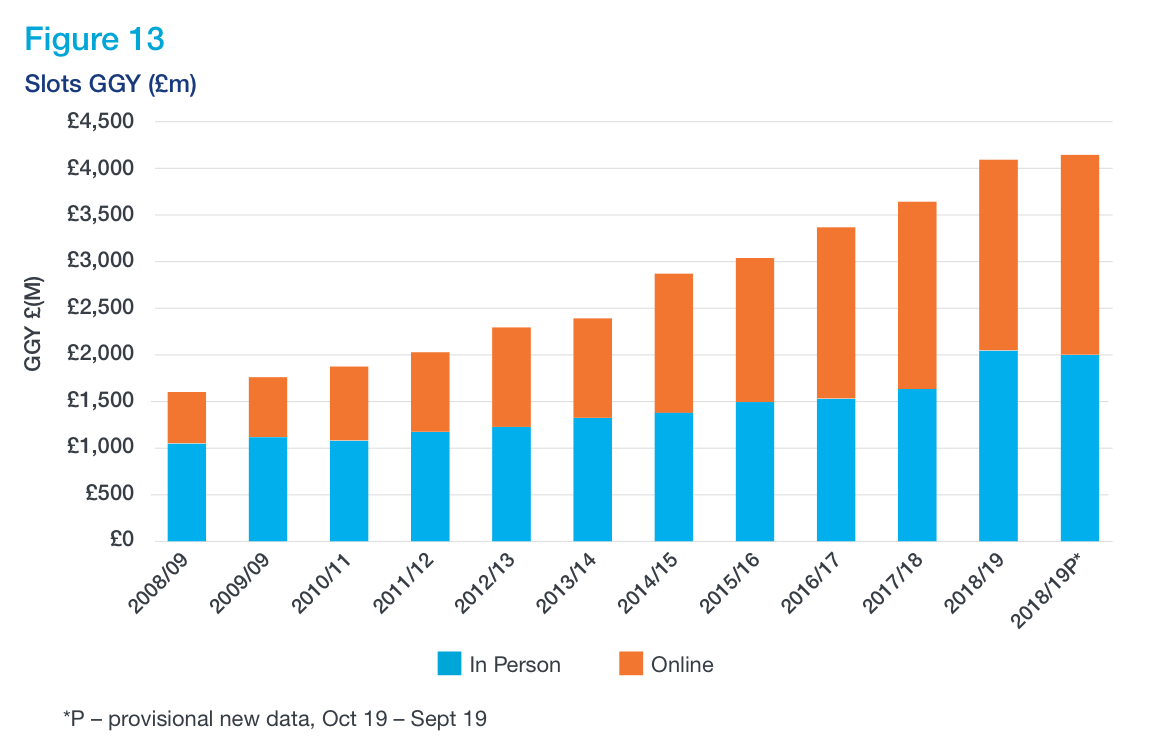
The Gambling Commission knows that problem gambling rates associated with online slots, casino or bingo games are higher than the land-based equivalents. We have therefore focused on the drivers behind these products and how they can be made safer for consumers.
We also know the success of content creators and games designers depends on their ability to establish and maintain the engagement of their consumers. We know that this can be done by behavioural techniques which has the potential to unconsciously change consumer behaviour.
GC action
We will publish the findings of the randomised controlled trials with three large operators into anchoring and commitment devices.
There are many contributing factors the risks associated with a gambling product, including the speed and frequency of play, ease of access and scope to deposit and lose funds as a result of the design of games and the platforms they are made available from.
Gambling-related harm occurs at all levels of staking and across different gambling products. Rates of problem gambling across different gambling products should inform how licensees identify and mitigate the risks associated with their product range.
No single policy change can make gambling products safe. Addressing the risks associated with the products people play - such as stake limits or speed of play - should be considered alongside a package of complementary initiatives which impact each stage of a customer’s interaction with a given product. That is why our approach includes looking at affordability measures, better identification of vulnerability, earlier preventative action, safer game design, responsible marketing and advertising, and customer interaction.
To date, stake and prize limits have not been imposed on online gambling in Great Britain. They have been a longstanding feature of gaming machine regulation and are set by the Government. The majority of gaming machine play remains anonymous making personalised gambling management tools less effective.
Conversely, the potential for effective player- centric consumer protection that account- based play offers online licensees has not been sufficiently seized.
The following table provides a snapshot of the levels at which players staked when playing online slot games. It is important to note this data has been collected from licensees during the coronavirus (COVID-19) period where consumer behaviour has been impacted by factors including the closure of gambling premises. This analysis builds on an earlier snapshot of staking behaviour from January 201735.
| Online slots staking levels | April to August 2020 |
|---|---|
| £1 and below | 88% |
| £1.01 to £2 | 8% |
| £2.01 to £5 | 3% |
| £5.01 to £10 | 1% |
| £10.01 to £20 | 0.2% |
| £20.01 to £50 | 0.1% |
| £50.01 to £100 | 0.01% |
| >£100 | 0.004% |
Parity in consumer protection between online games and games played in premises would require the implementation of stake and prize-controls for online games and a requirement for account-based play on gaming machines.
To help inform consumers about how products operate there needs to be better communication of key gambling concepts to help consumers to understand their chances of winning. Research has found that consumers often struggle to understand ‘industry jargon’ and associated mathematical concepts and this is also apparent in customer complaint data36.
Research commissioned by Gamble Aware considered several options for better communicating concepts such as house edge, return to player and game volatility to players. But we have not seen licensee make sufficient progress in this key area to ensure gambling is as fair and open as possible.
GC action
To improve understanding of player experience of gambling products, we are actively engaged in several research programmes including the large scale GambleAware-funded project into online patterns of play being led by NatCen.
References
Last updated: 25 July 2024
Show updates to this content
Following an audit corrected link formatting issues only.