
Guidance
Guidance to licensing authorities
The Gambling Commission's guidance for licensing authorities.
Contents
- Legislative changes and Changes to the Guidance to Licensing Authorities (GLA) - 1 April 2021
- Part 1: General guidance on the role and responsibilities of licensing authorities in gambling regulation
-
- Introduction
- Partnership working between the Commission and licensing authorities – shared regulation
- Co-ordination and contact
- Primary legislation
- Statutory aim to permit gambling
- The licensing objectives
- Codes of practice
- Licensing authority discretion (s.153 of the Act)
- Local risk assessments
- Licensing authority policy statement
- Limits on licensing authority discretion
- Other powers
- Part 2: The licensing framework
- Part 3: The Gambling Commission
- Part 4: Licensing authorities
- Part 5: Principles to be applied by licensing authorities
- Part 6: Licensing authority policy statement
- Part 7: Premises licences
- Part 8: Responsible authorities and interested parties definitions
- Part 9: Premises licence conditions
- Part 10: Review of premises licence by licensing authority
- Part 11: Provisional statements
- Part 12: Rights of appeal and judicial review
- Part 13: Information exchange
- Part 14: Temporary use notices
- Part 15: Occasional use notices
- Part 16: Gaming machines
- Part 17: Casinos
-
- Casino premises
- Casino games
- Protection of children and young persons
- The process for issuing casino premises licences
- Resolutions not to issue casino licences
- Converted casinos (with preserved rights under Schedule 18 of the Act)
- Casino premises licence conditions
- Mandatory conditions – small casino premises licences
- Mandatory conditions – converted casino premises licences
- Default conditions attaching to all casino premises licences
- Self-exclusion
- Part 18: Bingo
- Part 19: Betting premises
- Part 20: Tracks
-
- Definition of a track
- Track premises licences – differences from other premises licences
- Betting on tracks
- Licences and other permissions for the provision of betting facilities
- Betting on event and non-event days
- Social responsibility considerations for tracks
- Gaming machines
- Self-service betting terminals (SSBTs)
- Applications
- Licence conditions and requirements
- Part 21: Adult gaming centres
- Part 22: Licensed family entertainment centres
- Part 23: Introduction to permits
- Part 24: Unlicensed family entertainment centres
- Part 25: Clubs
- Part 26: Premises licensed to sell alcohol
- Part 27: Prize gaming and prize gaming permits
- Part 28: Non-commercial and private gaming, betting and lotteries
- Part 29: Poker
- Part 30: Travelling fairs
- Part 31: Crown immunity and excluded premises
- Part 32: Territorial application of the Gambling Act 2005
- Part 33: Door supervision
- Part 34: Small society lotteries
-
- Small society lotteries
- The status of lotteries under the Act
- Licensing authority guidance
- Social responsibility
- External lottery managers’ licence status
- Lottery tickets
- Prizes
- Specific offences in relation to lotteries
- Application and registration process for small society lotteries
- Administration and returns
- Part 35: Chain gift schemes
- Part 36: Compliance and enforcement matters
- Appendix A: Summary of machine provisions by premises
- Appendix B: Summary of gaming machine categories and entitlements
- Appendix C: Summary of gaming entitlements for clubs and alcohol-licensed premises
- Appendix D: Summary of offences under the Gambling Act 2005
- Appendix E: Summary of statutory application forms and notices
- Appendix F: Inspection powers
- Appendix G: Licensing authority delegations
- Appendix H: Poker games and prizes
- Appendix I: Glossary of terms
What are the issues - Gaming machines in premises
Whilst a lot of our focus relates to the shift of consumers toward online gambling and gambling on mobile phones, we remain mindful that playing gaming machines in premises also presents issues and risks.
There are 185,203 gaming machines in Great Britain according to the most recent industry statistics40. Gaming machines are subject to categorisation which determines their maximum stake, prize, speed of play and location41. The Gambling Commission sets the speed of play on gaming machines via technical standards.
The Health Survey for England 2018 records the problem gambling rate for those playing gaming machines in bookmakers at 12.7% and for slot machines at 5.1%, with the moderate risk rate being 14.5% and 9% respectively. This is in addition to low-risk rates of 21.8% for machines in bookmakers and 15.8% for slot machines.
The gaming machine market has had two significant recent interventions. Firstly, the reduction in the maximum stake for B2 gaming machines from £100 to £2 was implemented in April 2019. Subsequently licensed premises providing access to gaming machines were closed due to the coronavirus (COVID-19) outbreak and since reopening have been subject to restrictions. The impacts of these two interventions are still being assessed.
The stake cut to £2 has prompted the withdrawal of B2 gaming machines from the market. It is important that the risks posed by other categories of gaming machines are not overlooked. Remaining category B and C gaming machines share several risk factors considered concerns in relation to category B2 machines and have some additional environmental factors such as the availability of some machines in alcohol licensed premises.
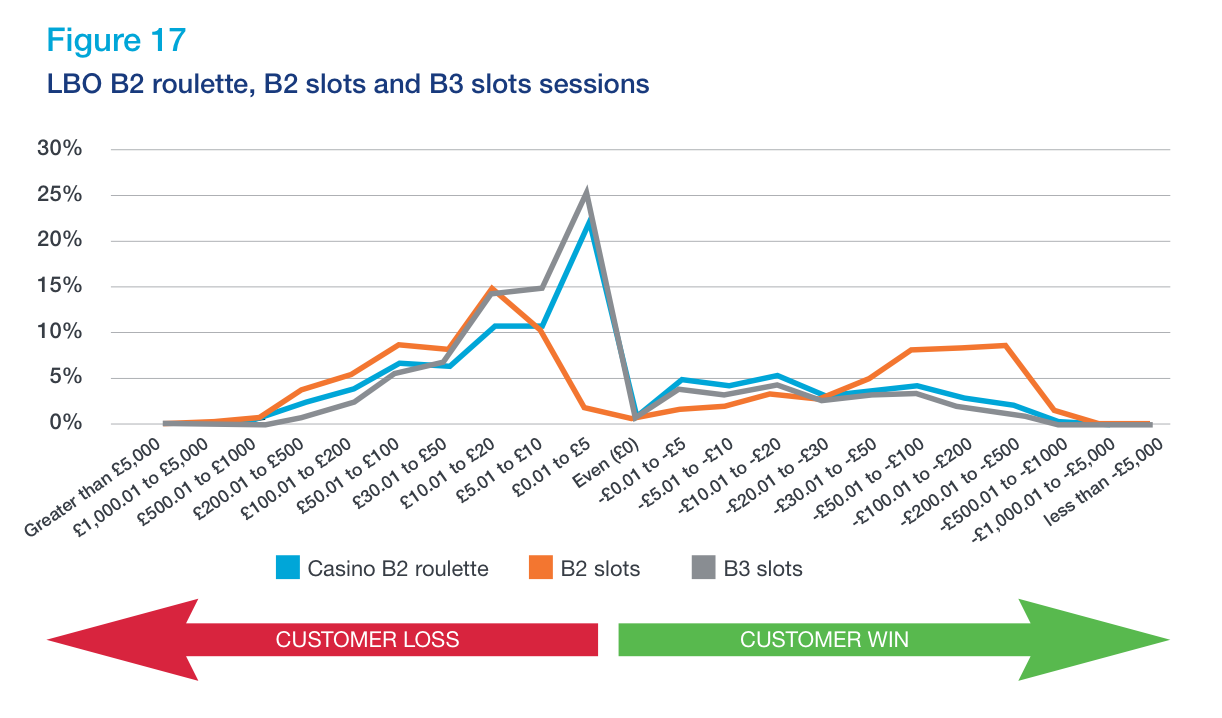
Risks in relation to gaming machines include their location and accessibility, anonymous and untracked play, intensity of play (based on stake, speed of play and return to player) and the effectiveness of oversight and intervention by licensees. Figure 13 illustrates the distribution of session outcomes across different category B2 content and B3 slots prior to the B2 stake cut.
Additional analysis undertaken on category B3 patterns of play since the B2 stake cut has identified a relatively strong correlation between sessions lasting for longer than 60 minutes and sessions ending in a sizeable loss. For example:
- 33% of all sessions losing more than £200 last longer than 60 minutes
- 69% of all sessions losing more than £500 last longer than 60 minutes
- 96% of all sessions losing more than £1,000 last longer than 60 minutes.
This analysis indicates that length of session (i.e. more than 60 minutes) is an important potential proxy for sizeable loss in the absence of real-time spend data.
Where industry has sought to overcome some of the challenges presented by gaming machine play, we have not seen robust evaluation of the impacts on players. For example, evaluation of developments designed to facilitate cashless payment solutions alongside greater player tracking and gambling management tools, or in- session markers of harm have to date been too fragmented.
GC action
We will:
- implement the enhanced test house framework and ensure that the United Kingdom Accreditation Service assessments of Test Houses are robust and effective, providing confidence that gaming machines and online gaming systems meet accreditation standards.
- review what changes are required to our regulatory framework to ensure players of gaming machines are safe, treated fairly and informed about how the machines operate.
Last updated: 25 July 2024
Show updates to this content
Following an audit corrected link formatting issues only.