
Report
Insights into affected others from the GSGB
Insights into affected others from the GSGB
Prevalence and characteristics of affected others
The Gambling Survey for Great Britain (GSGB) (2024) found that 48.0 percent of participants reported being close to someone who gambles. Among these participants, 5.3 percent had experienced at least one severe consequence from someone else’s gambling and 19.0 percent had experienced at least one potential consequence from someone else’s gambling. Overall, this corresponds to 9.0 percent of the total sample being affected by someone else’s gambling in the past 12 months (as shown in Figure 1).
Figure 1 - Proportion of participants affected by someone else’s gambling
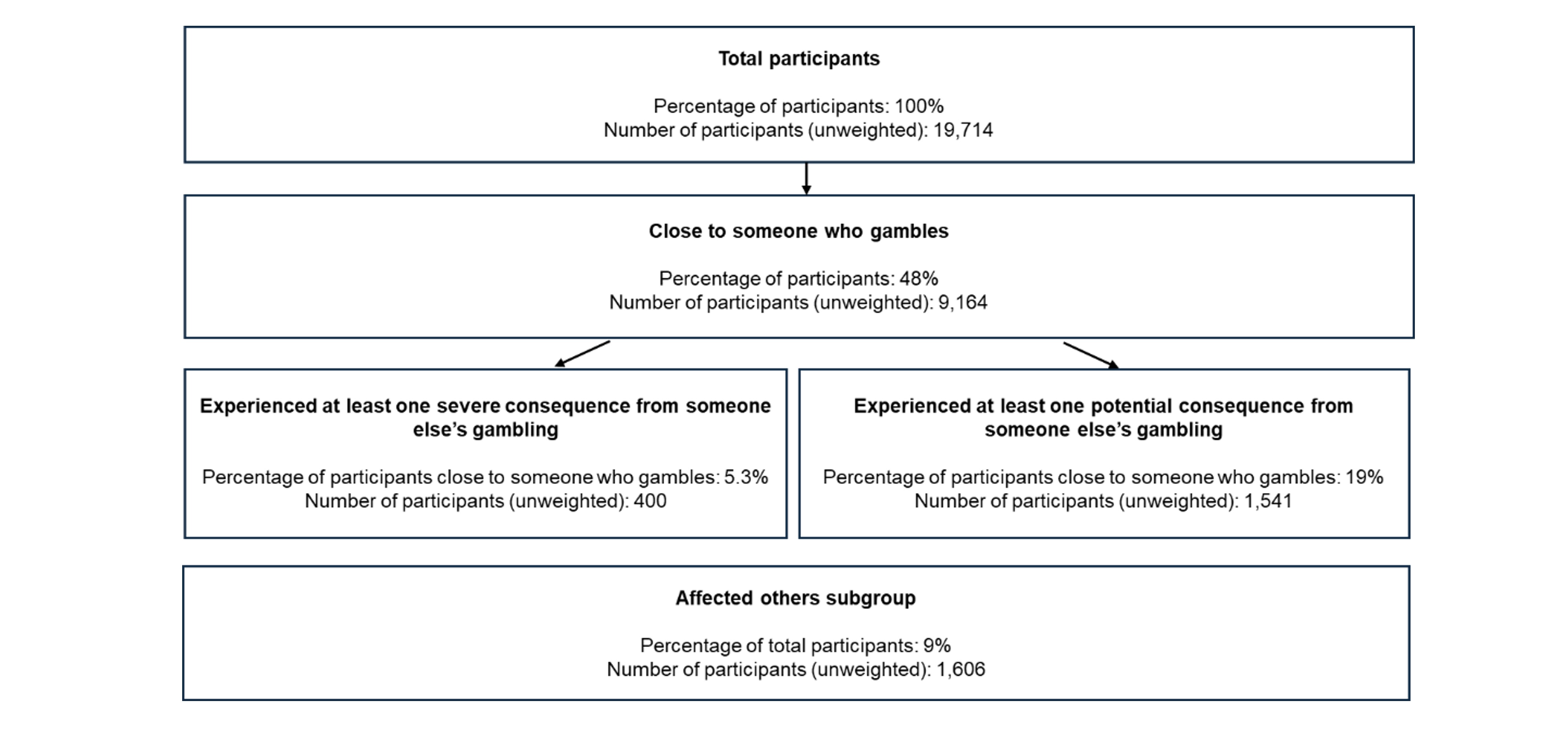
| Definition | Percentage | Number of participants |
|---|---|---|
| Total participants | 100% | 19,714 |
| Close to someone who gambles | 48% of total participants | 9,164 |
| Experienced at least one severe consequence from someone else’s gambling | 5.3% of participants close to someone who gambles | 400 |
| Experienced at least one potential consequence from someone else’s gambling | 19% of participants close to someone who gambles | 1,541 |
| Affected others subgroup | 9% of total participants | 1,606 |
Note: Although participants may have experienced both types of adverse consequences, they are included only once in the overall affected others base to avoid double counting.
Demographic profile
Among those who reported being affected by someone else’s gambling in the past 12 months, just over half were female (55 percent), compared with 45 percent who were male. More than 2 in 5 affected others were aged between 25 and 44 (46 percent). Compared with the overall profile of GSGB participants, affected others tended to be younger, with a higher proportion aged between 18 to 44 years, as shown in Table 1.
Table 1 - Demographic profile of affected others in comparison to all GSGB participants
| Sex | All affected others (percentage) | All GSGB participants (percentage) |
|---|---|---|
| Male | 45% | 48% |
| Female | 55% | 52% |
| Age | All affected others (percentage) | All GSGB participants (percentage) |
| 18 to 24 | 15% | 10% |
| 25 to 34 | 25% | 28% |
| 35 to 44 | 21% | 17% |
| 45 to 54 | 14% | 16% |
| 55 to 64 | 13% | 16% |
| 65 to 74 | 9% | 14% |
| 75 and over | 3% | 10% |
Gambling participation
When we explored the gambling participation of affected others, we found that many affected others were gambling themselves: 63 percent of affected others reported gambling in the past 12 months.
In fact, affected others were 1.1 times more likely to have gambled in the past 12 months compared with all participants in the GSGB (63 percent versus 60 percent). A similar pattern was seen when looking at gambling participation in the past 4 weeks (54 percent versus 48 percent).
When excluding those who only gambled on lottery draws (including the National Lottery and other charity lotteries), this gap widened. Those affected by someone else’s gambling were 1.5 times more likely to have gambled on any activity in the past 4 weeks (excluding lottery draws) compared with all participants (41 percent versus 28 percent), as shown in Table 2.
Table 2 - Gambling participation rates for affected others in comparison to all GSGB participants
| Definition | All affected others (percentage) | All GSGB participants (percentage) |
|---|---|---|
| Gambling participation in past 12 months | 63% | 60% |
| Gambling participation in past 4 weeks | 54% | 48% |
| Gambling participation in past 4 weeks excluding lotteries | 41% | 28% |
Further exploration of affected others who gamble and those who do not
Last updated: 14 May 2026
Show updates to this content
No changes to show.