- Print the full document
- Save the page as a HTML document to your device
- Save the page as a PDF file
- Bookmark it - it will always be the latest version of this document
This box is not visible in the printed version.
Insights into affected others from the GSGB
Insights into affected others from the GSGB
Published: 14 May 2026
Last updated: 14 May 2026
This version was printed or saved on: 30 September 2026
Online version: https://www.gamblingcommission.gov.uk/report/insights-into-affected-others-from-the-gsgb
Introduction
The Gambling Commission’s role is to safeguard consumers and the wider public by ensuring that gambling is safe, fair and crime free. We place consumers at the heart of our regulation. Under section 26 of the Gambling Act 2005 (opens in new tab), the Commission also has responsibility for collecting and disseminating information about the extent and impact of gambling in Great Britain. We do this through a programme of research and wider data analysis, which is structured across 6 evidence themes. We have published our Evidence Roadmaps, which for each theme set out the direction of travel for our research to inform regulation, the Commission’s priorities and progress against the roadmaps and also highlight areas where the wider evidence ecosystem can contribute and add value to the evidence base.
Within theme 3 ‘Gambling related harm and vulnerability’ we set out our intention to understand the impact of gambling on people who gamble and affected others. The Gambling Survey for Great Britain (GSGB) identifies people who may be impacted by someone else’s gambling, providing the opportunity to explore this topic in more detail. This report therefore starts to examine the self-reported experiences of adults impacted by someone else’s gambling, referred to as affected others.
The GSGB has included questions on the potential and severe adverse consequences from someone else’s gambling since its launch, covering 3 domains: health, relationships and resources. This report draws on the latest annual GSGB (2024) data, using its large sample size to explore in more depth those we identified as affected others.
The findings highlight the complexity within the affected other group. We originally set out to explore the impact of gambling on people who do not gamble themselves, but the research has identified a more nuanced picture whereby some people are impacted not only by someone else’s gambling, but also by their own gambling experiences. This impact shouldn’t always be assumed to be negative, with a greater proportion of affected others who gamble themselves saying they gamble because it is something they do with their friends or family, suggesting a social element to their experience (52 percent compared to 35 percent of all people who gamble).
This report first looks at the characteristics of affected others, before exploring their own gambling behaviour, including differences between those who gamble and those who do not. It then explores adverse consequences - both potential and severe - across the 3 domains: health, relationships and resources. This includes impacts arising from someone else’s gambling and, where relevant, from individuals’ own gambling, as well as their support-seeking behaviours.
Additionally, this report informs planned future qualitative research being undertaken by the Commission. The purpose of the qualitative research is to help contextualise the GSGB findings. Taken together, such findings may highlight potential areas for regulatory consideration by the Commission or identify further opportunities for research and analysis on affected others by the wider gambling ecosystem.
Background
Despite a growing evidence base, there is still relatively little research focusing on those affected by someone else’s gambling, especially within Great Britain. These individuals are often referred to as affected others. Although this term is commonly used, its acceptance is not universal. After consulting with our Lived Experience Advisory Panel (LEAP), it was agreed that it was appropriate to use this term in our work.
As identified in our Evidence Roadmap we wanted to understand more about the experiences of people affected by someone else’s gambling. The inclusion of questions on the Gambling Survey for Great Britain (GSGB) about the severe and potentially adverse consequences people may experience because of someone else’s gambling provided the opportunity to do that.
The questions on the GSGB were developed as part of a broader shift towards a more holistic understanding of gambling-related harm. This approach moves beyond solely relying on the Problem Gambling Severity Index (PGSI), which does not fully capture the wide range of adverse consequences people may experience from their own gambling, nor the broader harms experienced by friends, family and the wider community. The questions have been included in the GSGB since its launch in 2023, capturing the consequences of gambling both from one’s own gambling and someone else’s. The focus of this report is on the latter; research on the consequences experienced from one’s own gambling can be found elsewhere1,2.
The impacts covered by these questions are underpinned partly by Wardle and others (2018) framework for action on gambling-related harm (opens in new tab) , which group gambling-related harms into 3 key areas:
- resources – for example, financial pressure, or difficulty managing money
- relationships – such as conflict, tension, or social isolation
- health – including stress, worry or emotional strain.
The GSGB survey questions distinguish between 2 types of adverse consequences, covering impacts across these 3 areas.
Severe adverse consequences – where any experience of them, even only once, would have a serious negative impact. This includes relationship breakdown, losing something of significant financial value, violence or abuse, and crime. These are asked as “Yes” or “No” questions.
Potential adverse consequences – which are more likely to be harmful if experienced often or may be harmful depending on the individual’s specific circumstances. This includes spending less on everyday items, increased use of credit or savings to gamble, experience of conflict within relationships, feeling isolated, lying about the extent of gambling and poor work performance or work absences. These are measured on a four-point frequency scale, ranging from “Never” to “Very often”.
Full wording of the questions and a detailed list of consequences asked in the GSGB survey can be found in the Methods section.
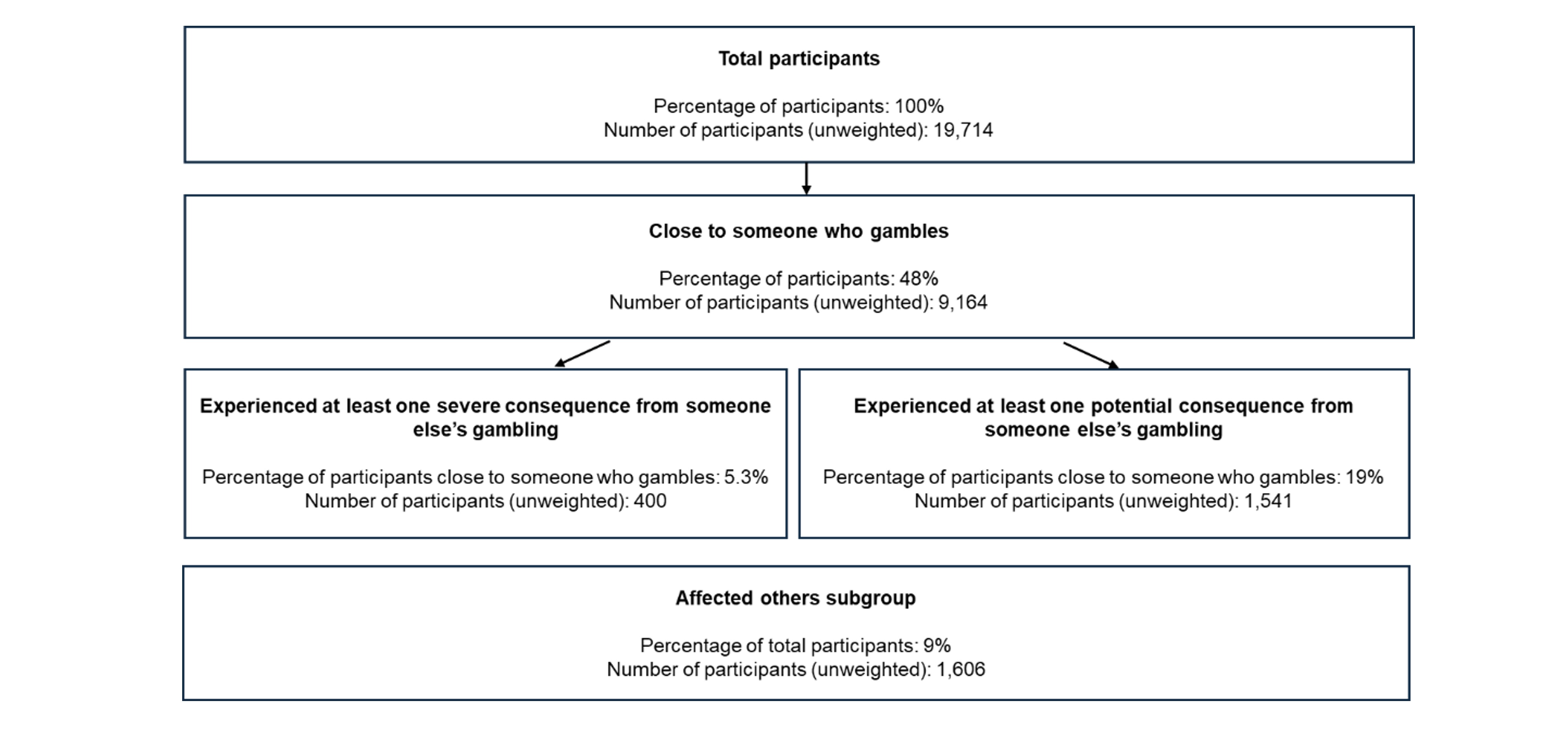
The latest GSGB (2024) annual survey shows that almost half (48.0 percent) of participants reported that someone close to them gambled, even if occasionally. Of these participants, 5.3 percent had experienced one or more severe adverse consequences from someone else’s gambling and 19.0 percent had experienced at least one potential adverse consequence from someone else’s gambling3. Using this as a starting point, we undertook a deeper analysis to identify those most likely to be considered affected others. Ultimately, the aim of this work was to develop a clearer understanding of this group, and feed into our evidence roadmap exploring the impact on people who gamble and affected others.
1 Statistics on gambling participation – Annual report Year 2 (2024): Official statistics
2 Qualitative research on the consequences of gambling
3 It should be noted that in the GSGB data available on the UKDS data archive, the derived variables assessing when a participant has experienced a potential adverse consequence only include 6 of the 9 adverse consequences (see Methods section for breakdown and reasoning). As a result, deriving rates of experiencing adverse consequences using these variables will derive different rates than this analysis, which included all 9 questions when considering potential adverse consequences.
Methods
The Statistics on gambling participation – Annual report Year 2 (2024): Official statistics collected data from 19,714 adults aged 18 years and older living in Great Britain. Fieldwork was carried out between January 2024 and January 2025, consisting of 4 waves running quarterly. Details regarding the methodology of the GSGB can be found in our technical report.
Questions regarding adverse consequences in relation to someone else’s gambling were asked to participants who reported that they knew someone close to them who gambles, irrespective of whether they live with that person.
Each consequence question relates to one of the following 3 domains: resources, relationships, and health. These domains are specified by Wardle and others (2018) framework for action on gambling-related harm (opens in new tab).
Potential adverse consequences
The following questions were asked to assess potential adverse consequences relating to someone else’s gambling. Participants were asked how often in the past 12 months someone else's gambling had caused them to:
...reduce or cut back your spending on everyday items such as food, bills and clothing? (resources)
...reduce your savings or increase your use of credit, such as credit cards, overdrafts and loans? (resources)
...experience conflict or arguments with friends, family and/or work colleagues? (relationships)
...feel isolated from other people, left out or feel completely alone? (relationships)
...lie to family, or others, to hide the extent of someone else’s gambling? (relationships)
...be absent or perform poorly at work or study? (resources)
Or, considering someone else's gambling in the last 12 months:
7*. Have you borrowed money or sold anything to get money because of someone else’s gambling? (resources)
8*. Have you felt that someone else’s gambling has caused you any health problems, including stress or anxiety? (health)
9*. Have you felt that someone else’s gambling has made you feel embarrassment, guilt or shame? (health)
Response options for all questions were ‘Never’, ‘Occasionally’, ‘Fairly often’, and ‘Very often’.
Questions 7, 8, and 9 – indicated with * – are derived from the Problem Gambling Severity Index (PGSI), which asks participants about their own gambling behaviour. When examining the impacts of one’s own gambling behaviour, these questions are asked as part of the 9-point PGSI question set, with the remaining potential adverse consequences (questions 1 to 6) asked in a separate question set. When examining the impacts of someone else’s gambling, these questions are similarly asked in 2 separate question sets for clarity. These PGSI items are included in the GSGB's list of potential adverse consequences due to their similarity to frequently reported adverse consequences identified during the development of this consequence set.
Participants who responded ‘Occasionally’, ‘Fairly often’, or ‘Very often’ to at least one potential adverse consequence were included in the analysis. Our previous assessment of the consequences question set showed that participants who experienced adverse consequences at least ‘occasionally’ exhibit significantly higher PGSI scores (indicating higher-risk gambling behaviour) and poorer mental wellbeing (assessed using the Short Warwick-Edinburgh Mental Wellbeing Scale) compared with those answering ‘Never’. As such, we consider participants responding at least ‘occasionally’ to have been affected by someone else’s gambling for the purposes of this analysis.
Severe adverse consequences
The following questions were asked to assess severe adverse consequences relating to someone else’s gambling. Participants were asked whether in the past 12 months:
Have you lost something of significant financial value such as your home, business, car or been declared bankrupt because of someone else’s gambling?
Has your relationship with someone close to you such as a spouse, partner, family member or friend broken down?
Have you experienced violence or abuse because of someone else’s gambling?
Have you committed a crime in order to finance someone else's gambling or to pay their gambling debts?
Response options were ‘Yes’ or ‘No’.
Support services
The following questions were asked to assess the use of support services by participants due to someone else’s gambling. Participants were asked whether in the past 12 months:
Has someone else’s gambling led you to seek help, support or information online, in-person or by telephone from…
…mental health services?
…food banks or other welfare organisations?
…relationship counselling and support services?
…gambling support services?
Response options were ‘Yes’ or ‘No’.
Consequences due to own gambling
Questions relating to potential adverse consequences4, severe adverse consequences and support services were also asked to participants if they had gambled in the past 12 months, in relation to their own gambling, with relevant changes in question wording to reflect this.
Defining an affected other
For this analysis we defined an affected other as someone who:
- knew someone close to them who gambled
- experienced at least one potential adverse consequence (at least occasionally) due to someone else’s gambling in the past 12 months
- experienced at least one severe adverse consequence due to someone else’s gambling in the past 12 months.
Throughout this report, any reference to ‘consequences’ (unless otherwise specified) refers to both types of adverse consequences described above.
Strengths of this analysis
It is important to recognise that this research has its strength and limitations. We first outline its strengths, followed by its limitations.
This research uses data from the GSGB which uses a push-to-web approach and stratified random probability sample. This provides nationally representative population estimates and enables a large sample size to be achieved. Further details on the GSGB methodology can be found in our technical report.
Rather than solely relying on the Problem Gambling Severity Index (PGSI), this research explores the additional questions relating to severe and potential adverse consequences. These questions were rolled onto the GSGB and asked both to participants who had gambled in the past 12 months about their own gambling, and to participants who knew someone close to them who gambles, with questions about consequences experienced due to someone else’s gambling. This approach provides a more holistic understanding of gambling-related consequences and addresses known limitations of the PGSI (opens in new tab), including its inability to capture the experiences of affected others.
Part of the analysis in this report focuses on adverse consequences from an individual’s own gambling. Participants were asked questions on adverse consequences in two separate sets: one relating to their own gambling and another relating to consequences from someone else’s gambling. Therefore, such findings reduce the risk of double counting.
Given it’s push-to-web methodology, research (opens in new tab) suggests that participants may feel more comfortable providing honest responses in self-completion surveys compared with interviewer-administered surveys, potentially reducing the influence of social desirability bias.
Limitations of this analysis
As the GSGB is a self-report survey, some participants may simply not know that someone close to them gambles. This could mean that data on participants affected by someone else’s gambling may be under-reported.
Additionally, we cannot identify the specific relationship between the affected person and the person who’s gambling is impacting them. We only know the participant knows someone close to them gambles. Furthermore, although we ask whether a person lives with someone who gambles, we cannot determine if it is this person's gambling that is impacting the participant.
Although this research has these limitations, a qualitative study later this year – mentioned later in this report – will aim to explore and address some of these areas in depth.
4 For own gambling, questions 7, 8, and 9 – indicated with * – were asked as part of the PGSI question set, and had the response options ‘almost always’, ‘most of the time’, ‘sometimes’, and ‘never’.
Findings
Prevalence and characteristics of affected others
The Gambling Survey for Great Britain (GSGB) (2024) found that 48.0 percent of participants reported being close to someone who gambles. Among these participants, 5.3 percent had experienced at least one severe consequence from someone else’s gambling and 19.0 percent had experienced at least one potential consequence from someone else’s gambling. Overall, this corresponds to 9.0 percent of the total sample being affected by someone else’s gambling in the past 12 months (as shown in Figure 1).
Figure 1 - Proportion of participants affected by someone else’s gambling
| Definition | Percentage | Number of participants |
|---|---|---|
| Total participants | 100% | 19,714 |
| Close to someone who gambles | 48% of total participants | 9,164 |
| Experienced at least one severe consequence from someone else’s gambling | 5.3% of participants close to someone who gambles | 400 |
| Experienced at least one potential consequence from someone else’s gambling | 19% of participants close to someone who gambles | 1,541 |
| Affected others subgroup | 9% of total participants | 1,606 |
Note: Although participants may have experienced both types of adverse consequences, they are included only once in the overall affected others base to avoid double counting.
Demographic profile
Among those who reported being affected by someone else’s gambling in the past 12 months, just over half were female (55 percent), compared with 45 percent who were male. More than 2 in 5 affected others were aged between 25 and 44 (46 percent). Compared with the overall profile of GSGB participants, affected others tended to be younger, with a higher proportion aged between 18 to 44 years, as shown in Table 1.
Table 1 - Demographic profile of affected others in comparison to all GSGB participants
| Sex | All affected others (percentage) | All GSGB participants (percentage) |
|---|---|---|
| Male | 45% | 48% |
| Female | 55% | 52% |
| Age | All affected others (percentage) | All GSGB participants (percentage) |
| 18 to 24 | 15% | 10% |
| 25 to 34 | 25% | 28% |
| 35 to 44 | 21% | 17% |
| 45 to 54 | 14% | 16% |
| 55 to 64 | 13% | 16% |
| 65 to 74 | 9% | 14% |
| 75 and over | 3% | 10% |
Gambling participation
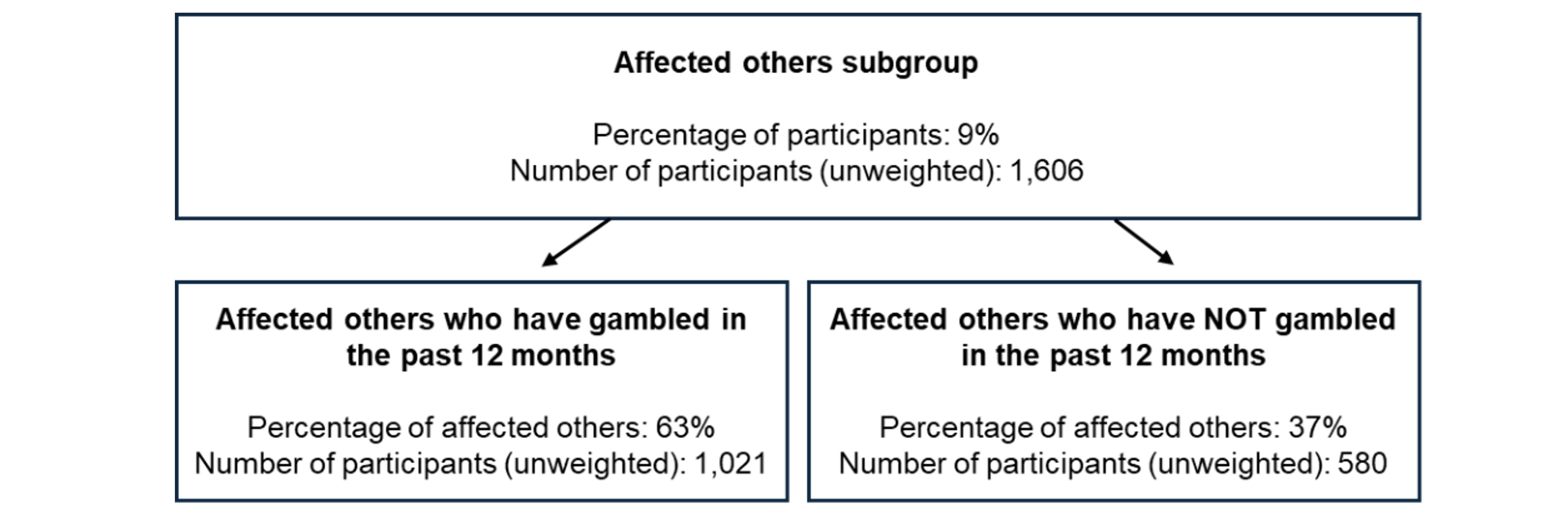
When we explored the gambling participation of affected others, we found that many affected others were gambling themselves: 63 percent of affected others reported gambling in the past 12 months.
In fact, affected others were 1.1 times more likely to have gambled in the past 12 months compared with all participants in the GSGB (63 percent versus 60 percent). A similar pattern was seen when looking at gambling participation in the past 4 weeks (54 percent versus 48 percent).
When excluding those who only gambled on lottery draws (including the National Lottery and other charity lotteries), this gap widened. Those affected by someone else’s gambling were 1.5 times more likely to have gambled on any activity in the past 4 weeks (excluding lottery draws) compared with all participants (41 percent versus 28 percent), as shown in Table 2.
Table 2 - Gambling participation rates for affected others in comparison to all GSGB participants
| Definition | All affected others (percentage) | All GSGB participants (percentage) |
|---|---|---|
| Gambling participation in past 12 months | 63% | 60% |
| Gambling participation in past 4 weeks | 54% | 48% |
| Gambling participation in past 4 weeks excluding lotteries | 41% | 28% |
Further exploration of affected others who gamble and those who do not
Given that many affected others were gambling themselves, we explored the demographics of affected others who gamble and those who do not, to identify any differences between these groups. Affected others were grouped into those who had gambled in the past 12 months (63 percent) and those who had not (37 percent), as shown in Figure 2.
Figure 2 - Proportion of affected others who do and do not gamble themselves
| Definition | Percentage | Number of participants |
|---|---|---|
| Affected others subgroup | 9% of total participants | 1,606 |
| Affected others who have gambled in the past 12 months | 63% of affected others | 1,021 |
| Affected others who have not gambled in the past 12 months | 37% of affected others | 580 |
Note: Base sizes do not sum to total number of affected others due to participants not responding to participation questions.
Where relevant, we also examined gambling behaviour among affected others who gambled, including types of gambling activities, reasons for gambling, and level of gambling risk, as measured by the Problem Gambling Severity Index (PGSI).
Demographic profiles
Similar to the overall group of people affected by someone else’s gambling, affected others that had gambled themselves in the past 12 months were more likely to be female (53 percent compared with 47 percent male). They were also more likely to be aged between 25 to 34 years (26 percent).
Among all participants who had gambled in the past 12 months, the proportion of males and females that gambled was similar (50 percent for each). Participants who gambled were more likely to be aged between 25 to 64 (ranging between 16 and 17 percent).
Within the affected others group, those who had gambled in the past 12 months were more likely to be male than those who had not (47 percent male versus 41 percent who did not). This pattern mirrors sex differences observed among all Gambling Survey for Great Britain (GSGB) participants, where adults who had gambled in the past 12 months were more likely to be male than those who had not (50 percent versus 45 percent). Taking into account the higher overall proportion of females among affected others relative to the GSGB sample, the greater representation of males among affected others who gambled is consistent with expectations. There is no increased propensity for male affected others to gamble compared to males overall.
The age profiles of affected others who did and did not gamble in the past 12 months were broadly similar across most age groups. The exception was those aged 18 to 24 years, who were more likely to report not participate in gambling.
Table 3 - Demographic profiles of affected others who did and did not gamble in the past 12 months5
| Sex | All affected others (percentage) | Affected others who have gambled in the past 12 months (percentage) | Affected others who have not gambled in the past 12 months (percentage) |
|---|---|---|---|
| Male | 45% | 47% | 41% |
| Female | 55% | 53% | 59% |
| Age | All affected others (percentage) | Affected others who have gambled in the past 12 months (percentage) | Affected others who have not gambled in the past 12 months (percentage) |
| 18 to 24 | 15% | 14% | 18% |
| 25 to 34 | 25% | 26% | 24% |
| 35 to 44 | 21% | 21% | 21% |
| 45 to 54 | 14% | 15% | 14% |
| 55 to 64 | 13% | 13% | 12% |
| 65 to 74 | 9% | 8% | 9% |
| 75 and over | 3% | 3% | 3% |
Participation in types of gambling activities
Participations rates for all gambling activities were higher amongst affected others who gambled in the past 12 months compared to all GSGB participants who had gambled in the past 12 months. The only exception was National Lottery draws where their participation was lower. Participation in charity lotteries were similar between the 2 groups.
The participation rates increased the most for betting on the outcome of events in person (3.7 times higher) and online (2.6 times higher) and playing casino games at a casino (2.7 times higher), compared with all participants who gambled. These differences are shown in Table 4.
Table 4 - Gambling participation rates for specific gambling activities in the past 12 months, for those affected by someone else’s gambling who gamble themselves, compared to rates for all people who gamble.
| Type of gambling | Affected others who have gambled in the past 12 months (percentage) | All GSGB participants who have gambled in the past 12 months (percentage) | Factor increase in participation (for affected others who gamble)6 |
|---|---|---|---|
| National Lottery draws | 60.1% | 65.0% | 0.93 |
| National Lottery scratchcards | 43.0% | 30.7% | 1.40 |
| Charity lottery draws | 35.0% | 34.2% | Non-significant difference | Betting on sports or racing online | 31.7% | 22.9% | 1.39 | Private betting | 25.3% | 13.1% | 1.93 | Fruit and/or slots machines played in person | 20.1% | 10.3% | 1.96 | National Lottery online instant win games | 19.4% | 13.8% | 1.40 | Non-National Lottery online instant win games | 17.8% | 7.6% | 2.36 | Bingo played at a venue | 17.5% | 10.0% | 1.75 | Betting on sports and racing in person | 17.2% | 10.2% | 1.69 | Non-National Lottery scratchcards | 15.9% | 8.7% | 1.82 | Fruit and/or slots machines played online | 15.8% | 7.5% | 2.09 | Casino games played online | 15.6% | 7.7% | 2.04 | Football pools | 13.0% | 5.4% | 2.42 | Betting on the outcome of events online | 11.6% | 4.5% | 2.58 | Casino games played at a casino | 11.5% | 4.3% | 2.66 | Bingo played online | 11.5% | 5.8% | 1.97 | Casino games played on a machine and/or terminal in a venue | 11.4% | 4.6% | 2.49 | Betting on the outcome of events in person | 7.7% | 2.1% | 3.70 |
Reasons for gambling
Participants who had gambled in the past 12 months were asked about 15 different reasons for gambling and how often each reason applied to them.
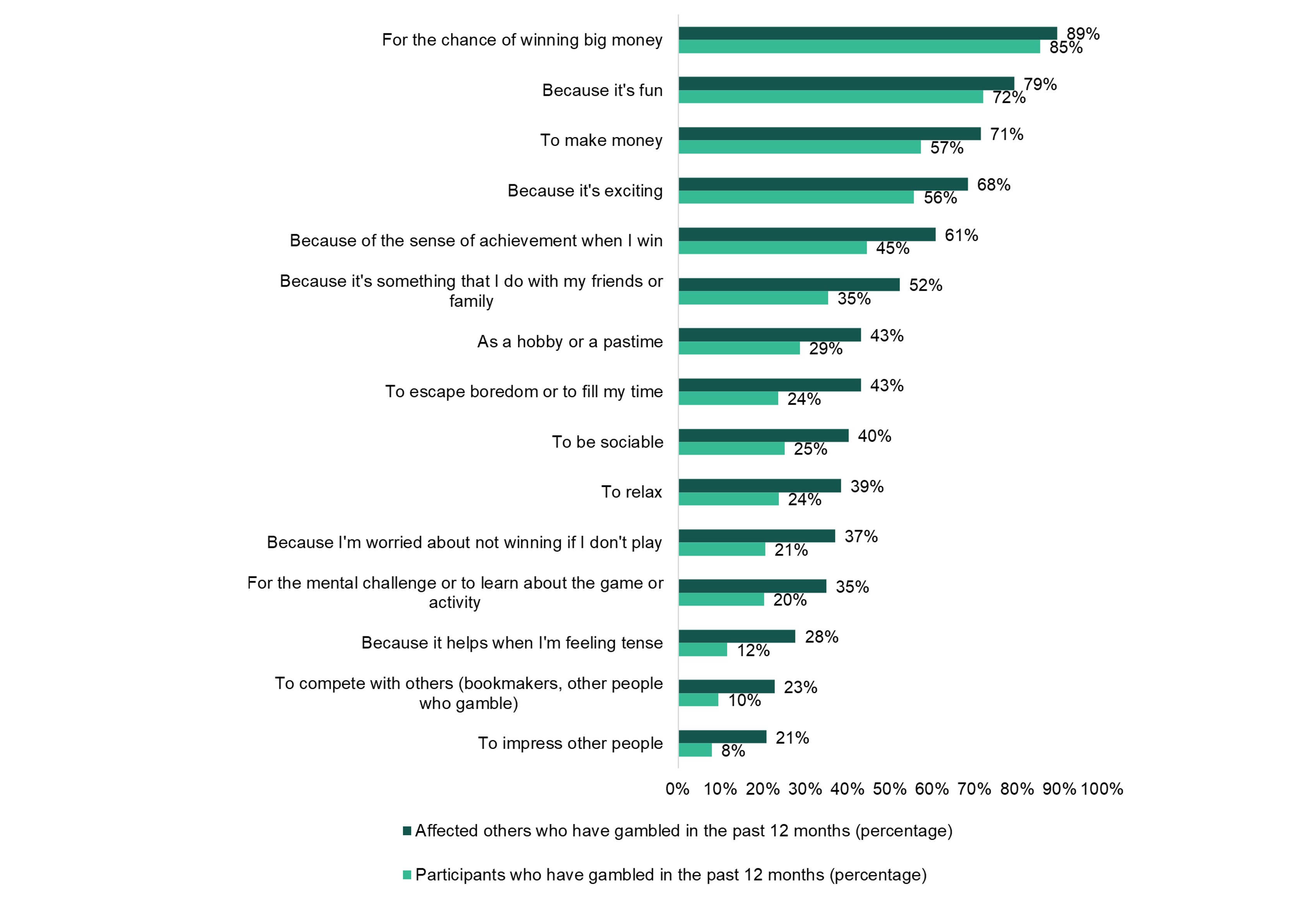
When comparing affected others who gambled with participants who gambled in the past 12 months, the top 3 most reported reasons (at least sometimes) were similar across both groups. These were gambling for the chance of winning money (89 percent versus 85 percent), because it’s fun (79 percent versus 72 percent), and to make money (71 percent versus 57 percent).
Across all reasons, a higher proportion of affected others who gambled reported gambling for each reason (at least sometimes), compared with participants who gambled in the past 12 months. In particular, ‘to escape boredom or to fill my time’ and ‘because it’s something that I do with my friends or family’ had the biggest differences, as shown in Figure 3.
Figure 3 - Reasons for gambling in the past 12 months for those affected by someone else’s gambling who gamble themselves, compared to rates for all people who gamble
| Reason for gambling | Affected others who have gambled in the past 12 months (percentage) | Participants who have gambled in the past 12 months (percentage) |
|---|---|---|
| For the chance of winning big money | 89% | 85% |
| Because it’s fun | 79% | 72% |
| To make money | 71% | 57% |
| Because it’s exciting | 68% | 56% |
| Because of the sense of achievement when I win | 61% | 45% |
| Because it’s something that I do with friends or family | 52% | 35% |
| As a hobby or pastime | 43% | 29% |
| To escape boredom or to fill my time | 43% | 24% |
| To be sociable | 40% | 25% |
| To relax | 39% | 24% |
| Because I’m worried about not winning if I don’t play | 37% | 21% |
| For the mental challenge or to learn about the game or activity | 35% | 20% |
| Because it helps when I’m feeling tense | 28% | 12% |
| To compete with others (bookmakers, other people who gamble) | 23% | 10% |
| To impress other people | 21% | 8% |
Problem Gambling Severity Index (PGSI)
Affected others who reported gambling themselves were more likely to score higher on the Problem Gambling Severity Index (PGSI) than for all those who gambled in the past 12 months. Specifically, they were 4.8 times more likely to score at least 8 compared to all participants who gamble, as shown in Table 5, where a score of 8 to 27 is represents experiences of problem gambling behaviour.
Table 5 - Grouped Problem Gambling Severity Index (PGSI) scores of those who have gambled in the past 12 months
| PGSI score | Affected others who have gambled in the past 12 months (percentage) | Participants who have gambled in the past 12 months (percentage) |
|---|---|---|
| 0 | 46.5% | 75.5% |
| 1 to 2 | 18.4% | 14.8% |
| 3 to 7 | 13.6% | 5.3% |
| 8 to 27 | 21.5% | 4.5% |
5 Within sex and age breakdowns, percentages may not sum to 100 percent due to rounding.
6 This factor describes how many times larger the participation rate for affected others (who have gambled in the past 12 months) is compared to the participation rate for all GSGB participants who have gambled in the past 12 months). A factor of less than 1 indicates that the participation rate for affected others is lower than for those who gambled in the past 12 months. Factors are not given for activities where there is not a statistically significant difference in rates between the two groups (when accounting for the size of the groups, the participation rates are similar to be considered equivalent).
Adverse consequences experienced as an affected other
By the definition used in this analysis, those affected by someone else’s gambling experienced at least one adverse consequence – whether severe or potentially adverse - due to someone else’s gambling in the past 12 months. We explored these adverse consequences by domain (health, relationship and resource) and by each specific consequence within the overall affected others group, and examined differences between those who did and didn’t gamble themselves.
Adverse consequences experienced by affected others across domains
Affected others were most likely to experience at least one health consequence (73.7 percent) due to someone else’s gambling, followed by at least one relationship consequence (65.3 percent), and at least one resource consequence (42.5 percent), as seen in Table 6.
Affected others who did and didn’t gamble in the past 12 months were similarly likely to experience at least one health consequence, but those who did gamble were more likely to experience other types of consequences. Resource consequences show the largest difference between the two groups, with affected others who gamble being 1.5 times more likely to experience at least one resource consequence (48.1 percent compared to 32.8 percent).
Table 6 - Types of consequences experienced by affected others due to someone else’s gambling
| Type of consequence | All affected others (percentage) | Affected others who have not gambled in the past 12 months (percentage) | Affected others who have gambled in the past 12 months (percentage) |
|---|---|---|---|
| At least one health consequence | 73.7% | 74.6% | 73.3% |
| At least one relationship consequence | 65.3% | 60.8% | 68.0% |
| At least one resource consequence | 42.5% | 32.8% | 48.1% |
| At least one severe consequence | 26.6% | 22.4% | 29.1% |
| Used a support service | 14.5% | 7.7% | 18.3% |
Specific adverse consequences experienced by affected others
The 3 most common consequences reported overall due to someone else’s gambling were:
- health problems, including stress and anxiety (57.9 percent)
- felt embarrassment, guilt or shame (52.0 percent)
- increased conflict or arguments (45.4 percent).
The full list of adverse consequences is reported in Table 7. Affected others who did and didn’t gamble reported experiencing these top 3 consequences at similar rates, whilst all other consequences were more likely to be experienced by affected others who also gambled themselves. The likelihood of experiencing consequences increased with the PGSI score of the affected other.
Table 7 - Consequences experienced by affected others due to someone else’s gambling (Categories in brackets describe the domain of the consequence)7
| Consequence experienced | All affected others (percentage) | Affected others who have not gambled in the past 12 months (percentage) | Affected others who have gambled in the past 12 months (percentage) |
|---|---|---|---|
| Health problems, stress, anxiety (health) | 57.9% | 58.7% | 57.5% |
| Embarrassment, guilt, shame (health) | 52.0% | 50.6% | 52.9% |
| Greater conflict or arguments (relationship) | 45.4% | 44.2% | 46.1% |
| Lied to hide extent of gambling (relationship) | 33.6% | 23.9% | 39.3% |
| Reduced spending on everyday items (resource) | 25.5% | 18.5% | 29.5% |
| Felt isolated (relationship) | 25.5% | 21.2% | 28.0% |
| Used savings or increased credit (resource) | 24.0% | 15.4% | 28.9% |
| Borrowed money or sold anything (resource) | 20.8% | 13.0% | 25.0% |
| Relationship broken down (relationship, severe) | 19.8% | 17.0% | 21.5% |
| Absent from work or poor performance (resource) | 18.9% | 13.2% | 22.1% |
| Experienced violence or abuse (relationship, severe) | 11.1% | 7.1% | 13.4% |
| Lost something of significant financial value (resource, severe) | 7.4% | 5.7% | 8.4% |
| Committed a crime (resource, severe) | 5.5% | 1.4% | 7.9% |
Severe consequences experienced by affected others
Additionally, over a quarter of people affected by someone else’s gambling (26.6 percent) reported experiencing at least one severe consequence. Those who had gambled themselves were 1.3 times more likely to report experiencing at least one severe consequence. The most commonly reported severe adverse consequences were relationship based, with 74.3 percent of people who experienced at least one severe consequence experiencing a break down of a close relationship, as shown in Table 8.
Of those who reported experiencing at least one severe consequence, those who had and hadn’t gambled in the past 12 months were equally likely to report experiencing a relationship break down or losing something of significant financial value, whilst those who had gambled were significantly more likely to experience abuse or violence, or to commit a crime in order to finance someone else's gambling.
Table 8 - Break down of severe consequences experienced by those who reported experiencing at least one severe consequence7
| Severe consequence | Affected others who experienced at least one severe consequence (percentage) | Affected others (at least one severe consequence) who have not gambled in the past 12 months (percentage) | Affected others (at least one severe consequence) who have gambled in the past 12 months (percentage) |
|---|---|---|---|
| Relationship broken down (relationship, severe) | 74.3% | 76.0% | 73.9% |
| Experienced violence or abuse (relationship, severe) | 41.9% | 31.7% | 46.2% |
| Lost something of significant financial value (resource, severe) | 27.8% | 25.4% | 29.0% |
| Committed a crime (resource, severe) | 20.9% | 6.0% | 27.2% |
7 Full wordings of consequences questions are available in the Methods section.
Adverse consequences experienced as an affected other from their own gambling
Since affected others who gambled were more likely to experience adverse consequences than affected others who did not gamble, as well as affected others more broadly, we explored what these consequences looked like in the context of their own gambling behaviour.
Types of adverse consequences experienced
Of those who were affected by someone else’s gambling, 30.1 percent also reported experiencing adverse consequences from their own gambling, whether those consequences were severe or potentially adverse. This represents 47.2 percent of affected others who reported gambling themselves.
The likelihood of an affected other who gambles reporting experiencing adverse consequences due to their own gambling increased with PGSI score. Of those reporting these consequences, 45.4 percent had a PGSI score of 8 to 27 (representing experiences of problem gambling): this included all affected others who had a PGSI score of 8 to 27.
Affected others who reported adverse consequences due to their own gambling were most likely to report health consequences, and similarly likely to relationship and resource consequences, as shown in Table 9.
Table 9 - Types of adverse consequences experienced by affected others due to their own gambling
| Type of adverse consequence | Affected others who have gambled in the past 12 months (percentage) | Affected others with PGSI 8 to 27 (percentage) |
|---|---|---|
| At least one potential or severe consequence due to own gambling | 47.2% | 100.0% |
| At least one health consequence due to own gambling | 37.5% | 96.2% |
| At least one relationship consequence due to own gambling | 33.7% | 92.3% |
| At least one resource consequence due to own gambling | 33.0% | 91.5% |
| At least one severe consequence due to own gambling | 13.0% | 49.2% |
| Used a support service due to own gambling | 14.6% | 49.5% |
The 5 most commonly reported consequences due to an affected other’s own gambling were the same as the 5 most commonly reported due to someone else’s gambling, though in different priority order. Reduced spending on everyday items became more prevalent as the second more common consequence, and feelings of embarrassment or guilt were reported more commonly than stress or anxiety, the opposite order to someone else’s gambling.
Consequences affecting resources saw the smallest differences in reporting due to one’s own or someone else’s gambling, including for severe consequences, with differences in reporting being at most 1.5 times larger for someone else’s gambling. Severe consequences affecting relationships saw the largest differences in reporting, with a breakdown of a close relationship being reported 2.7 times more often due to someone else’s gambling than due to one’s own, as shown in Table 10.
Table 10 - Adverse consequences experienced by affected others who have gambled in the past 12 months due to their own gambling and due to someone else’s gambling8
| Adverse consequence | Own gambling (percentage) | Someone else's gambling (percentage) |
|---|---|---|
| Embarrassment, guilt, shame (health) | 32.1% | 52.9% |
| Reduced spending on everyday items (resource) | 27.0% | 29.5% |
| Health problems, stress, anxiety (health) | 25.6% | 57.5% |
| Lied to hide extent of gambling (relationship) | 24.1% | 39.3% |
| Greater conflict or arguments (relationship) | 23.4% | 46.1% |
| Used savings or increased credit (resource) | 22.0% | 28.9% |
| Felt isolated (relationship) | 21.7% | 28.0% |
| Absent from work or poor performance (resource) | 17.4% | 22.1% |
| Borrowed money or sold anything (resource) | 16.3% | 25.0% |
| Relationship broken down (relationship, severe) | 8.1% | 21.5% |
| Lost something of significant financial value (resource, severe) | 7.4% | 8.4% |
| Committed a crime (resource, severe) | 5.3% | 7.9% |
| Experienced violence or abuse (relationship, severe) | 5.2% | 13.4% |
8 Full wordings of consequences questions are available in the Methods section.
Seeking help, support or information as an affected other
Participants who reported that someone close to them gambled were asked whether they had sought any help, support or information, either online, in-person or by telephone in the past 12 months due to someone else’s gambling. We looked at the responses for all affected others together and then compared those who also gambled themselves with those who did not.
Overall, 14.5 percent of affected others had sought some form of support due to someone else’s gambling. The proportions were similar across different types of services:
- 7.6 percent had sought support from mental health services
- 7.3 percent had sought support from food banks or welfare organisations
- 7.2 percent had sought support from relationship counselling or support services
- 6.8 percent had sought support from gambling support services.
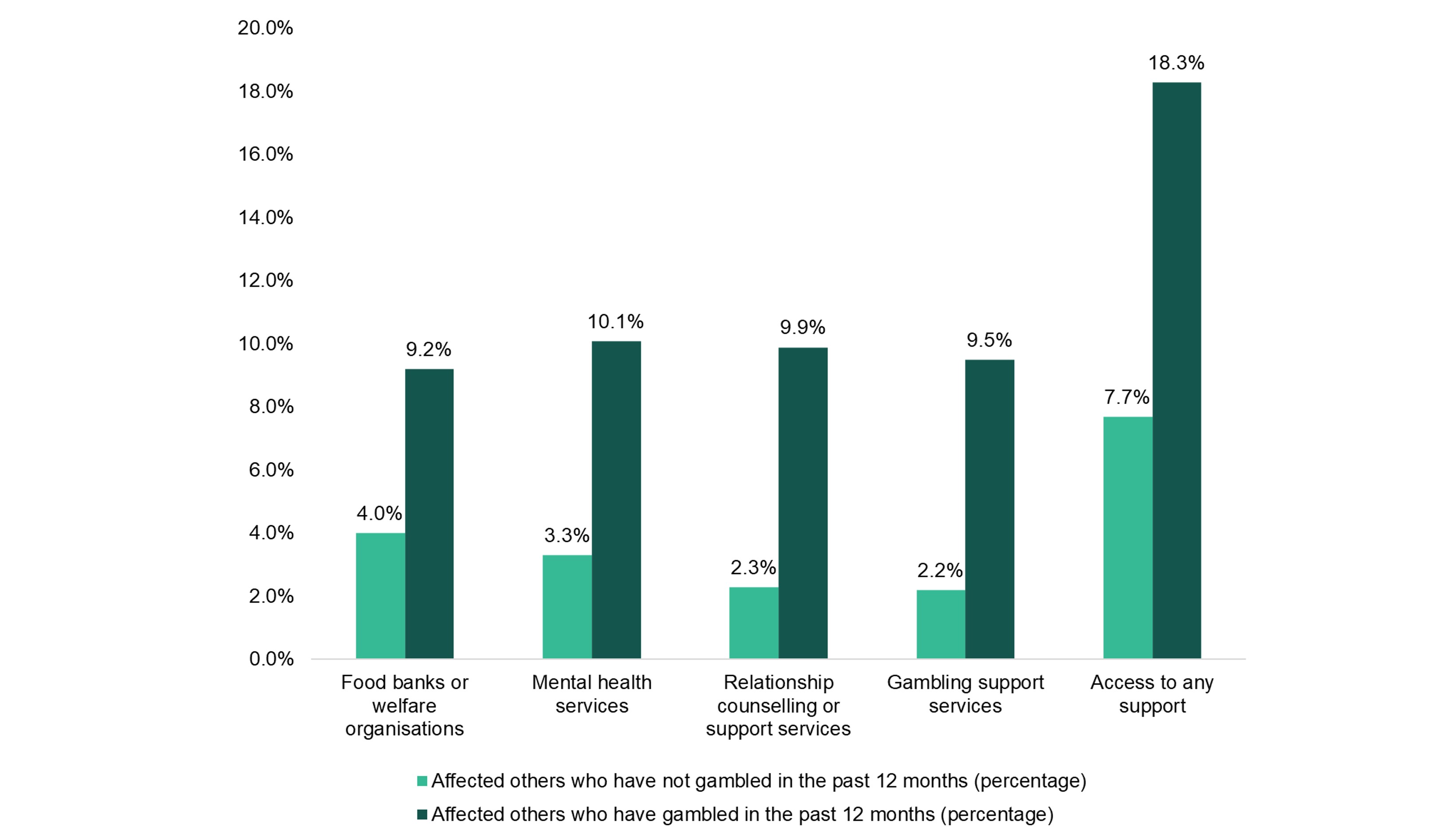
When comparing the 2 groups, affected others who also gambled were more likely to have sought support (18.3 percent) than those who did not gamble (7.7 percent). Across all types of services, affected others who gambled were more likely to have used each one (around 9 to 10 percent) than affected others who did not gamble (around 2 to 4 percent).
The most commonly used service differed between the groups. Affected others who gambled were most likely to seek help from mental health services (10.1 percent), while those who did not gamble were most likely to seek help from food banks or welfare organisations (4.0 percent). These differences are shown in Figure 4.
Figure 4 - Proportion of affected others who gambled in the past 12 months and who had not gambled in the past 12 months, seeking help, support or information in the past 12 months due to others gambling
| Type of support | Affected others who have not gambled in the past 12 months (percentage) | Affected others who have gambled in the past 12 months(percentage) |
|---|---|---|
| Food banks or welfare organisations | 4.0% | 9.2% |
| Mental health services | 3.3% | 10.1% |
| Relationship counselling or support services | 2.3% | 9.9% |
| Gambling support services | 2.2% | 9.5% |
| Access to any support | 7.7% | 18.3% |
The next section of the main report can be found on the Discussion page.
Discussion
Many affected others are also gambling themselves
The aim of this research was to better understand the characteristics of people who are affected by someone else’s gambling. The findings show that a relatively small proportion of participants in the Gambling Survey for Great Britain (GSGB) sample could be identified as affected others (9 percent). Among those who were affected by another person’s gambling, more than half also reported gambling themselves – 63 percent in the past 12 months and 54 percent in the past 4 weeks. This is higher than the gambling participation rate observed across the overall GSGB sample.
Affected others were more likely to be female and in mid-adulthood – a pattern consistent with what we see among affected others who also gamble.
When taking a closer look at affected others who also gambled in the past 12 months, the findings showed that they had higher participation rates across all gambling activities (except the National Lottery and charity lotteries). The largest differences between affected others and for those who gamble were found in activities associated with a higher risk of harm – those that previous GSGB studies have shown to carry higher PGSI scores and experiences of problem gambling as determined by a relative risk ratio. Affected others who gamble were more likely to engage in these higher-risk activities: betting on event outcomes in person (3.7 times higher) or online (2.6 times higher) and playing casino games in a casino (2.7 times higher) or on a terminal (2.5 times higher).
Affected others who gamble were also 4.8 times more likely to have a PGSI score of 8 to 27 than for the wider group of participants who gambled. Their responses to PGSI items showed higher reports of experiencing financial problems due to gambling, and of borrowing money or selling anything to fund gambling. This may reflect the compounding financial impact when multiple people in the same household or relationship gamble. They were also more likely to report being criticised for betting or being told they had a problem with gambling, which may again stem from the dynamics of multiple people who gamble within a household or same social group.
However, we should also consider the reasons why people gamble and for affected others who have also gambled they were more likely to state that they gamble to be sociable (40 percent compared to 25 percent of all participants who have gambled) or because it is something they do with friends or family (52 percent compared to 35 percent).
Overall, these findings show that affected others are not always passive observers; many are engaged in gambling themselves. This overlap has implications for recognising the complexity of gambling-related consequences.
Complexities of gambling-related adverse consequences
Adverse consequences experienced due to someone else’s gambling
Using the gambling-related harm framework developed by Wardle and others (2018) (opens in new tab), which groups harms into resources, relationships and health – and which are covered by the adverse consequences questions – we observe that the most commonly reported consequences experienced due to someone else’s gambling relates to health. More than half of affected others reported that someone else’s gambling had caused them health problems including stress or anxiety, or feelings of embarrassment, guilt or shame.
Consequences affecting resources were reported more by affected others who also participate in gambling compared with those who do not. This pattern suggests that consequences related to finances could be more likely to occur in household where multiple people gamble, potentially increasing pressure on shared financial resources.
Affected others who gamble were also more likely than affected others who didn’t gamble to report consequences relating to relationships, suggesting that when multiple people experience gambling consequences within the same network – such as a family or household – this may place additional strain on interpersonal relationships.
Additionally, affected others who gamble were more likely to report experiencing abuse or violence, or committing a crime related to someone else’s gambling.
Overall, such findings suggest that when more than one person in a household or social network gambles – and consequences are already present – that situation appears to exacerbate both the breadth and severity of consequences experienced. Affected others who gamble report higher levels of consequences across resource related, relationship related, and severe consequence items.
Adverse consequences experienced from one’s own gambling
Around one-third (30.1 percent) of people affected by someone else’s gambling also reported adverse or potentially adverse consequences from their own gambling – equivalent to nearly half (47.2 percent) of affected others who gamble.
The likelihood of experiencing these consequences increased with PGSI score. As discussed in the Methods section, 3 of the consequences that we examine are derived from the PGSI and hence count towards both of these outcomes, therefore some relationship here was expected. All affected others with a PGSI score of 8 to 27 had experienced at least 1 potential or severe consequence due to their own gambling, with health, relationship and resource consequences reported at a similar rate.
Overlaps between adverse consequences experienced from own and other’s gambling
For affected others who gamble, differences between consequences attributed to one’s own gambling and those attributed to someone else’s suggest a pattern in how they distinguish the source of consequence. Resource related consequences showed the smallest difference, indicating that people tend to attribute financial strain to both themselves and the person whose gambling affects them. In contrast, relationship consequences showed the largest differences with severe consequences – such as breakdown of a close relationship – reported 2.7 times more often caused by someone else’s gambling. This suggests that interpersonal harm is more likely to be perceived as arising from the behaviour of the other person rather than one’s own.
Overall, affected others who gamble experience a compounded form of consequences, shaped by both their own gambling and the gambling of others within their network, with patterns differing across consequence types.
For participants who both gamble and are affected by someone else’s gambling, it is not always possible to determine the source of a reported consequence. Although affected others who gamble are generally more likely to report experiencing consequences due to someone else’s gambling, this relationship may be more complex and vary by individual circumstance. Further research is needed to fully understand these dynamics.
Affected others who don’t gamble are less likely to seek support
Less than 1 in 5 of affected others sought support in the past year (14.5 percent), and those who did used a range of services – including mental health, welfare, relationship support, and gambling services at similar rates.
A clear distinction emerged between affected others who gamble and those who do not. Seeking support was more than twice as common among affected others who also gamble (18.3 percent) compared with affected others who don’t gamble (7.7 percent). This pattern was consistent across all support types, with those who gambled reporting higher help seeking behaviours (around 9 to 10 percent) than those who didn’t gamble (2 to 4 percent). This suggests that affected others who do not gamble may be less likely to seek support, despite being impacted by someone else’s gambling.
Next steps
Overall, this analysis provides insights into affected others using data from the Gambling Survey for Great Britain (GSGB), helping to strengthen our evidence base. It has begun to feed into our wider evidence roadmap exploring the impact on people who gamble and affected others.
To build on and better understand these findings, we have commissioned further qualitative research. This work will help to contextualise the GSGB findings and support us in determining how to interpret statistics relating to people impacted by someone else’s gambling.
It will also help to address some of the limitations outlined earlier in this report. In particular, the qualitative research will support a more detailed understanding of the complexity of gambling-related consequences by considering people with a range of characteristics (including those who do and do not gamble) and exploring the relationship between the affected other and the person who gambles. It will also help clarify how the term ‘affected other’ is understood in practice.