
Report
Understanding the adverse consequences of gambling: the role of gambling activity
The Gambling Commission's report on gambling activity and demographic differences in risk of adverse consequences.
Results
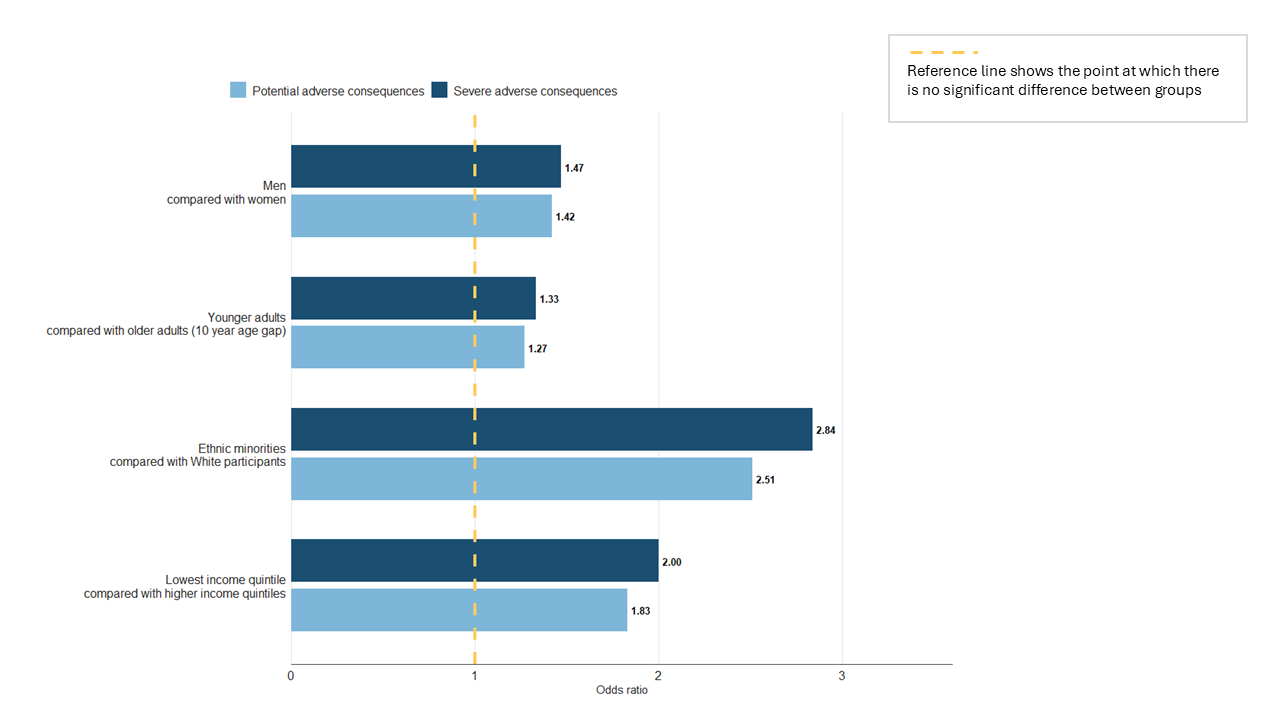
Before controlling for differences in gambling activity, the prevalence of adverse consequences from gambling was highest among males, younger participants, those from ethnic minority backgrounds, and participants living in lower income households. Specifically, the odds of experiencing potential and severe adverse consequences from gambling were 1.42 and 1.47 times higher, respectively for males compared with females, and 2.51 and 2.84 times higher among ethnic minority compared with White participants (Figure 1). Similar differences were observed for younger, compared with older, participants, and those in the lowest income quintile, relative to those in higher income quintiles.
Figure 1. Odds of reporting potential and severe adverse consequences by demographic group, before controlling for differences in gambling activity
| Demographic | Potential adverse consequences | Severe consequences |
|---|---|---|
| Men (compared with women) | 1.42 | 1.47 |
| Younger adults (compared with adults 10 years older) | 1.27 | 1.33 |
| Ethnic minorities (compared with white participants) | 2.51 | 2.84 |
| Lowest income (compared with higher quintiles) | 1.83 | 2.00 |
An odd ratio of 1 says there is no association between demographic group and odds of adverse consequences. Estimates above this ratio indicate higher odds of adverse consequences, relative to each group’s reference category, and estimates below indicate lower odds of adverse consequences.
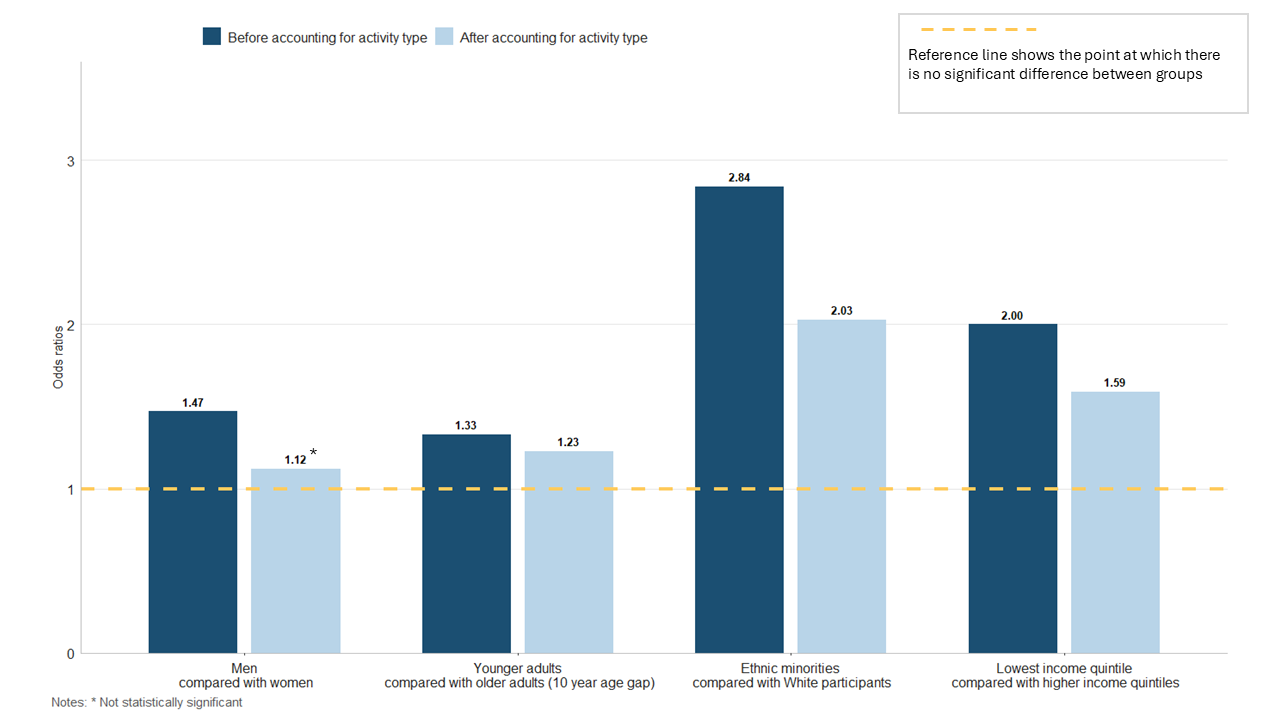
After controlling for past 4-week participation in casino games and fruit and slots, male and female participants had similar odds of experiencing potential and severe adverse consequences from gambling (Figure 2). This suggests that the increased prevalence of adverse consequences among male participants can be explained by a tendency to engage in higher-risk gambling activities.
Participation in casino games, fruit and slots, and online instant-win games also helped to explain differences in adverse consequences by age, ethnicity, and household income. However, younger participants, those from ethnic minority backgrounds, and participants living in lower income households remained significantly more likely than their comparison groups to report both potential and severe adverse consequences. These findings indicate that participation in higher-risk gambling activities accounts for part, but not all, of the increased prevalence of adverse consequences observed in these groups. Other factors such as gambling frequency, financial pressure, and wider social circumstances, likely play an important role. Importantly, because the data were collected at a single point in time (rather than repeated over a longer period), we cannot establish causal relationships between variables. For example, we are unable to rule out the possibility that the adverse consequences associated with certain games may partly reflect the characteristics of the people drawn to them, rather than the games themselves.
Figure 2. Odds of reporting severe adverse consequences, compared with reference groups (in brackets), before and after accounting for past 4-week participation in casino games, fruit and slots, and online instant win games.
| Demographic | Before accounting for activity type | After accounting for activity type |
|---|---|---|
| Men (compared with women) | 1.47 | 1.12 |
| Younger adults ((compared with adults 10 years older) | 1.33 | 1.23 |
| Ethnic minorities (compared with white participants) | 2.84 | 2.03 |
| Lowest income (compared with higher quintiles) | 2.00 | 1.59 |
Note: An odd ratio of 1 says there is no association between demographic group and odds of severe adverse consequences. Estimates above this ratio indicate higher odds of adverse consequences, relative to each group’s reference category, and estimates below indicate lower odds of severe consequences.
Of the 3 gambling activities included in this analysis, participation in casino games (both online and land-based) was the most important driver of adverse consequences among higher-risk groups2. Specifically, we found that past 4-week participation in casino games explained up to 79 percent of demographic differences in adverse consequences, while fruit and slots and online instant-win games explained up to 31 percent and 29 percent of the difference, respectively.
References
2Casino games were both strongly associated with adverse consequences and participation differed across demographic groups. So while casino games emerged as the strongest mediator, this reflects demographic differences in participation as well as the risk of the activity itself.
Method - Adverse consequences Next section
Conclusion - Adverse consequences
Last updated: 6 July 2026
Show updates to this content
No changes to show.