- Print the full document
- Save the page as a HTML document to your device
- Save the page as a PDF file
- Bookmark it - it will always be the latest version of this document
This box is not visible in the printed version.
Understanding the adverse consequences of gambling: the role of gambling activity
The Gambling Commission's report on gambling activity and demographic differences in risk of adverse consequences.
Published: 2 July 2026
Last updated: 6 July 2026
This version was printed or saved on: 14 October 2026
Online version: https://www.gamblingcommission.gov.uk/report/understanding-the-adverse-consequences-of-gambling-the-role-of-gambling-activity
Summary
Our previous research found that adverse consequences from gambling were most prevalent among males, younger participants, people from ethnic minority backgrounds, and those living in lower income households. This report builds upon these findings by exploring whether the increased susceptibility to adverse consequences in these groups can be explained by differences in the types of gambling activities that they play. We conducted secondary analysis of Year 2 GSGB data (2024), focusing on participants who had gambled in the past 4 weeks.
Results showed that past 4-week participation in casino games, fruit and slots, and online instant-win games, helped explain why some groups are more likely to experience adverse consequences from gambling. While differences in engagement with these activities fully explained the elevated risk observed among men, they only partly explained the higher prevalence of harm among younger adults, people from ethnic minority backgrounds, and those living in lower-income households. Future research is needed to explore how wider contextual factors, such as financial pressure, stigma, and barriers to support, contribute to the heightened risk of adverse consequences observed in these groups.
Background
One of the Gambling Commission’s key evidence priorities is to build our understanding of how gambling harms are experienced and who is most at risk. To help achieve this, we developed a set of survey questions, within the Gambling Survey for Great Britain (GSGB), that measure a range of adverse consequences from gambling. These consequences are grouped into 2 categories:
- Potential adverse consequences, which vary in severity and often have cumulative effects. Examples include cutting back on everyday spending and experiencing conflict with family
- Severe consequences, which are unequivocally harmful. For example, relationship breakdown and crime.
Previous analysis of GSGB data showed that adverse consequences from gambling were most prevalent among males, younger participants, people from ethnic minority backgrounds, and those living in lower income households. In this report, we explored whether the increased susceptibility to adverse consequences in these higher-risk groups can be explained by differences in the types of gambling activities that they play.
Method
We conducted secondary analysis of Year 2 (2024) GSGB data, which collected responses from 19,714 adults between January 2024 and January 2025. Participants who had gambled in the past 4 weeks were included in subsequent analyses (N= 9187).
We used a statistical technique called mediation analysis to test whether demographic differences in adverse consequences can be explained by participation in higher-risk gambling activities.
We focused specifically on past 4-week participation in casino games, fruit and slots, and online instant win games. This was based on preliminary findings which showed:
- Higher rates of potential and severe adverse consequences among participants who had played these games in the past 4 weeks, relative to other activities (Table 1).
- Participation in these activities was most common among younger participants, males1, people from ethnic minority backgrounds, and those living in lower income households.
Participation in casino games and fruit and slots included both online and land-based play. These modes were analysed together due to the substantial overlap between them: most participants who engaged in land-based play also reported playing online, which limited our ability to assess the independent effect of land-based participation.
| Past 4-week gambling activity | Percent reporting potential adverse consequences | Percent reporting severe adverse consequence | Base size (unweighted) | |
|---|---|---|---|---|
| Casino games (online or at a venue or casino) | 47% | 17% | 496 | |
| Fruit and slot games (Online or in person) | 38% | 13% | 799 | |
| Online instant win games | 29% | 10% | 1,265 | |
| Bingo | 24% | 9% | 777 | |
| Betting | 24% | 7% | 1,774 | |
| Scratchcards | 24% | 7% | 2,257 | |
| Lottery draws | 10% | 2% | 7,215 |
1Male and female participants were similarly likely to have played online instant win games in the past 4 weeks and so this activity was not included when comparing sex differences in adverse consequences.
Results
Before controlling for differences in gambling activity, the prevalence of adverse consequences from gambling was highest among males, younger participants, those from ethnic minority backgrounds, and participants living in lower income households. Specifically, the odds of experiencing potential and severe adverse consequences from gambling were 1.42 and 1.47 times higher, respectively for males compared with females, and 2.51 and 2.84 times higher among ethnic minority compared with White participants (Figure 1). Similar differences were observed for younger, compared with older, participants, and those in the lowest income quintile, relative to those in higher income quintiles.
Figure 1. Odds of reporting potential and severe adverse consequences by demographic group, before controlling for differences in gambling activity
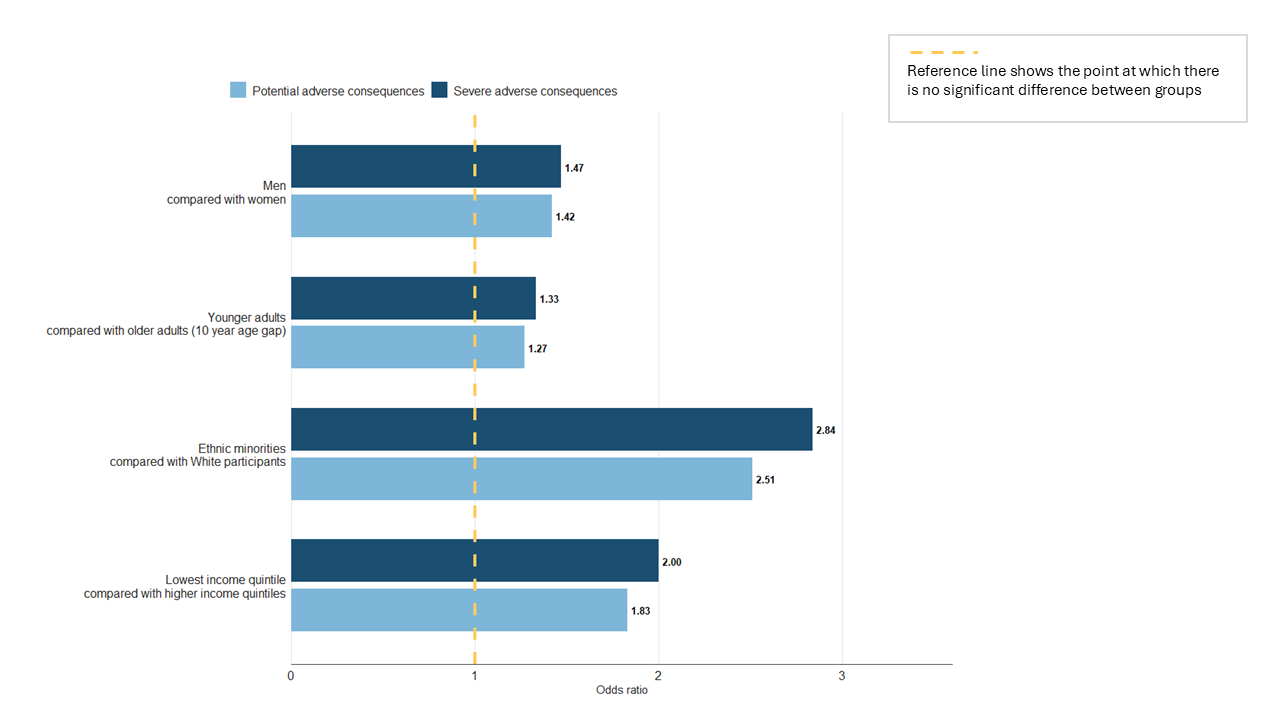
| Demographic | Potential adverse consequences | Severe consequences |
|---|---|---|
| Men (compared with women) | 1.42 | 1.47 |
| Younger adults (compared with adults 10 years older) | 1.27 | 1.33 |
| Ethnic minorities (compared with white participants) | 2.51 | 2.84 |
| Lowest income (compared with higher quintiles) | 1.83 | 2.00 |
An odd ratio of 1 says there is no association between demographic group and odds of adverse consequences. Estimates above this ratio indicate higher odds of adverse consequences, relative to each group’s reference category, and estimates below indicate lower odds of adverse consequences.
After controlling for past 4-week participation in casino games and fruit and slots, male and female participants had similar odds of experiencing potential and severe adverse consequences from gambling (Figure 2). This suggests that the increased prevalence of adverse consequences among male participants can be explained by a tendency to engage in higher-risk gambling activities.
Participation in casino games, fruit and slots, and online instant-win games also helped to explain differences in adverse consequences by age, ethnicity, and household income. However, younger participants, those from ethnic minority backgrounds, and participants living in lower income households remained significantly more likely than their comparison groups to report both potential and severe adverse consequences. These findings indicate that participation in higher-risk gambling activities accounts for part, but not all, of the increased prevalence of adverse consequences observed in these groups. Other factors such as gambling frequency, financial pressure, and wider social circumstances, likely play an important role. Importantly, because the data were collected at a single point in time (rather than repeated over a longer period), we cannot establish causal relationships between variables. For example, we are unable to rule out the possibility that the adverse consequences associated with certain games may partly reflect the characteristics of the people drawn to them, rather than the games themselves.
Figure 2. Odds of reporting severe adverse consequences, compared with reference groups (in brackets), before and after accounting for past 4-week participation in casino games, fruit and slots, and online instant win games.
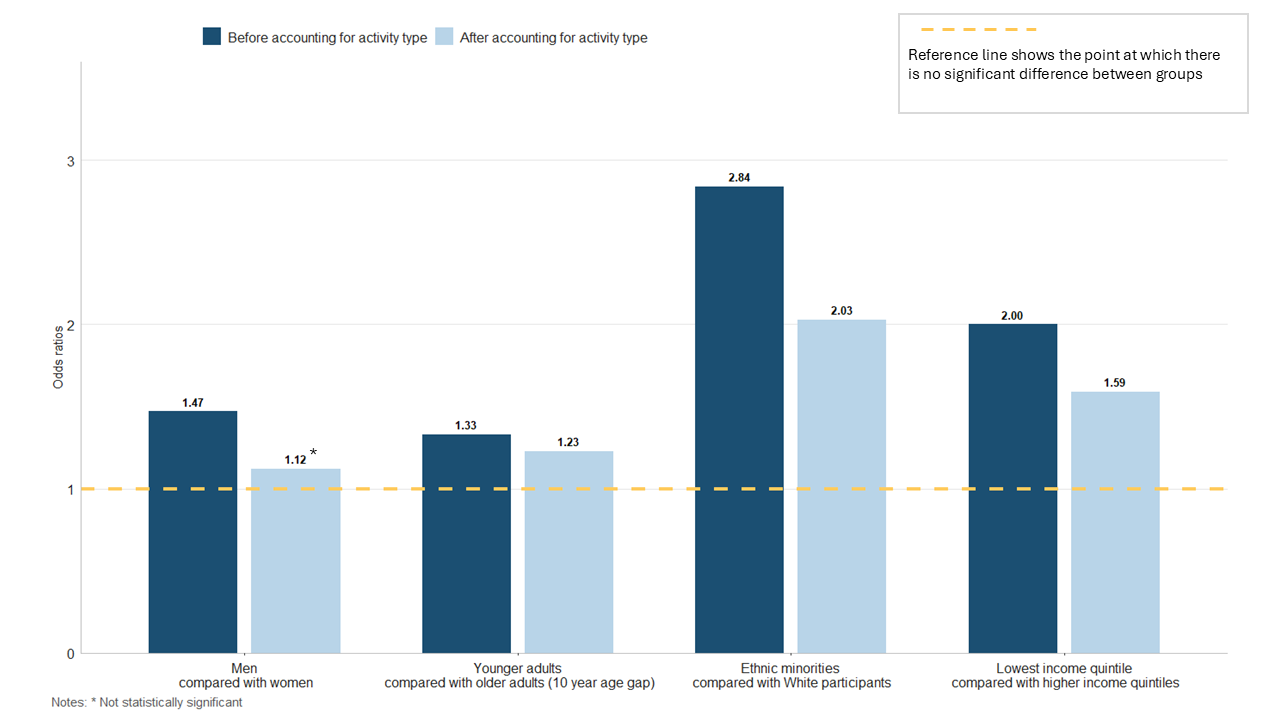
| Demographic | Before accounting for activity type | After accounting for activity type |
|---|---|---|
| Men (compared with women) | 1.47 | 1.12 |
| Younger adults ((compared with adults 10 years older) | 1.33 | 1.23 |
| Ethnic minorities (compared with white participants) | 2.84 | 2.03 |
| Lowest income (compared with higher quintiles) | 2.00 | 1.59 |
Note: An odd ratio of 1 says there is no association between demographic group and odds of severe adverse consequences. Estimates above this ratio indicate higher odds of adverse consequences, relative to each group’s reference category, and estimates below indicate lower odds of severe consequences.
Of the 3 gambling activities included in this analysis, participation in casino games (both online and land-based) was the most important driver of adverse consequences among higher-risk groups2. Specifically, we found that past 4-week participation in casino games explained up to 79 percent of demographic differences in adverse consequences, while fruit and slots and online instant-win games explained up to 31 percent and 29 percent of the difference, respectively.
2Casino games were both strongly associated with adverse consequences and participation differed across demographic groups. So while casino games emerged as the strongest mediator, this reflects demographic differences in participation as well as the risk of the activity itself.
Conclusion
This analysis builds on our previous research which showed that adverse consequences from gambling were most prevalent among males, younger adults, people from ethnic minority backgrounds, and those living in lower-income households. We examined whether demographic differences in susceptibility to adverse consequences could be explained by past 4-week gambling activity. Our analysis focused specifically on participation in casino games, fruit and slots, and online instant-win games.
Findings suggest that participation in these higher-risk activities helps to explain why some people are more likely to experience adverse consequences from gambling. In particular, the increased prevalence of adverse consequences among male participants, compared with females, was fully accounted for by past 4-week participation in casino games and fruit and slots. Furthermore, engagement in higher-risk gambling activities significantly contributed to the increased risk observed among younger participants, those from ethnic minority backgrounds, and people living in lower income households.
Casino games, fruit and slots, and online instant-win games share characteristics such as rapid and continuous play, near-misses, and high event-to-event variability in outcomes. These characteristics may encourage sustained engagement and riskier patterns of play, and could therefore help explain why participation in these activities contributed to the increased risk of adverse consequences observed among higher-risk groups. In addition to game-specific features, our research demonstrates the role of wider social and cultural factors that may contribute to the development of gambling-related harm. Notably, participation in higher-risk activities did not fully explain the increased prevalence of adverse consequences among younger adults, ethnic minority participants, and those living in lower-income households. This suggests that the heightened vulnerability of these groups extends beyond the type of gambling they engage with, and may reflect wider social circumstances and financial pressures.
This analysis extends our previous report, Understanding the adverse consequences of gambling, by examining whether demographic differences in people’s risk of gambling harm can be explained by differences in past 4-week gambling activity. Overall, we found that participation in higher-risk gambling activities, particularly casino games, fruit and slots, and online instant-win games, helped explain why some groups are more likely to experience adverse consequences from gambling. While differences in engagement with these activities fully explained the elevated risk observed among men, they only partly explained the higher prevalence of harm among younger adults, people from ethnic minority backgrounds, and those living in lower-income households. Future research is needed to explore the extent to which wider contextual factors, such as financial pressure, stigma, and barriers to support, contribute to the heightened risk of adverse consequences observed in these groups.