
Report
Insights into affected others from the GSGB
Insights into affected others from the GSGB
Seeking help, support or information as an affected other
Participants who reported that someone close to them gambled were asked whether they had sought any help, support or information, either online, in-person or by telephone in the past 12 months due to someone else’s gambling. We looked at the responses for all affected others together and then compared those who also gambled themselves with those who did not.
Overall, 14.5 percent of affected others had sought some form of support due to someone else’s gambling. The proportions were similar across different types of services:
- 7.6 percent had sought support from mental health services
- 7.3 percent had sought support from food banks or welfare organisations
- 7.2 percent had sought support from relationship counselling or support services
- 6.8 percent had sought support from gambling support services.
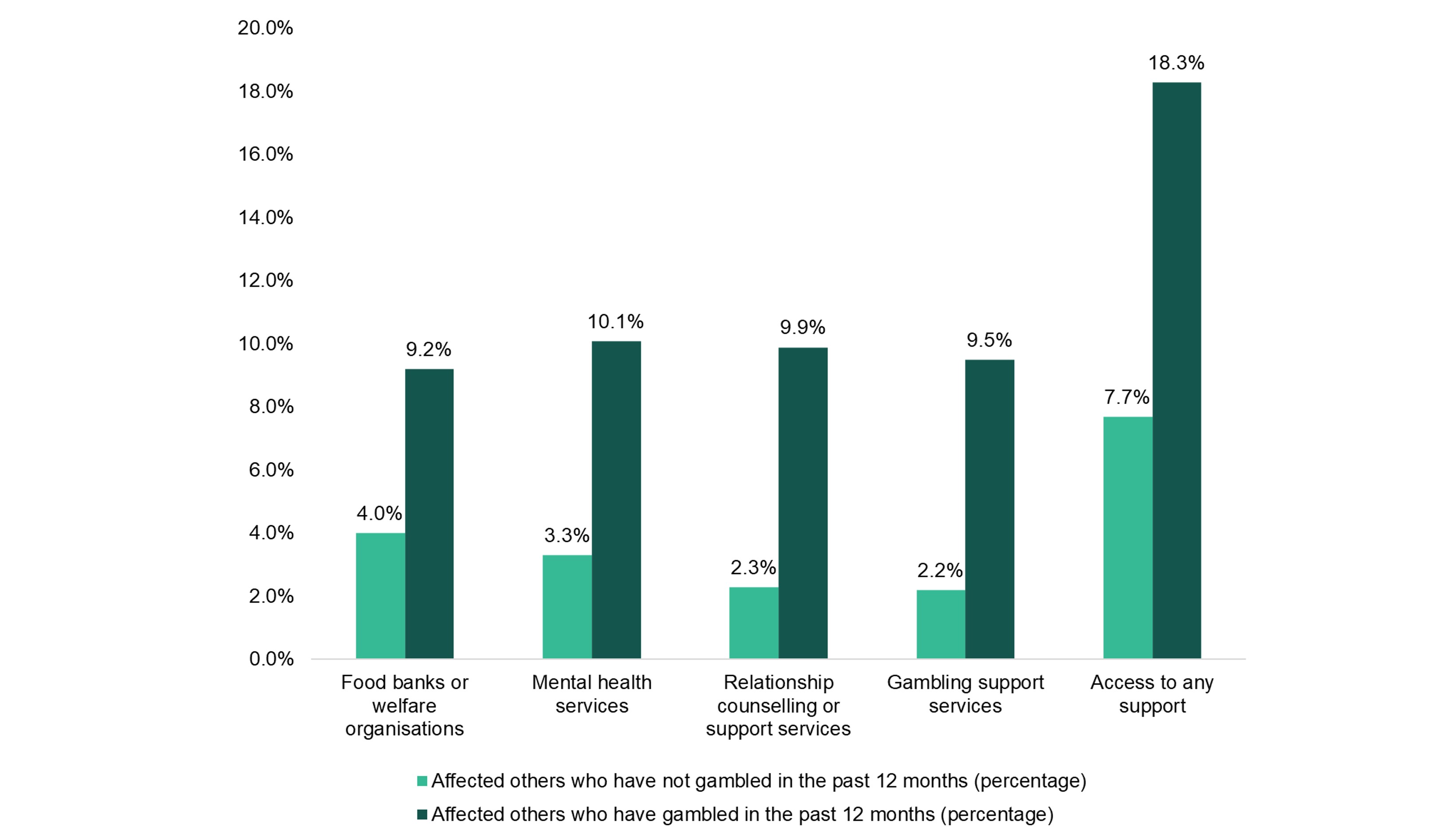
When comparing the 2 groups, affected others who also gambled were more likely to have sought support (18.3 percent) than those who did not gamble (7.7 percent). Across all types of services, affected others who gambled were more likely to have used each one (around 9 to 10 percent) than affected others who did not gamble (around 2 to 4 percent).
The most commonly used service differed between the groups. Affected others who gambled were most likely to seek help from mental health services (10.1 percent), while those who did not gamble were most likely to seek help from food banks or welfare organisations (4.0 percent). These differences are shown in Figure 4.
Figure 4 - Proportion of affected others who gambled in the past 12 months and who had not gambled in the past 12 months, seeking help, support or information in the past 12 months due to others gambling
| Type of support | Affected others who have not gambled in the past 12 months (percentage) | Affected others who have gambled in the past 12 months(percentage) |
|---|---|---|
| Food banks or welfare organisations | 4.0% | 9.2% |
| Mental health services | 3.3% | 10.1% |
| Relationship counselling or support services | 2.3% | 9.9% |
| Gambling support services | 2.2% | 9.5% |
| Access to any support | 7.7% | 18.3% |
The next section of the main report can be found on the Discussion page.
Previous sectionAdverse consequences experienced as an affected other from their own gambling
Last updated: 14 May 2026
Show updates to this content
No changes to show.