
Report
Initial findings from new data on consumer trust – GSGB
Initial findings from new data on consumer trust – GSGB
Regulation and accountability
Confidence in regulatory oversight is a key driver of trust. The presence of a visible gambling regulatory body was ranked as the highest priority for respondents in our previous research, which also uncovered how consumer’s perceived risk of corruption across the industry and wider government can drive their views on accountability.
"Gambling companies that operate under the oversight of reputable regulatory bodies are more likely to adhere to strict standards of fairness, security, and responsible gambling practices."
– Qualitative Research Participant
Earlier stages of the research used these consumer insights to inform the development of 2 statements to provide insight into people’s views on gambling regulation and accountability:
Gambling companies are held accountable by a regulator if their conduct falls short of standards.
Gambling companies are free from corruption.
Gambling companies are held accountable by a regulator if their conduct falls short of standards
Overall 48 percent of people who had gambled in the past 12 months agreed with this statement, with 33 percent responding neutrally, and 18 percent disagreeing. Participants aged over 65 were more likely to agree that gambling companies are held accountable by a regulator (54 to 59 percent), whereas those aged 18 to 24, had lower levels of agreement with this statement than other age groups (37 percent). This is likely to be driven by findings from the earlier phases of the research which highlighted that there is a lack of awareness and understanding of the Commission’s role as a regulator, particularly among young audiences. Males and females had similar levels of agreement relating to regulation and accountability (47.3 percent and 47.9 percent respectively).
“I know on all adverts they state “when the fun stops, stop” but I don’t know how much they are held accountable.”
– Qualitative Research Participant
People’s views on regulatory oversight also varied based on the types of gambling activities they played, and whether they enjoyed their most recent gambling experience. Looking at past 4-week participation in different gambling activities, those that had participated in bingo games were more likely than other groups to agree that companies are held accountable. In contrast, participation in scratchcards over the past 4 weeks is associated with lower agreement on regulatory accountability. Participants who rated their last gambling experience as ‘positive’ were more likely to agree that gambling companies are held accountable, than those who rated it as ‘neutral’ or ‘negative’ (positive 53 percent; neutral 42 percent; negative 45 percent).
Figure 3: Agreement level with ‘regulatory accountability’ statement by gambling activity in the past 4 weeks
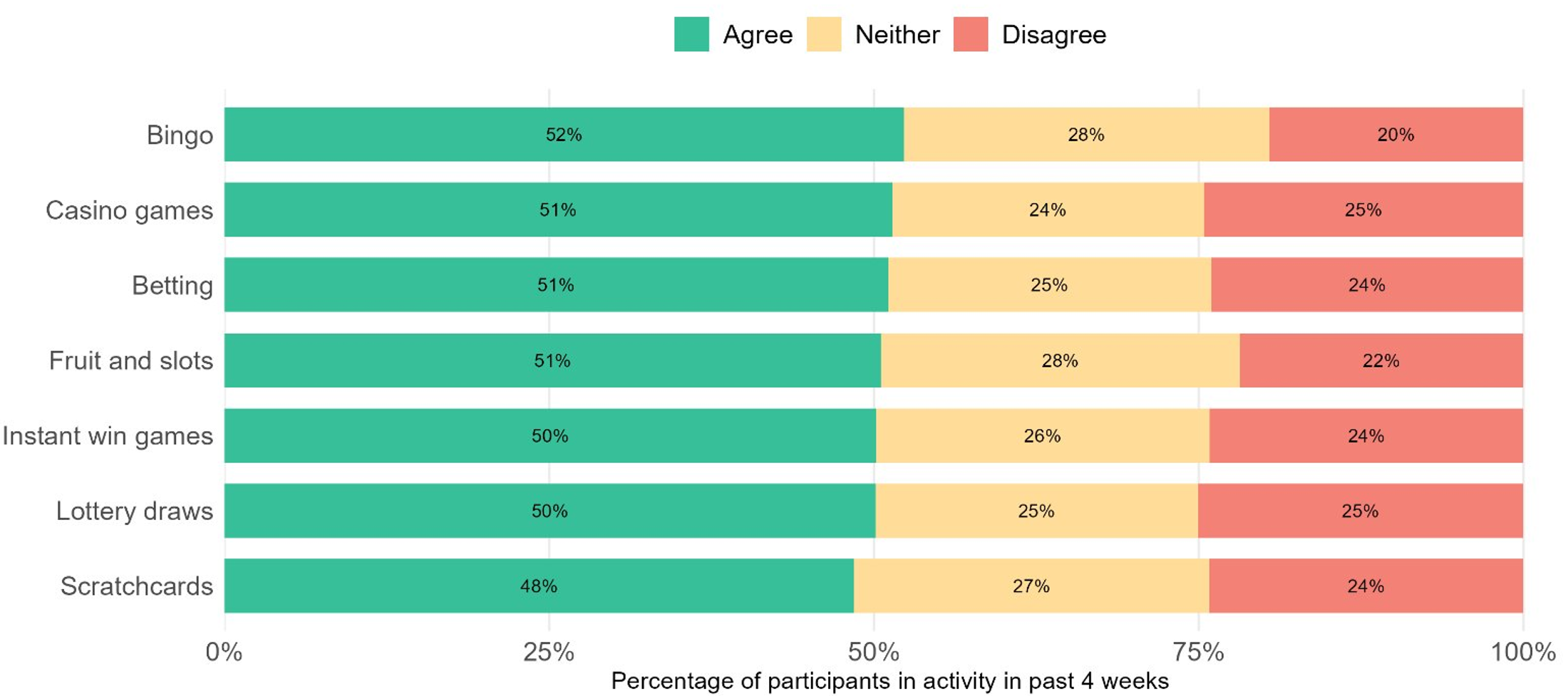
| Activity | Agree (percentage) | Neither (percentage) | Disagree (percentage) |
|---|---|---|---|
| Bingo | 52 | 28 | 20 |
| Casino games | 51 | 24 | 25 |
| Betting | 51 | 25 | 24 |
| Fruit and slots | 51 | 28 | 22 |
| Instant win games | 50 | 26 | 24 |
| Lottery draws | 50 | 25 | 25 |
| Scratchcards | 48 | 27 | 24 |
Gambling companies are free from corruption
In the earlier phases of research consumers recognised that there is a complex but necessary relationship between gambling companies, regulators and the government, with the need for independence identified as an important factor. Where independence is not evident to consumers there can be a perceived risk of what participants referred to as corruption.
"My perception is that the owners of gambling companies have very close links with the government … I have no faith in the government being free from corruption to be perfectly honest."
– Qualitative Research Participant
These views could also be driven by the nature of the relationship between a gambling company and customer, and the inherent presence of risk, chance, and potential loss. They can also be influenced by the reporting of regulatory activity such as enforcement cases and investigations. A further hypothesis, which requires further exploration, is this driver being influenced by the presence of the illegal gambling market.
Overall, 9 percent of participants in the GSGB who had gambled in the past 12 months agreed with this statement, with 29 percent responding neutrally, and 63 percent disagreeing. Younger participants aged 18 to 44 (65 to 77 percent) and females (64 percent) were more likely to disagree that gambling companies are free from corruption, compared with those aged 45 or over (52 to 59 percent), and male participants (61 percent).
Participants who had played casino games in the past 4 weeks were significantly more likely to agree that the industry is free from corruption, compared with other participants who had gambled in the past 12 months. Those who had played lottery draws were significantly less likely than average to agree with this statement as shown in figure 4.
Participants who rated their most recent gambling experience as ‘positive’ were slightly more likely to agree that the industry is free from corruption (11 percent), compared with those who rated it as ‘neutral’ (7 percent) or ‘negative’ (7 percent), however this difference did not reach statistical significance.
Figure 4. Agreement level with ‘free from corruption’ statement by gambling activity in the past 4 weeks
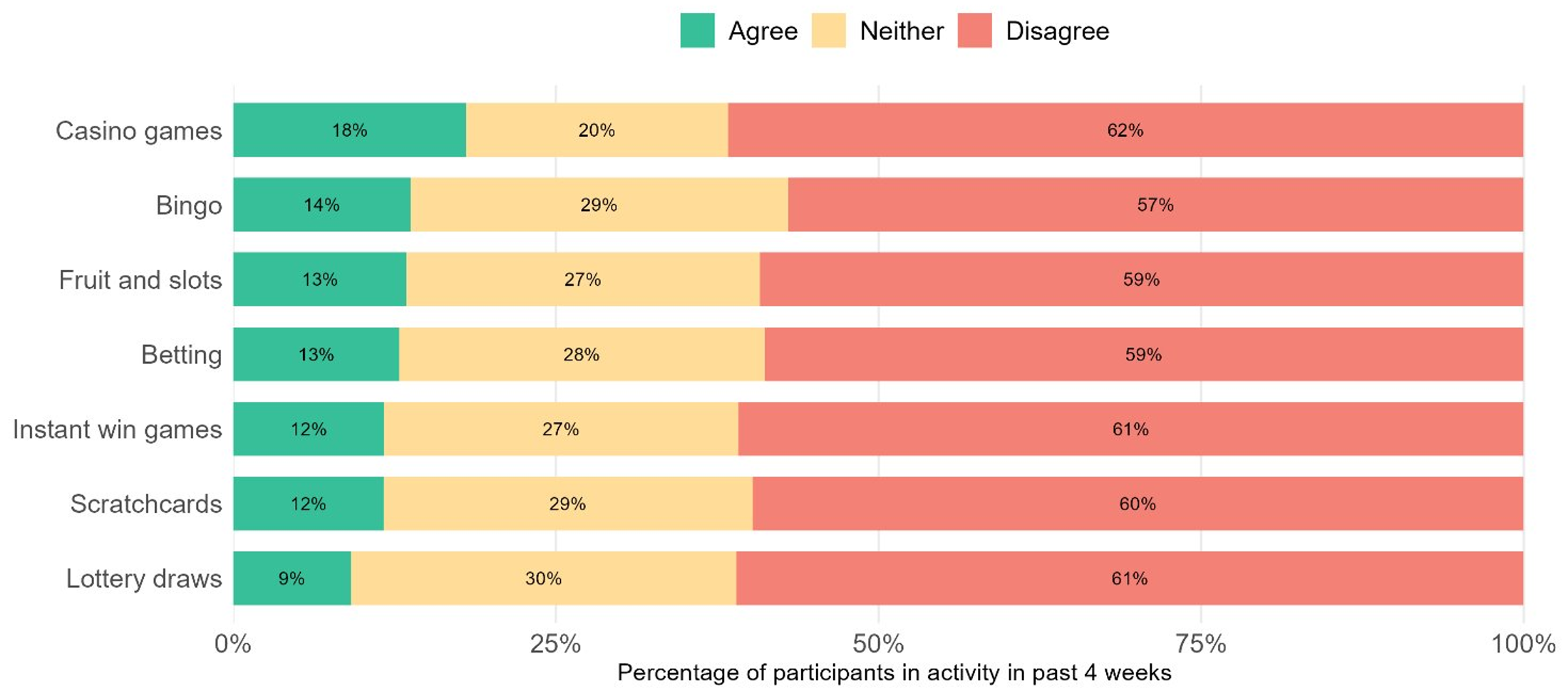
| Activity | Agree (percentage) | Neither (percentage) | Disagree (percentage) |
|---|---|---|---|
| Casino games | 18 | 20 | 62 |
| Bingo | 14 | 29 | 57 |
| Fruit and slots | 13 | 27 | 59 |
| Betting | 13 | 28 | 59 |
| Instant win games | 12 | 27 | 61 |
| Scratchcards | 12 | 29 | 60 |
| Lottery draws | 9 | 30 | 61 |
Base: Participants who gambled on each activity in the past 4 weeks (Bingo: 714; Casino games: 466; Betting: 1,616; Fruit and slots: 757; Instant win games: 1,257; Lottery draws: 6,388; Scratchcards: 1,954).
The next page in this section is Protection and safety.
Last updated: 18 August 2026
Show updates to this content
Formatting changes only.