- Print the full document
- Save the page as a HTML document to your device
- Save the page as a PDF file
- Bookmark it - it will always be the latest version of this document
This box is not visible in the printed version.
Initial findings from new data on consumer trust – GSGB
Initial findings from new data on consumer trust – GSGB
Published: 23 July 2026
Last updated: 23 July 2026
This version was printed or saved on: 21 October 2026
Online version: https://www.gamblingcommission.gov.uk/report/initial-findings-from-new-data-on-consumer-trust-gsgb
Executive Summary
The Gambling Commission, working with Yonder, has undertaken a comprehensive, mixed-methodology research project through its Consumer Voice programme to qualitatively explore the drivers of consumer trust, identify the elements most important to gambling consumers, and develop a new and more effective survey question that could be used to monitor this over time. The question has been piloted on the Gambling Survey for Great Britain (GSGB), and this report presents findings from the first year of data collection. The data is currently in development, with data assurance taking place during 2026 ahead of further publications being shared.
The new survey generates a composite score of consumer trust, with the individual question statements providing greater granularity enabling the Commission to identify any changes in the key drivers of trust over time. This will become an effective tool in understanding the impact of regulatory activity, but also the performance of the wider industry in building and maintaining consumer trust.
The overall composite trust score for people who have gambled in the past 12 months currently sits at 47.9, out of a possible 100. This appears to be driven by higher scores for statements relating to regulatory accountability and the understandability of odds and offers, and lower scores for fairness of games and machines and the protection of young and vulnerable people. The results show that trust varies across different aspects of the gambling experience. Differences by age, gambling activity, and recent experience demonstrate that trust is not uniform and that consumers hold diverse views depending on their circumstances and patterns of play.
The composite trust score offers a baseline for future measurement and continued development of the trust framework. As this measure remains in development, findings should be interpreted as indicative rather than definitive and will be refined as more data becomes available.
Throughout 2026, further analysis and monitoring will be conducted to assess how the updated question performs in practice, including checks on reliability, relevance across gambling behaviours, and comparison to previous findings from the stages of development. The measure will remain in development while this work continues and will only move out of development status once there is sufficient evidence that the statements and composite index operate consistently and provide a robust basis for ongoing reporting.
The data will also be analysed further against a range of other variables available in the GSGB, including new questions that are currently in development about engagement in the illegal market. The role of the illegal market on consumer perceptions and trust in gambling is an important area for follow-up research, which will be explored later in 2026.
Background
The Gambling Act 2005 (opens in new tab) sets out 3 licensing objectives that must be met by all licensed gambling operators, including “ensuring that gambling is conducted in a fair and open way.” The Gambling Commission carries out regulatory activity to ensure that:
- products and services provided by licensees are fair and deliver what they promise
- consumers are able to make informed choices about their gambling
- licensees ensure consumer issues are addressed fairly and promptly.
Success in achieving this can ultimately impact consumers’ trust in the gambling companies that they use. Consumer trust has therefore been a longstanding metric of interest to the Commission as a marker of the effectiveness of its regulatory work.
Historically, the Commission measured public trust in the gambling industry using a single question administered in its consumer surveys:
How far do you agree or disagree that, in this country, gambling is conducted fairly and can be trusted?
Responses were captured on a Likert scale from 1 to 5, where 1 was strongly disagree, and 5 was strongly agree.
This provided a quarterly trend, which was reported as levels of agreement versus disagreement and fed into the Commission’s impact metrics. These metrics are linked to regulatory outcomes in key areas, including fair and open gambling. Most recently, this measure has been captured through the Gambling Survey for Great Britain (GSGB) on an annual basis.
However, the question has its limitations. As well as common limitations associated with self-report survey methodologies, the question itself was also very broad and responses susceptible to being driven by a range of factors outside of direct regulatory activity. Whilst the trend data were useful, they did not identify why levels of trust were where they were, or what factors were driving improvements or declines in the headline levels of agreement. The Commission was therefore limited in what we could do in response.
The Commission therefore developed a brief for a comprehensive, mixed-methodology research project to be undertaken through its Consumer Voice programme to qualitatively explore the drivers of consumer trust and identify the elements most important to gambling consumers. The main objective of the research was to develop a new, multi-statement question on consumer trust that could be added to the GSGB to replace the former single statement question. The research was delivered by Yonder in 2024, with further piloting and validation of the new question led by the Commission continuing throughout 2025. Full findings from the qualitative research were published in October 2024.
This report provides headline findings from the first full year of data (2025) and is accompanied by a detailed technical report outlining the development of the new survey question, and the piloting and validation exercise which resulted in some minor changes being made to the introduction of the survey question and some of the statements and response options. These changes have been made to the 2026 survey, and as such the findings in this report should be treated as ‘in development’ until the impact of these changes can be assessed in later waves of data.
The data collected via the GSGB was entirely quantitative. The quotes shared in this report were provided by respondents in the qualitative phase of the research, and have been included to provide supplementary depth to the findings.
Details and methodology
Trust statements and survey question
The 2024 research identified 5 overarching themes and used a range of qualitative and quantitative techniques to identify, test and refine a series of statements that were underpinned by consumers’ own experiences, perspectives and language to measure consumer trust. These themes are:
- regulation and accountability
- protection and safety measures
- transparency and fairness
- advertising and promotion
- customer experience and support.
The 8 statements mapping to the 5 themes were developed to form the new survey question. 5 of these statements (1 to 5) were focused on the core drivers identified in the research and will be used on a permanent basis to monitor trends over time using a composite score. A further 3 statements (6 to 8) were added to the question which were related to current and emerging themes that drive trust. These 3 statements can be changed and adapted as regulatory priorities change, without impacting on the headline composite score and trend data.
The following question was asked to anyone who has gambled in the last 12 months:
Thinking about all activities you have engaged in (such as betting, casino, bingo and lottery), both online and in person, how much do you agree or disagree with the following statements?
- Gambling companies are held accountable by a regulator if their conduct falls short of standards
- Gambling companies are free from corruption
- Gambling games and machines are fair and free of errors
- Activities, offers and odds provided by gambling companies are clear, easy to understand and not misleading
- Effective measures are in place to protect young, and other vulnerable, people when gambling
- Gambling companies have effective checks in place before they allow people to gamble (e.g. ID checks, financial checks)
- Gambling promotions and incentives don’t encourage excessive gambling
- It is quick and easy to withdraw and collect my winnings.
Participants indicated the extent to which they agreed or disagreed with each statement on a 5-point scale from ‘agree strongly’ to ‘disagree strongly'. 'Neither agree nor disagree’ and ‘don’t know’ responses were also available.
Data collection
The Gambling Survey for Great Britain (GSGB) is conducted via a push-to-web methodology, with data collected from 20,000 adults aged 18 and older living in Great Britain. Fieldwork is carried out in 4 waves running quarterly. The new question was first piloted on the online survey in wave 4 of the 2024 survey, which was in field from October 2024 to January 2025. Following the pilot, we added it to the online and paper questionnaire at the start of 2025 and it has been asked in every wave since.
This report details initial GSGB findings from data collected between January 2025 and January 2026 (waves 1 to 4 of the 2025 survey). The combined sample size of respondents who had gambled in the last 12 months is 12,194. Statistics are reported from the base of past 12 month gamblers, with the exception of analysis by gambling activity which uses the base of past 4 week gamblers. Past 4 week gambling activity captures more active players and allows more meaningful comparisons between those engaging in different activities.
Going forward, the data will be published on an annual basis. The data in this report should not be compared with previous data on trust as a different methodology and questions have been used.
Composite trust score
Statements 1 to 5 feed into an overall composite trust score (a composite index). This allows multiple responses to be aggregated into a single metric, which gives a fuller picture of trust in the gambling industry which can be tracked over time.
The index works by assigning a ‘score’ to each statement based on the response given. This is then averaged and creates an overall composite score (0 to 100) reflecting trust. The higher the score, the higher the measure of trust.
The scores for each response option are shown in the following table.
Table 1: Composite trust scores
| Response | Score |
|---|---|
| Agree strongly | 100 |
| Agree slightly | 80 |
| Neither agree nor disagree | 60 |
| Disagree slightly | 40 |
| Disagree strongly | 20 |
| Don't know | 0 |
For example, if a respondent selected ‘Agree strongly’ for 3 statements, and ‘Disagree strongly disagree’ for the other 2, the calculation would be as follows:
If a respondent selects ‘Don’t know’, then that statement does not receive a score for their respondent-level index, and the index is calculated by taking an average of the remaining statements. An example of this is as follows, using the same responses as before, except for ‘Don’t know' and 'Not applicable’ instead of the final ‘Strongly disagree’.
If ‘Don’t know’ is the response for 3 or more statements per respondent, then that respondent does not contribute to the index score at the overall dataset-level.
Further details on the calculation of the trust score can be found in the technical report.
The findings in this report include the analysis of the trust question statements and the composite score, alongside a range of other variables.
Initial findings
Composite Trust Score
The overall composite trust score for all those who gambled in the past 12 months is 47.9. This appears to be driven by higher scores for statements relating to regulatory accountability and the understandability of odds and offers, and lower scores for fairness of games and machines and the protection of young and vulnerable people. Across the sample scores varied by demographic factors, the types of activities people participate in, and people’s feelings towards their most recent gambling experience.
Table 2: Composite trust score by 5 core statements
| Composite score statements | Score |
|---|---|
| Gambling companies are held accountable by a regulator if their conduct falls short of standards | 66.3 |
| Activities, offers and odds provided by gambling companies are clear, easy to understand and not misleading | 50.1 |
| Gambling companies are free from corruption | 42.8 |
| Effective measures are in place to protect young, and other vulnerable, people when gambling | 41.6 |
| Gambling games and machines are fair and free of errors | 40.1 |
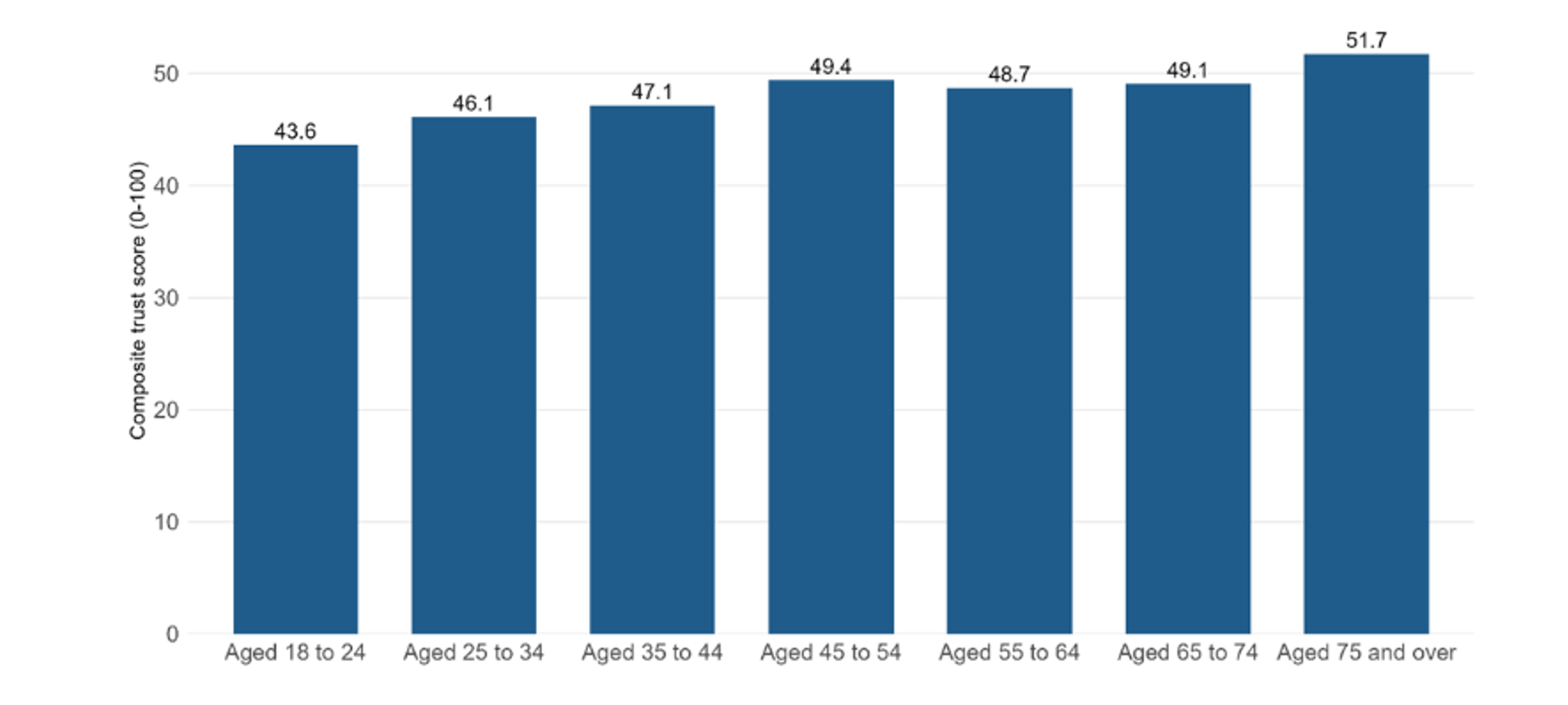
The composite score increases as age rises with 18 to 24-year-olds reporting lower levels of trust (43.6) and those aged 75 and over reporting the highest levels (51.7), as shown in Figure 1.
For each of the 5 core statements, respondents aged 18 to 24 scored lower than those aged 75 and over. The biggest differences were seen for regulatory accountability (59.5 compared with 73.7), corruption (37.8 compared with 48.5) and fairness of games and machines (36.8 compared with 43.8). Age differences were less pronounced for statements around the understandability of offers and odds (46.5 compared with 51.8) and protection of young and vulnerable people (40.3 compared with 42.7).
Figure 1: Composite trust score by age group
| Age group | Composite trust score (percentage) |
|---|---|
| Aged 18 to 24 | 43.6 |
| Aged 25 to 34 | 46.1 |
| Aged 35 to 44 | 47.1 |
| Aged 45 to 54 | 49.4 |
| Aged 55 to 64 | 48.7 |
| Aged 65 to 74 | 49.1 |
| Aged 75 and over | 51.7 |
There are also differences in trust scores when looking at different gambling activities. People who had participated in casino and fruit and slot games in the past 4 weeks had higher trust scores than people who had played lottery draws.
Table 3: Composite trust score by past 4 week gambling activity
| Gambling activity in past 4 weeks1 | Composite trust score | Base size |
|---|---|---|
| Lottery draws | 48.6 | 6,388 |
| Scratchcards | 50.1 | 1,954 |
| Instant win games | 50.4 | 1,257 |
| Betting | 52.6 | 1,616 |
| Bingo | 52.3 | 714 |
| Casino games | 53.2 | 466 |
| Fruit and slots | 53.1 | 757 |
Participants were asked how they felt about the last time they spent money on gambling. Responses were given on a scale of 0 to 10 with 0 being ‘hated it’ and 10 being ‘loved it’. Participants who assigned a score of 0 to 4 were grouped as having a ‘negative’ experience, those who assigned a score of 5 were grouped as ‘neutral’, and those who scored 6 to 10 were grouped as having a ‘positive’ experience.
For statements relating to ‘accountability’ and ‘understandability of odds and offers’, participants who rated their most recent gambling experience as ‘positive’ had higher scores compared with those who rated their experience as neutral or negative. Statements relating to ‘corruption’, ‘player protection’, and ‘fairness’, were less strongly associated with participants’ most recent gambling experience as shown in Table 4.
Table 4: Composite trust score by most recent gambling experience
| Statement | Negative | Neutral | Positive |
|---|---|---|---|
| Gambling companies are held accountable by a regulator if their conduct falls short of standards | 64.5 | 63.7 | 69.1 |
| Gambling companies are free from corruption | 39.7 | 41.9 | 44.6 |
| Gambling games and machines are fair and free of errors | 37.1 | 38.9 | 42.3 |
| Activities, offers and odds provided by gambling companies are clear, easy to understand and not misleading | 44.0 | 48.7 | 53.9 |
| Effective measures are in place to protect young, and other vulnerable, people when gambling | 39.1 | 39.4 | 44.2 |
| (Base size2) | (1734) | (3390) | (3849) |
Taken together, these findings highlight that trust in the gambling industry varies based on the types of activity people play, as well as the emotional tone of recent interactions. While we are unable to conclude that these factors directly influence people’s trust in the industry, our findings highlight the variability of consumer attitudes.
1 Note: Participants may have taken part in more than one gambling activity in the past 4 weeks.
2 Base sizes for the statement 'Gambling companies are held accountable by a regulator' are shown. Base sizes for other statements are similar.
Overall agreement levels
Agreement levels indicate where consumers currently feel most confident and where uncertainty or concern is more prominent. Viewing the data using this method across the statements provides insight into the overall levels of trust within the gambling industry3.
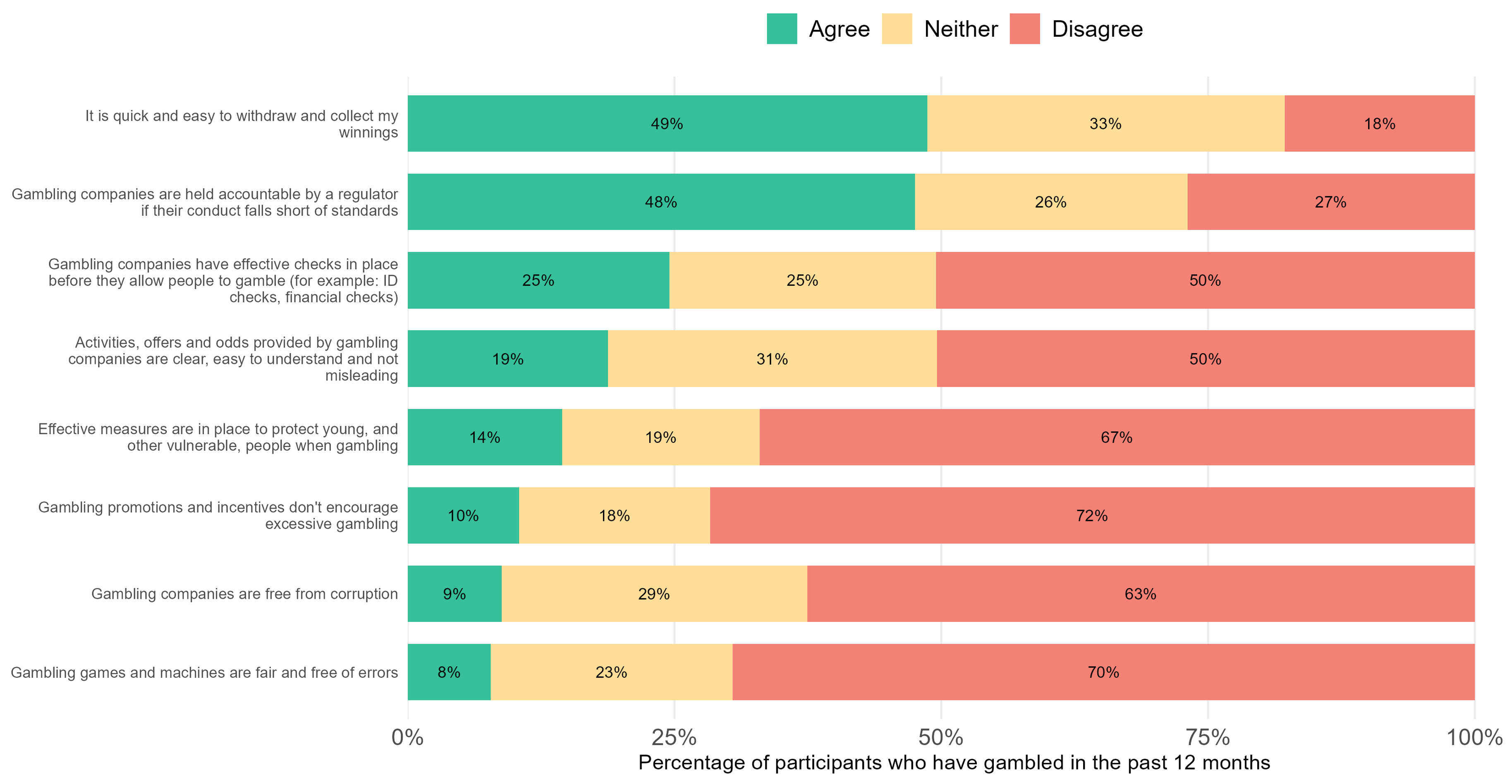
As shown in figure 2, the highest agreement levels relate to the withdrawing of winnings. Just under half of people who gambled in the last 12 months agree that it is quick and easy to withdraw their winnings (49 percent). This suggests that many consumers have a positive experience with this central part of the consumer journey, although there are also many who do not.
The next highest agreement level relates to regulatory accountability, with 48 percent of people who have gambled in the last 12 months agreeing that gambling companies are held accountable by a regulator if their conduct falls short of standards. This indicates that nearly half of consumers perceive oversight mechanisms as functioning effectively, even if broader industry trust is more mixed.
In contrast, the highest levels of disagreement appear in areas relating to fairness and promotional practices. Around two thirds of respondents (70 percent) disagree that gambling games and machines are fair and free of errors, and that promotions and incentives do not encourage excessive gambling (72 percent).
Figure 2: Agreement levels of trust statements among people who have gambled in the last 12 months
| Statement | Agree (percentage) | Neither (percentage) | Disagree (percentage) |
|---|---|---|---|
| It is quick and easy to withdraw and collect my winnings | 49 | 33 | 18 |
| Gambling companies are held accountable by a regulator if their conduct falls short of standards | 48 | 26 | 27 |
| Gambling companies have effective checks in place before they allow people to gamble (for example, ID checks, financial checks) | 25 | 25 | 50 |
| Activities, offers and odds provided by gambling companies are clear, easy to understand and not misleading | 19 | 31 | 50 |
| Effective measures are in place to protect young, and other vulnerable, people when gambling | 14 | 19 | 67 |
| Gambling promotions and incentives don’t encourage excessive gambling | 10 | 18 | 72 |
| Gambling companies are free from corruption | 9 | 29 | 63 |
| Gambling games and machines are fair and free of errors | 8 | 23 | 70 |
Table 5 provides an overview of how agreement with each trust statement varies by age. In general, older respondents were more likely to agree with statements relating to accountability, corruption, and fairness, whereas younger respondents were more likely to agree that effective checks are in place before people are allowed to gamble. These findings are discussed in more detail in the following section, which focuses on individual key themes.
Table 5. Proportion of those who gambled in the last 12 months NET: Agree to trust statements by age
| Statement | 18 to 24 (percentage) | 25 to 34 (percentage) | 35 to 44 (percentage) | 45 to 54 (percentage) | 55 to 64 (percentage) | 65 to 74 (percentage) | 75 and over (percentage) |
|---|---|---|---|---|---|---|---|
| Gambling companies are held accountable by a regulator if their conduct falls short of standards | 37.3 | 40.7 | 44.7 | 48.4 | 50.1 | 54.0 | 59.4 |
| Gambling companies are free from corruption | 8.2 | 7.0 | 7.1 | 8.6 | 8.8 | 10.6 | 15.2 |
| Gambling games and machines are fair and free of errors | 5.9 | 7.9 | 7.7 | 8.0 | 7.4 | 7.6 | 10.2 |
| Activities, offers and odds provided by gambling companies are clear and easy to understand and not misleading | 16.1 | 20.6 | 20.0 | 19.3 | 17.0 | 16.8 | 20.0 |
| Effective measures are in place to protect young, and other vulnerable people when gambling | 13.1 | 14.9 | 13.8 | 15.1 | 13.4 | 13.8 | 18.4 |
| Gambling promotions and incentives don't encourage excessive gambling | 13.6 | 11.2 | 11.1 | 9.4 | 8.8 | 9.3 | 11.9 |
| It is quick and easy to withdraw my winnings | 43.6 | 52.1 | 52.0 | 49.9 | 46.5 | 44.6 | 43.3 |
| Gambling companies have effective checks in place before they allow people to gamble | 32.3 | 32.0 | 26.4 | 23.8 | 19.2 | 16.2 | 19.7 |
| Base size (number) | 616 | 1,781 | 2,119 | 1,921 | 2,276 | 2,103 | 1,378 |
3 Where percentages for a question do not add up to 100 percent, this is due to computer rounding.
Drivers of trust
Introduction to drivers of trust
The overall trust scores and agreement levels can be used to dive deeper into the 5 overarching drivers of consumer trust. This section explores each theme in more detail, and the extent to which agreement with each statement varies by age, gender, and gambling activity.
The next page in this section is Regulation and accountability.
Regulation and accountability
Confidence in regulatory oversight is a key driver of trust. The presence of a visible gambling regulatory body was ranked as the highest priority for respondents in our previous research, which also uncovered how consumer’s perceived risk of corruption across the industry and wider government can drive their views on accountability.
"Gambling companies that operate under the oversight of reputable regulatory bodies are more likely to adhere to strict standards of fairness, security, and responsible gambling practices."
– Qualitative Research Participant
Earlier stages of the research used these consumer insights to inform the development of 2 statements to provide insight into people’s views on gambling regulation and accountability:
Gambling companies are held accountable by a regulator if their conduct falls short of standards.
Gambling companies are free from corruption.
Gambling companies are held accountable by a regulator if their conduct falls short of standards
Overall 48 percent of people who had gambled in the past 12 months agreed with this statement, with 33 percent responding neutrally, and 18 percent disagreeing. Participants aged over 65 were more likely to agree that gambling companies are held accountable by a regulator (54 to 59 percent), whereas those aged 18 to 24, had lower levels of agreement with this statement than other age groups (37 percent). This is likely to be driven by findings from the earlier phases of the research which highlighted that there is a lack of awareness and understanding of the Commission’s role as a regulator, particularly among young audiences. Males and females had similar levels of agreement relating to regulation and accountability (47.3 percent and 47.9 percent respectively).
“I know on all adverts they state “when the fun stops, stop” but I don’t know how much they are held accountable.”
– Qualitative Research Participant
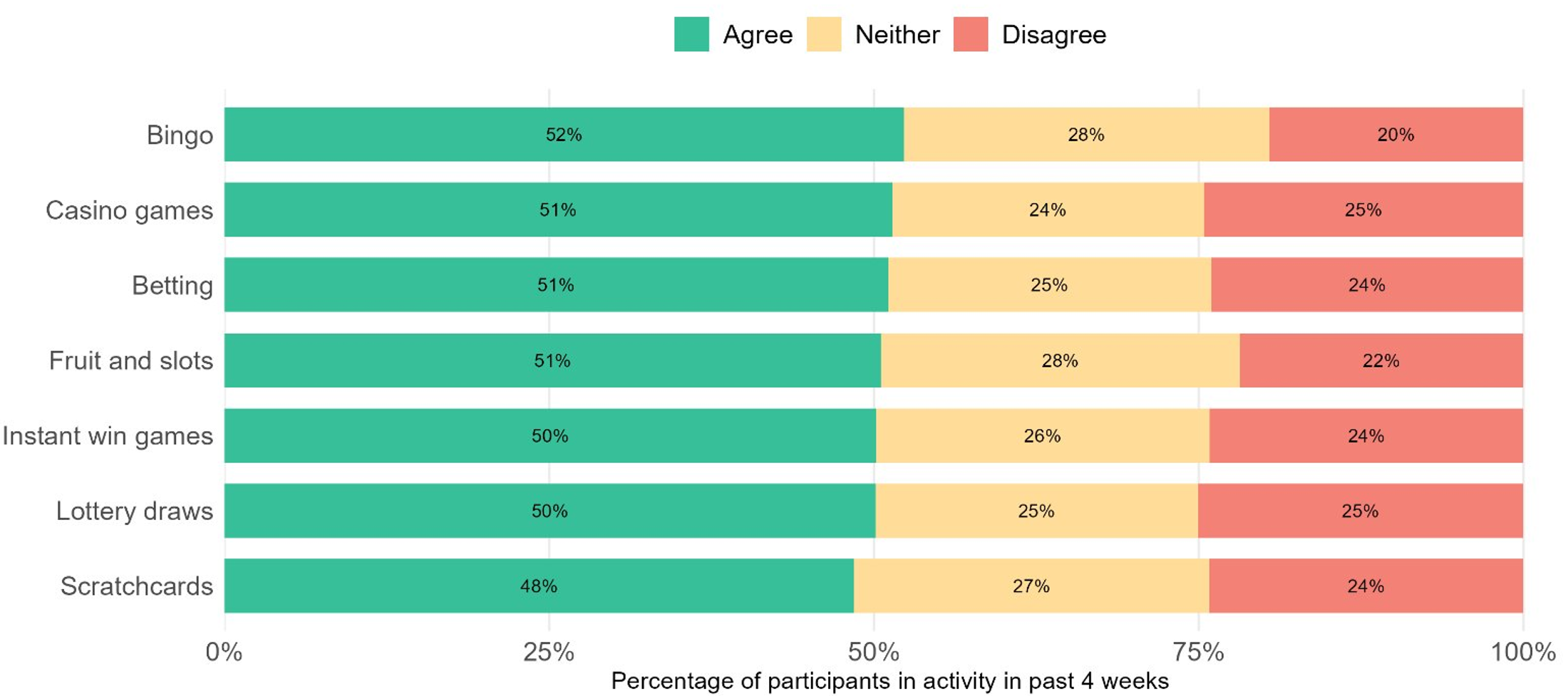
People’s views on regulatory oversight also varied based on the types of gambling activities they played, and whether they enjoyed their most recent gambling experience. Looking at past 4-week participation in different gambling activities, those that had participated in bingo games were more likely than other groups to agree that companies are held accountable. In contrast, participation in scratchcards over the past 4 weeks is associated with lower agreement on regulatory accountability. Participants who rated their last gambling experience as ‘positive’ were more likely to agree that gambling companies are held accountable, than those who rated it as ‘neutral’ or ‘negative’ (positive 53 percent; neutral 42 percent; negative 45 percent).
Figure 3: Agreement level with ‘regulatory accountability’ statement by gambling activity in the past 4 weeks
| Activity | Agree (percentage) | Neither (percentage) | Disagree (percentage) |
|---|---|---|---|
| Bingo | 52 | 28 | 20 |
| Casino games | 51 | 24 | 25 |
| Betting | 51 | 25 | 24 |
| Fruit and slots | 51 | 28 | 22 |
| Instant win games | 50 | 26 | 24 |
| Lottery draws | 50 | 25 | 25 |
| Scratchcards | 48 | 27 | 24 |
Gambling companies are free from corruption
In the earlier phases of research consumers recognised that there is a complex but necessary relationship between gambling companies, regulators and the government, with the need for independence identified as an important factor. Where independence is not evident to consumers there can be a perceived risk of what participants referred to as corruption.
"My perception is that the owners of gambling companies have very close links with the government … I have no faith in the government being free from corruption to be perfectly honest."
– Qualitative Research Participant
These views could also be driven by the nature of the relationship between a gambling company and customer, and the inherent presence of risk, chance, and potential loss. They can also be influenced by the reporting of regulatory activity such as enforcement cases and investigations. A further hypothesis, which requires further exploration, is this driver being influenced by the presence of the illegal gambling market.
Overall, 9 percent of participants in the GSGB who had gambled in the past 12 months agreed with this statement, with 29 percent responding neutrally, and 63 percent disagreeing. Younger participants aged 18 to 44 (65 to 77 percent) and females (64 percent) were more likely to disagree that gambling companies are free from corruption, compared with those aged 45 or over (52 to 59 percent), and male participants (61 percent).
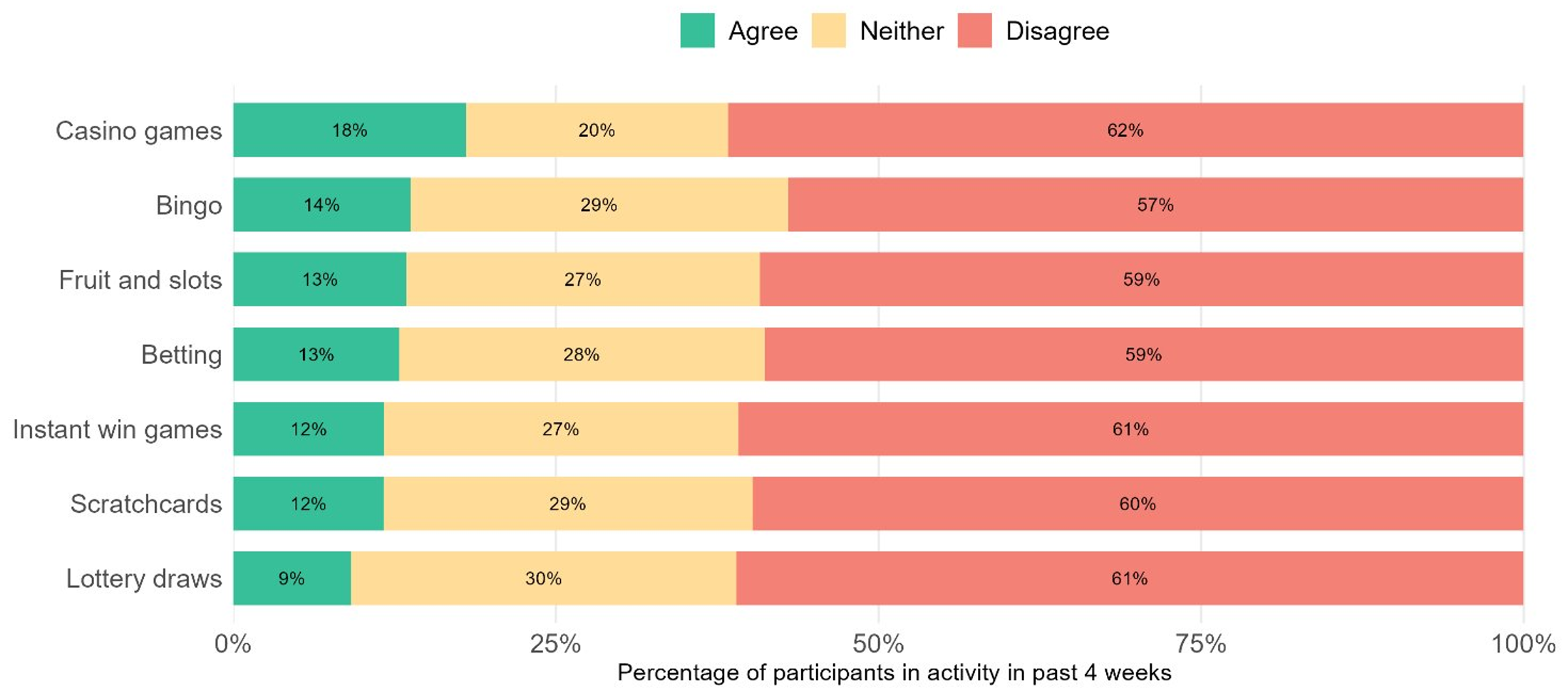
Participants who had played casino games in the past 4 weeks were significantly more likely to agree that the industry is free from corruption, compared with other participants who had gambled in the past 12 months. Those who had played lottery draws were significantly less likely than average to agree with this statement as shown in figure 4.
Participants who rated their most recent gambling experience as ‘positive’ were slightly more likely to agree that the industry is free from corruption (11 percent), compared with those who rated it as ‘neutral’ (7 percent) or ‘negative’ (7 percent), however this difference did not reach statistical significance.
Figure 4. Agreement level with ‘free from corruption’ statement by gambling activity in the past 4 weeks
| Activity | Agree (percentage) | Neither (percentage) | Disagree (percentage) |
|---|---|---|---|
| Casino games | 18 | 20 | 62 |
| Bingo | 14 | 29 | 57 |
| Fruit and slots | 13 | 27 | 59 |
| Betting | 13 | 28 | 59 |
| Instant win games | 12 | 27 | 61 |
| Scratchcards | 12 | 29 | 60 |
| Lottery draws | 9 | 30 | 61 |
Base: Participants who gambled on each activity in the past 4 weeks (Bingo: 714; Casino games: 466; Betting: 1,616; Fruit and slots: 757; Instant win games: 1,257; Lottery draws: 6,388; Scratchcards: 1,954).
The next page in this section is Protection and safety.
Protection and safety
In earlier phases of the research the protection of vulnerable groups, particularly young people, was consistently identified as a factor in maintaining trust in the gambling industry. Participants expressed concerns over the growing exposure of younger, more vulnerable audiences to gambling through wider marketing and advertising, particularly during sporting events. Safeguarding children was seen to be a shared societal responsibility and therefore a key factor influencing peoples’ trust in gambling.
"I think that the protection of children is the greatest thing the Gambling Commission can do."
– Qualitative Research Participant
The following statements were developed to measure this key driver:
Effective measures are in place to protect young and other vulnerable people when gambling.
Gambling companies have effective checks in place before they allow people to gamble.
Effective measures are in place to protect young and other vulnerable people when gambling
Overall 14 percent of those who had gambled in the past 12 months agreed with this statement, with 19 percent responding neutrally, and 67 percent disagreeing. Younger adults aged 18 to 24 were the most likely to disagree that effective measures are in place to protect young and other vulnerable people (70.3 percent). Those aged 75 and over were slightly more likely than other age groups to agree with the statement (18.4 percent). Women are more likely to disagree that effective measures are in place to protect young and other vulnerable people than men (69 percent compared to 65 percent).
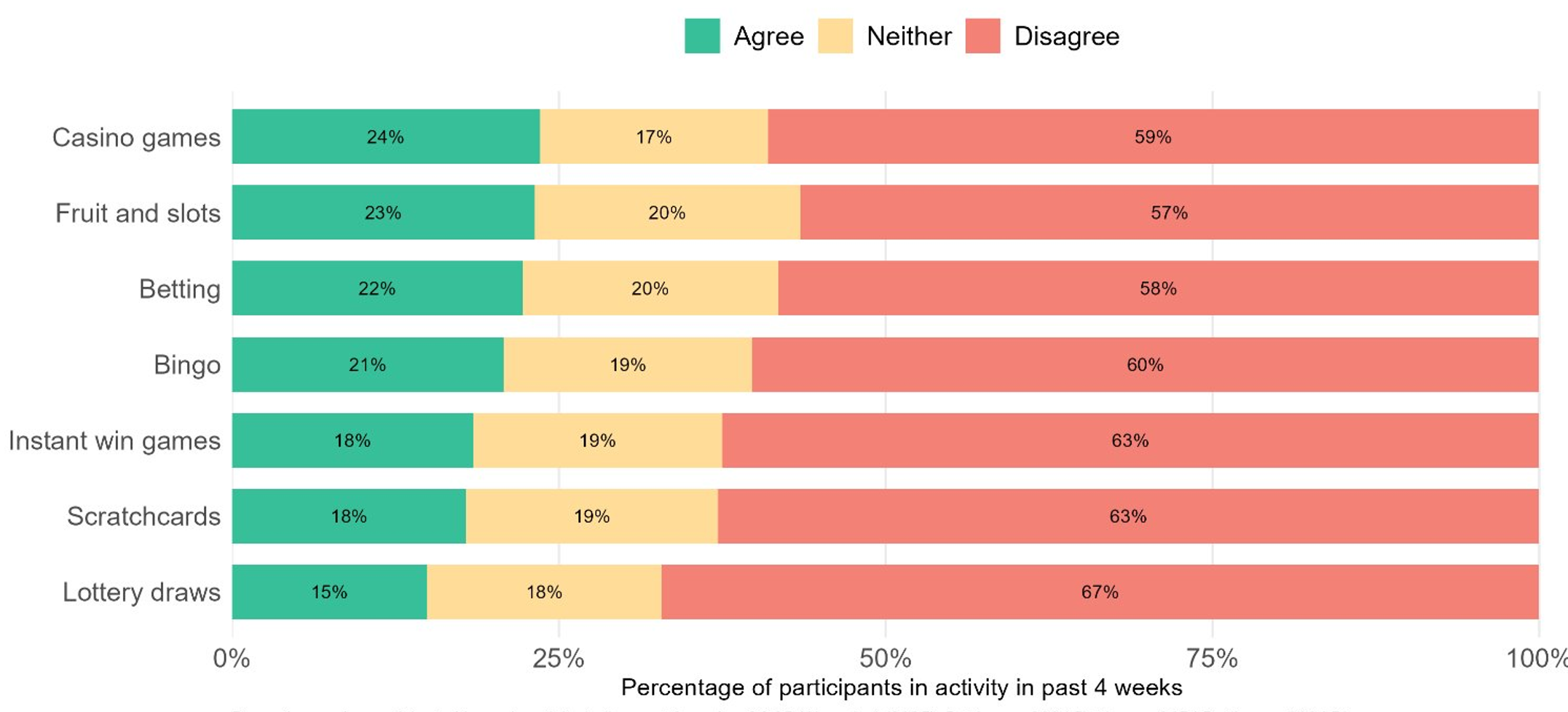
Agreement also varied by the types of gambling activities people had taken part in over the past four weeks. Those who had participated in casino games (23.5 percent), fruit and slots (23.2 percent), and betting (22.2 percent) were more likely to agree that effective protections are in place, while agreement was lowest among lottery draw players (14.9 percent)
Levels of agreement did not differ significantly based on whether participants rated their most recent gambling experience as ‘positive’ (18 percent), ‘neutral’ (11 percent), or ‘negative’ (13 percent).
Figure 5: Agreement level with ‘protection measures’ statement by gambling activity in the past 4 weeks
| Activity | Agree (percentage) | Neither (percentage) | Disagree (percentage) |
|---|---|---|---|
| Casino games | 24 | 17 | 59 |
| Fruit and slots | 23 | 20 | 57 |
| Betting | 22 | 20 | 58 |
| Bingo | 21 | 19 | 60 |
| Instant win games | 18 | 19 | 63 |
| Scratchcards | 18 | 19 | 63 |
| Lottery draws | 15 | 18 | 67 |
Gambling companies have effective checks in place before they allow people to gamble
25 percent of those who had gambled in the past 12 months agreed with this statement, with 25 percent responding neutrally and 50 percent disagreeing. Those aged 18 to 34 had higher levels of agreement that effective checks are in places before allowing people to gamble (32 percent) and those aged over 65 show the highest disagreement that effective checks are in place (60 to 61 percent). This could be due to the recency of younger players being asked to confirm their age, for example. Men had higher levels of agreement that effective checks are in place before allowing people to gamble (27 percent compared to 22 percent), and women had higher levels of disagreement (53 percent compared to 48 percent). This factor could also be influenced by consumers’ engagement with the illegal gambling market, where age verification checks and other measures are applied less consistently, or not at all. This will be an area for further exploration in the GSGB.
“I have never been asked my age or whether I might be a vulnerable person when gambling online”
– Qualitative Research Participant
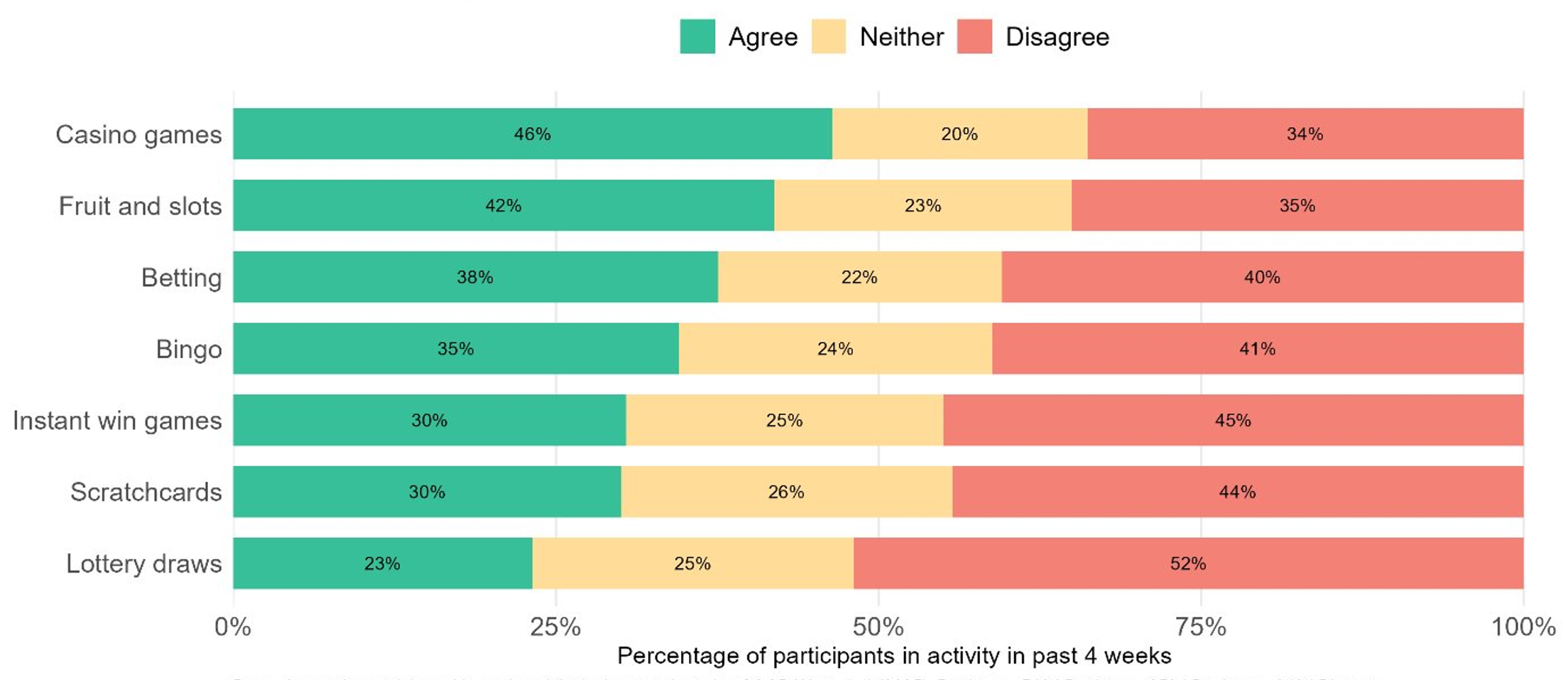
Those who played casino games in the past 4 weeks are 1.9 times more likely than average to agree that effective checks are in place before allowing people to gamble. Agreement levels among lottery players are close to the overall average. Participants who rated their most recent gambling experience as ‘positive’ were more likely to agree with the statement (31 percent), than those who rated it as ‘neutral’ (18 percent) or ‘negative’ (21 percent).
Figure 6: Agreement level with ‘effective checks’ statement by gambling activity in the past 4 weeks
| Activity | Agree (percentage) | Neither (percentage) | Disagree (percentage) |
|---|---|---|---|
| Casino games | 46 | 20 | 34 |
| Fruit and slots | 42 | 23 | 35 |
| Betting | 38 | 22 | 40 |
| Bingo | 35 | 24 | 41 |
| Instant win games | 30 | 25 | 45 |
| Scratchcards | 30 | 26 | 44 |
| Lottery draws | 23 | 25 | 52 |
Base: Participants who gambled on each activity in the past 4 weeks (Bingo: 714; Casino games: 466; Betting: 1,616; Fruit and slots: 757; Instant win games: 1,257; Lottery draws: 6,388; Scratchcards: 1,954).
The next page in this section is Transparency and fairness.
Transparency and fairness
Transparency and fairness are core drivers of consumer trust in any industry, not just in gambling. However, they are particularly relevant in this sector and link directly back to the Commission’s licensing objective to ensure that gambling is conducted in a fair and open way. In the earlier phase of this research participants talked about the understandability of terms and conditions, the presence of clear information about how games work, odds and offers, and wider points around fair gameplay.
"You only read terms and conditions when you have a problem and then you start going through them and scratching your head."
– Qualitative Research Participant
This driver was measured using the following statements:
Gambling games and machines are fair and free from errors
Activities, offers and odds provided by gambling companies are clear, easy to understand and not misleading.
Gambling games and machines are fair and free from errors
8 percent of people who had gambled in the past 12 months agreed with this statement, with 23 percent responding neutrally, and 70 percent disagreeing. This may be linked to levels of gambling literacy and comprehension of the way that gambling games and products work, and the inherent chance and risk associated with taking part in certain activities.
“My perception is that the majority of the time people lose so I assume there may be faults and/or unfairness with games and/or slot machines.”
– Qualitative Research Participant
However, in the earlier phases of the research some participants expressed confidence in the way that games are offered.
"Knowing a game has random odds and a random selection that is not rigged in terms of winning and losing, gives me some reassurance."
– Qualitative Research Participant
Younger people (aged 18 to 45) had higher levels of disagreement that gambling games and machines are fair and free from errors (71 to 77 percent) compared to those over 45 (62 to 67 percent), with the highest disagreement among 18 to 24 year olds and the highest agreement for those aged 75 and over (10 percent).
Men had higher levels of agreement that gambling games and machines are fair and free from errors (9 percent compared to 6 percent) and women had higher levels of disagreement (72 percent compared to 68 percent).
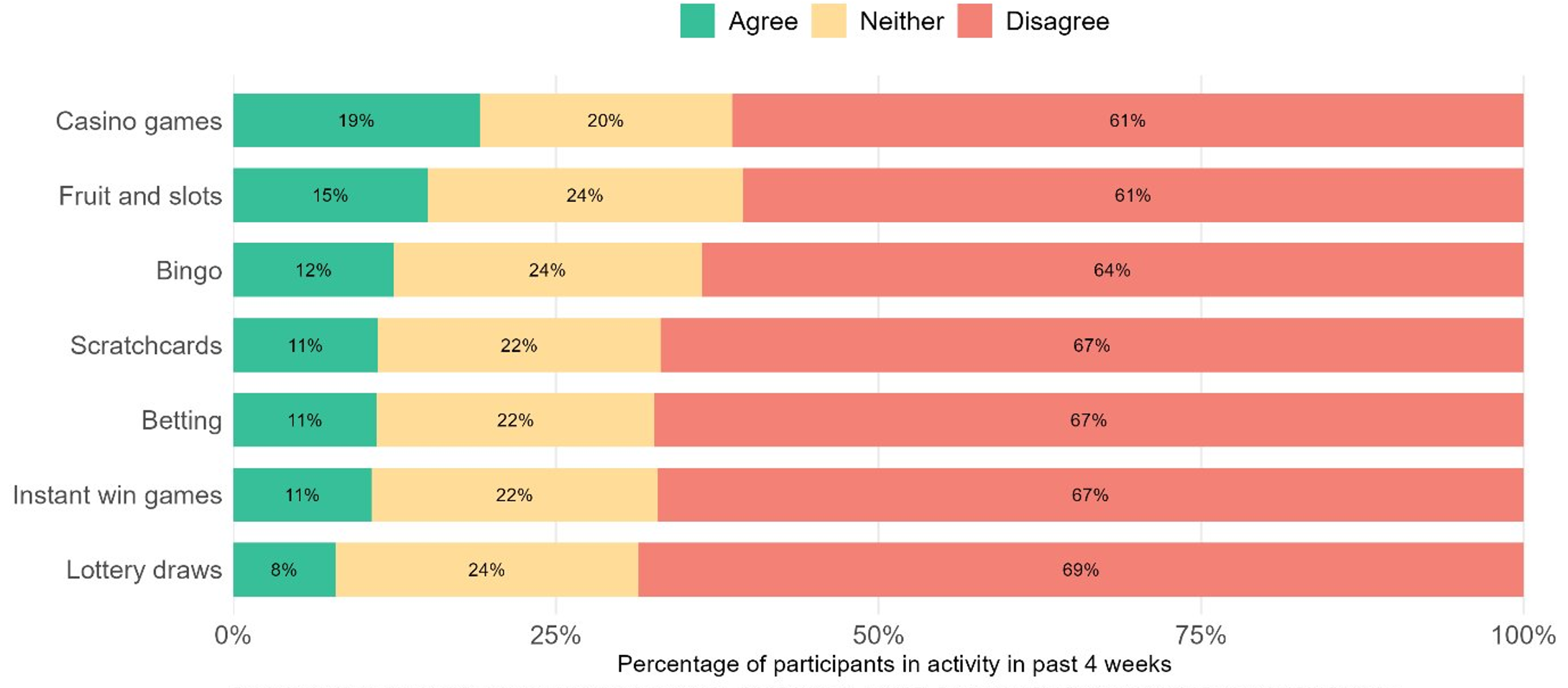
Levels of agreement to this statement varied by the type of gambling activity participants had played in the past 4 weeks, and whether they had enjoyed their most recent gambling experience. Those that participated in lottery draws were least likely to agree that gambling games are fair and free from errors, and those who had played casino games had the highest level of agreement, followed by playing fruit and slots in the past 4 weeks (19 percent and 15 percent respectively and shown in figure 7. Agreement with the statement did not differ significantly based on whether participants rated their last gambling experience as ‘negative’ (7 percent,) ‘neutral’ (5 percent) or ‘positive’ (10 percent).
Figure 7: Agreement level with ‘games and machine fairness’ statement by gambling activity in the past 4 weeks
| Activity | Agree (percentage) | Neither (percentage) | Disagree (percentage) |
|---|---|---|---|
| Casino games | 19 | 20 | 61 |
| Fruit and slots | 15 | 24 | 61 |
| Bingo | 12 | 24 | 64 |
| Scratchcards | 11 | 22 | 67 |
| Betting | 11 | 22 | 67 |
| Instant win games | 11 | 22 | 67 |
| Lottery draws | 8 | 24 | 69 |
Activities, offers and odds provided by gambling companies are clear and easy to understand and not misleading
19 percent of past 12-month gamblers agreed with this statement, with 31 percent responding neutrally, and 50 percent disagreeing. Some participants in the earlier phase of research explained that they didn’t understand some elements of gambling and struggled to comprehend the rules or terms and conditions provided by operators.
“I never bet on games with “odds”, I don’t understand how they are worked out”
– Qualitative Research Participant
There was little difference in agreement across age groups (all between 16 to 21 percent with no pattern), but large differences in disagreement with a clear trend that younger people are more likely to disagree that activities, odds and offers are clear and easy to understand. People aged 18 to 24 had the highest levels of disagreement (61 percent) whilst those aged over 75 had the lowest levels (44 percent). This could be driven by levels of gambling experience or the types of activities that are played by younger people.
Men are significantly more likely to agree that activities, offers and odds provided by gambling companies are clear and easy to understand and not misleading (22 percent compared to 15 percent), whilst women are more likely to disagree (54 percent compared to 48 percent).
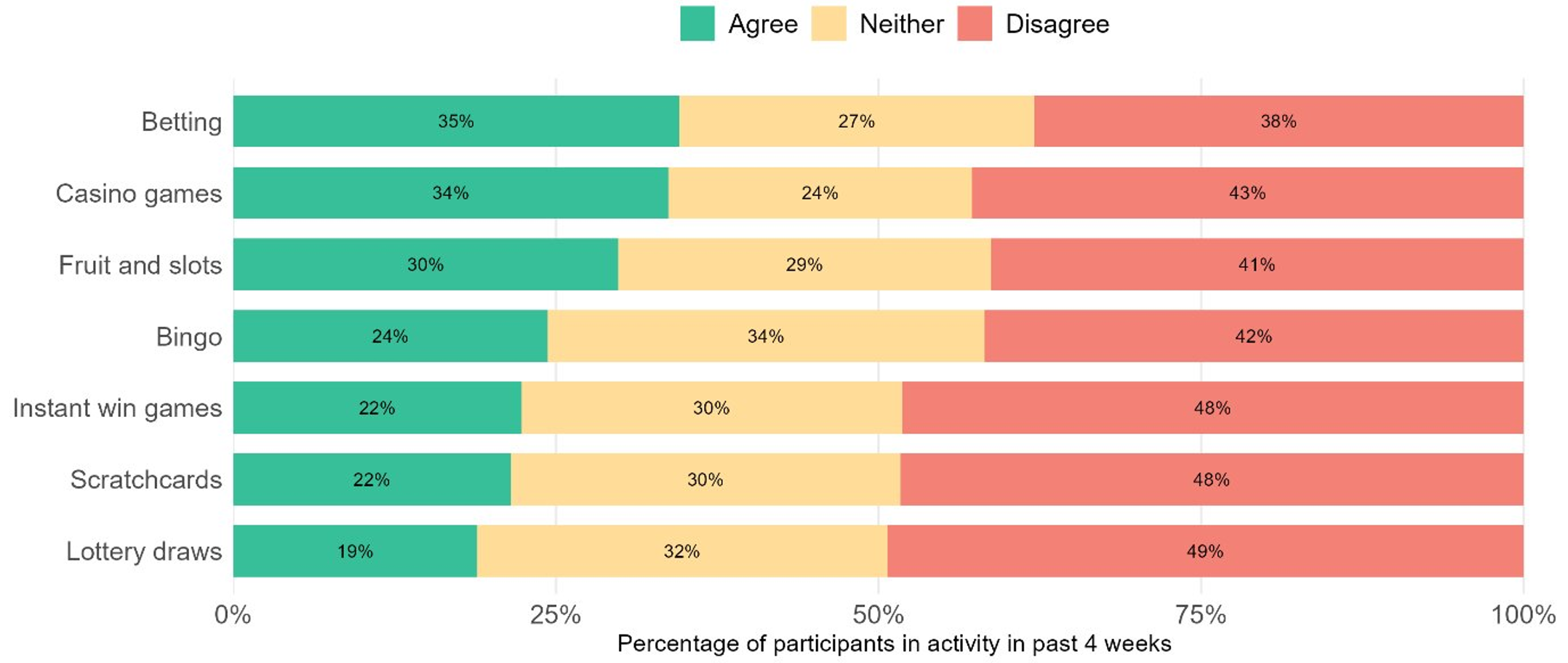
Levels of agreement were highest among participants who had engaged in casino games or betting over the past 4 weeks (34 to 35 percent), while those who had played Lottery draws had the lowest levels of agreement (19 percent) as shown in Figure 8. Participants who rated their most recent gambling experience as positive were more likely to agree that activities, offers and odds are easy to understand (25 percent), compared with those who rated their experience as neutral (14 percent) or negative (12 percent).
Figure 8: Agreement level with ‘activities, odds and offers’ statement by gambling activity in the past 4 weeks
| Activity | Agree (percentage) | Neither (percentage) | Disagree (percentage) |
|---|---|---|---|
| Betting | 35 | 27 | 38 |
| Casino games | 34 | 24 | 43 |
| Fruit and slots | 30 | 29 | 41 |
| Bingo | 24 | 34 | 42 |
| Instant win games | 22 | 30 | 48 |
| Scratchcards | 22 | 30 | 48 |
| Lottery draws | 19 | 32 | 49 |
The next page in this section is Advertising and promotion.
Advertising and promotion
Advertising and promotions in gambling are an external influence to the play experience. Promotions are popular among people who gamble, but the balance between reward and over-promotion is frequently questioned. There are a number of themes that influence this driver, including the volume and targeting of offers and promotions, the visibility of advertising online, and the role of social media and influencers.
"The betting companies nowadays know exactly what games you like to play and when you usually place a bet; they notify you with tailored promotions which sometimes feel a bit intrusive!"
– Qualitative Research Participant
Participants in the earlier phase of research also identified the risk that advertising and promotions pose to people who may be struggling with their gambling.
“I’ve seen how offers and bonuses can tempt people. It’s hard to say if they lead to excessive gambling but they definitely encourage more play.”
– Qualitative Research Participant
People’s views on advertising and promotion were assessed using the following statement:
Gambling promotions and incentives don’t encourage excessive gambling.
Gambling promotions and incentives don’t encourage excessive gambling
Overall, 10 percent of people who had gambled in the past 12 months agreed with this statement, with a further 18 percent responding neutrally, and 72 percent disagreeing. However, the data show clear age-related differences. Respondents aged 18 to 24 were more likely to agree that promotions do not encourage excessive gambling, compared with older participants. Men are also more likely to agree that promotions do not encourage excessive gambling than women (12 percent compared to 9 percent).
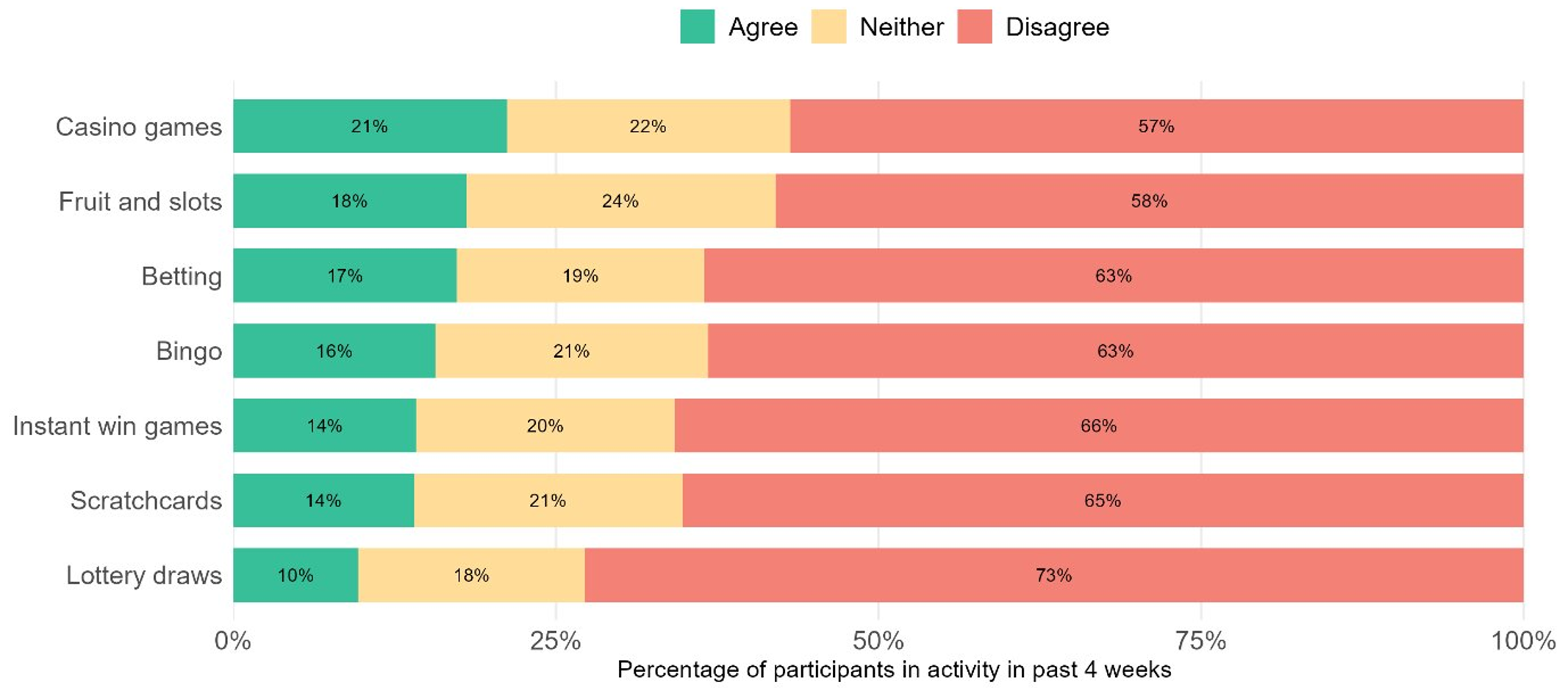
As we see throughout all themes, the type of activities participated in in the past 4 weeks is associated with agreement levels to different aspects of trust. Those that played casino games or fruit and slots in the past 4 weeks have the highest levels of agreement that promotions and incentives don’t encourage excessive gambling as shown in Figure 9. Agreement with the statement did not differ based on whether participants rated their most recent gambling experience as ‘positive’ (13 percent), ‘neutral’ (7 percent) or ‘negative’ (11 percent).
Figure 9: Agreement level with ‘promotions and incentives’ statement by gambling activity in the past 4 weeks
| Activity | Agree (percentage) | Neither (percentage) | Disagree (percentage) |
|---|---|---|---|
| Casino games | 21 | 22 | 57 |
| Fruit and slots | 18 | 24 | 58 |
| Betting | 17 | 19 | 63 |
| Bingo | 16 | 21 | 63 |
| Instant win games | 14 | 20 | 66 |
| Scratchcards | 14 | 21 | 65 |
| Lottery draws | 10 | 18 | 73 |
The next page in this section is Customer experience and support.
Customer experience and support
Good customer service and experience is a key component of consumer trust in the gambling sector. This can include the ease of withdrawing winnings, quality of communication with gambling companies and, where necessary, the ease of making a complaint and resolving issues. Some participants in the earlier phase of research reported difficulties and delays in withdrawing funds and had concerns about the type of information that they had to share in order to withdraw. This is also a common theme seen in the Commission’s own contact centre.
"I’m still waiting for my win, 8 days later. They want ID, they want utility bills and all these things when I win, despite not asking for them when I opened my account."
– Qualitative Research Participant
People’s views on this topic have been assessed using the following statement:
It is quick and easy to withdraw and collect my winnings
It is quick and easy to withdraw and collect my winnings
Overall 49 percent of people who had gambled in the past 12 months agreed with this statement, with a further 33 percent responding neither agree or disagree and 18 percent disagreeing.
“Most of time if you win, your winnings will be paid to you in full, even if the bet you won was a free bet.”
– Qualitative Research Participant
Respondents aged 18 to 24 were most likely to disagree with this statement (28 percent), whilst 25 to 54 year olds are most likely to agree (50 to 52 percent). Younger people were also more likely to have clear opinions on this topic, with the percentage of “neither” responses increasing with age (18 to 45 with 26 to 30 percent among 18 to 45 year olds, compared to 40 to 43 percent among those aged 55 and over). This could be driven by the types of activities that respondents had participated in.
“As I play bingo in person, any winnings are instantly given to me. Likewise, if I win on a scratchcard, on a return to a store, my winnings are given instantly.”
– Qualitative Research Participant
Men are more likely to agree with this statement than women (50 percent compared to 47 percent).
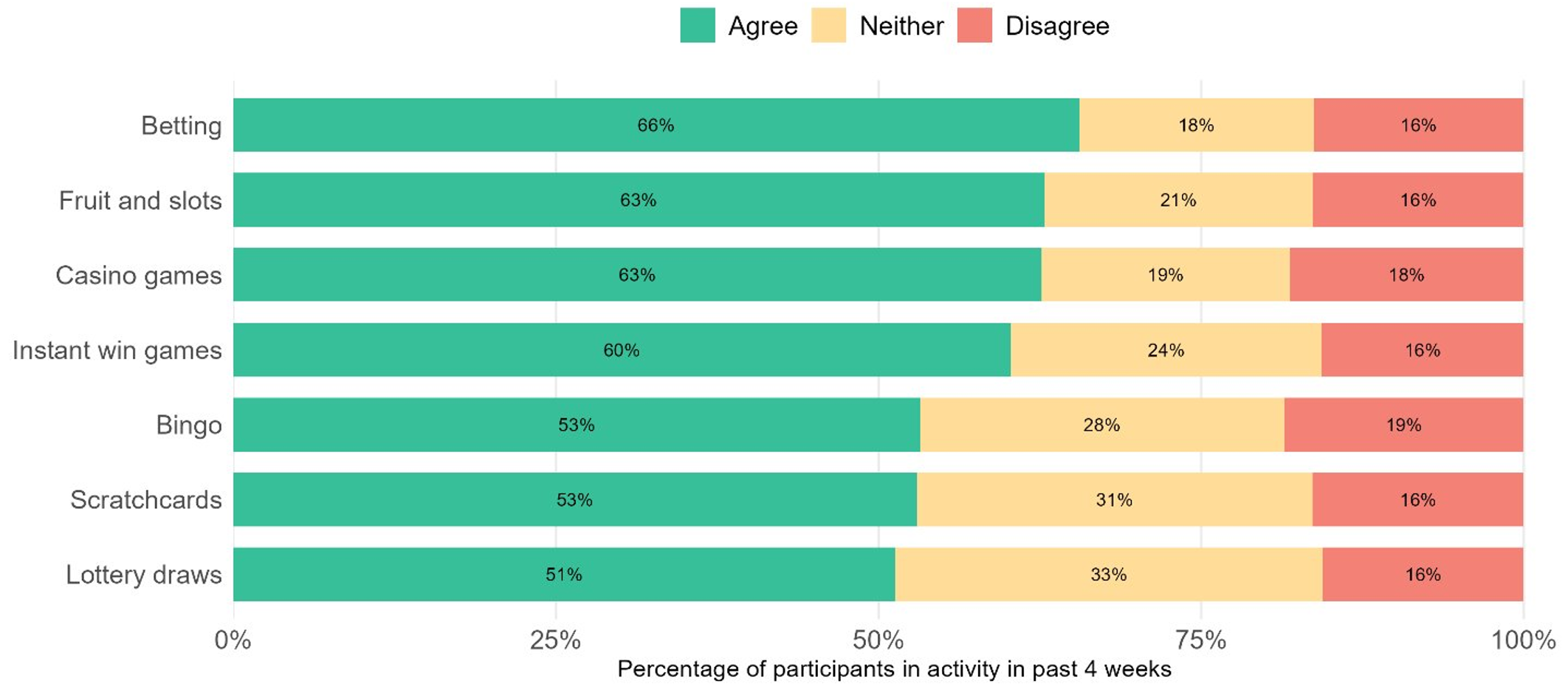
Agreement is highest among those who participated in betting, casino games and fruit and slots in the past 4 weeks (62.6 to 65.6 percent) as shown in Figure 10. Participants who rated their last gambling experience as ‘positive’ were more likely to agree with the statement (59 percent), compared with those who rated their last experience as neutral (41 percent) or negative (37 percent).
Figure 10: Agreement level with ‘quick and easy withdrawals’ statement by gambling activity in the past 4 weeks
| Activity | Agree (percentage) | Neither (percentage) | Disagree (percentage) |
|---|---|---|---|
| Betting | 66 | 18 | 16 |
| Fruit and slots | 63 | 21 | 16 |
| Casino games | 63 | 19 | 18 |
| Instant win games | 60 | 24 | 16 |
| Bingo | 53 | 28 | 19 |
| Scratchcards | 53 | 31 | 16 |
| Lottery draws | 51 | 33 | 16 |
This report continues in the Conclusion section.
Conclusion
These initial findings provide an early view of how we will be able to monitor consumer trust using the Gambling Survey for Great Britain. The results show that trust varies across different aspects of the gambling experience, with higher agreement in areas relating to withdrawals and regulatory accountability and lower agreement in areas relating to fairness and promotions. This granularity will enable us to identify areas for further research and attention and provides a more nuanced picture of the complex drivers that influence consumer trust. Differences by age, gambling activity, and recent experience demonstrate that trust is not uniform and that consumers hold diverse views depending on their circumstances and patterns of play.
The composite trust score of 47.9 offers a baseline for future measurement and continued development of the trust framework. As this measure remains in development, findings should be interpreted as indicative rather than definitive and will be refined as more data becomes available.
Next steps
The trust statements and composite index remain in development. Building on the outcomes of the validation exercise and feedback from stakeholders, the wording of the question has been updated and incorporated into both the paper and online versions of the 2026 GSGB questionnaire. These changes aim to improve clarity, relevance, and consistency in the trust measure. Core details on the validation exercise and question development can be found in the technical report.
The revised question that has been added to the 2026 survey is as follows:
The next question asks for your thoughts on how gambling companies operate.
Based on your own personal views and experiences of the gambling activities you have engaged in (such as betting, bingo and lottery), both online and in person, even if you take part occasionally/infrequently.
How much do you agree or disagree with the following statements?
Gambling companies are held accountable by a regulator if their conduct falls short of standards.
Gambling companies are free from corruption.
Gambling games and machines are fair and free of errors.
Odds and offers provided by gambling companies are clear and easy to understand.
Effective measures are in place to protect young, and other vulnerable, people when gambling.
Answer options:
a) Agree strongly
b) Agree slightly
c) Neither agree nor disagree
d) Disagree slightly
e) Disagree strongly
f) Don’t know/Not applicable
And how much do you agree or disagree with the following?
Gambling companies have effective checks in place before they allow people to gamble (e.g. ID checks, financial checks).
Gambling promotions and incentives don’t encourage excessive gambling.
It is quick and easy to withdraw and collect my winnings.
Answer options:
a) Agree strongly
b) Agree slightly
c) Neither agree nor disagree
d) Disagree slightly
e) Disagree strongly
f) Don’t know/Not applicable
Throughout 2026, further analysis and monitoring will be conducted to assess how the updated question performs in practice, including checks on reliability, relevance across gambling behaviours, and comparison to previous findings from the stages of development. The data will remain in development while this work continues and will only move out of development status once there is sufficient evidence that the statements and composite index operate consistently and provide a robust basis for ongoing reporting.
The data will also be analysed further against a range of other variables available in the GSGB, including new questions that are currently in development about engagement in the illegal market. The role of the illegal market on consumer perceptions and trust in gambling is an important area for follow-up research, which will be explored later in 2026.