
Report
Exploring online, illegal, individual-led lotteries and raffles
Exploring online, illegal, individual-led lotteries and raffles
Trust and legitimacy
Prize-led, live and winner-led content helps build trust
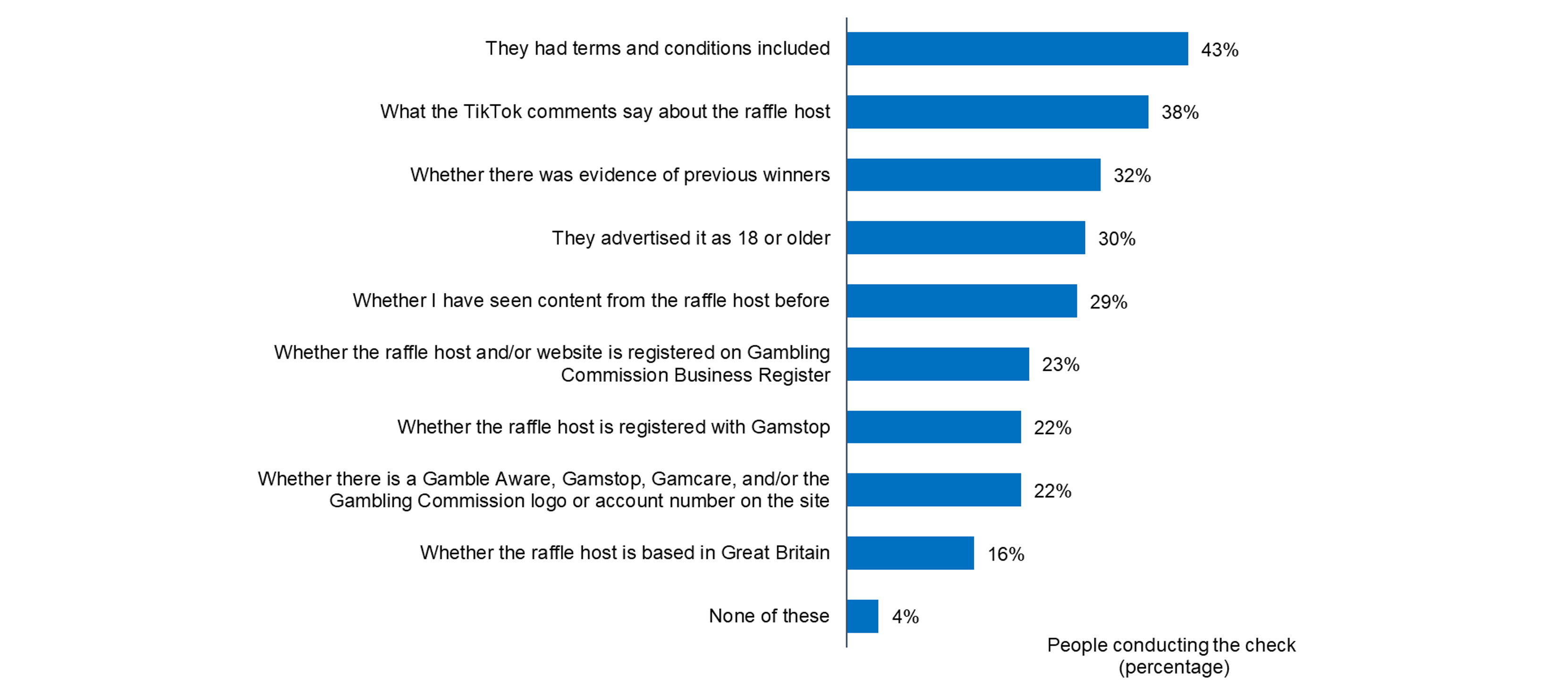
Evidence from the qualitative and quantitative phases suggests that most players are not carrying out formal due diligence before entering a draw. Figure 3 shows the checks that quantitative survey participants report doing before entering an individual-led lottery or raffle.
Figure 3: When choosing which individual-led lotteries or raffles to take part in via TikTok, what checks, if any, do you do on the provider?
| Checks done on an online individual-led lottery or raffle provider | People conducting the check (percentage) |
|---|---|
| They had terms and conditions included | 43% |
| What the TikTok comments say about the raffle host | 38% |
| Whether there was evidence of previous winners | 32% |
| They advertised it as 18 or older | 30% |
| Whether I have seen content from the raffle host before | 29% |
| Whether the raffle host and/or website is registered on Gambling Commission Business Register | 23% |
| Whether the raffle host is registered with Gamstop | 22% |
| Whether there is a Gamble Aware, Gamstop, Gamcare, and/or the Gambling Commission logo or account number on the site | 22% |
| Whether the raffle host is based in Great Britain | 16% |
| None of these | 4% |
As seen in Figure 3, instead of formal checks and visible signs of regulation, participants more commonly cited relying on simple, visible cues and more practical signals that a draw feels legitimate enough to enter. This appears to reflect both limited awareness and convenience. Qualitative participants were often unclear about what formal checks were possible, or whether they should be checking legitimacy at all. In that context, they also tended to rely on signals that were easy to see within the platform itself, such as long-running raffles, platform verification, polished branding and visible players and winners in comments or live content.
Participants within the interviews described these visible interactions and engagement between players and hosts as reinforcing trust and making the draw feel genuine.
"A lot of the companies, they'll do a live draw for the raffle, so you can actually, see it live… It's really good, because then you know it's genuine. And, it just makes it a little bit more exciting, rather than just saying, oh, this was the winner."
– Participant taking part in an illegal lottery, Facebook, Female, 54 years old
Seeing winners announced, prizes handed over, and players engaging publicly gave the impression that other people were already taking part and benefiting. This helped make the draw feel legitimate enough to enter. In some cases, winners also posted about receiving their prize, further reinforcing the sense that the draw was genuine.
Hosts also encourage winners to post about their win, helping to demonstrate to others that the draw is genuine and increasing participation.
As one participant explained:
"I took a screenshot of the payments. After taking the screenshots, I sent it to their Instagram handle. I backed it up with some messages, and they put it up on their post."
– Participant taking part in an illegal lottery, TikTok, Male, 32 years old
Hosts’ personality, values and familiarity also shape participation
Evidence from the qualitative phase suggests that players are more likely to take part when they feel a sense of familiarity or affinity with the host. This can reflect the host’s personality, perceived values, or the sense that they are already known through repeated exposure on social media. In some cases, this created a halo effect, where positive feelings about the host appeared to extend to the activity itself.
Participants often said that engaging and entertaining hosts made raffles seem more appealing. Others were drawn to hosts whose proceeds were said to be going to charity, which helped create a sense of community around the host and their cause.
Familiarity was also important. This included hosts that players knew directly, either through a personal relationship or because the host was an influencer they had followed for some time. Familiarity could also be indirect, such as when hosts had been recommended, reposted or vouched for by a friend or another community member.
As one participant explained:
"The person who organised it is one of the admins in the group. He’s been a member of that group for several years now. He has an online presence, and he's been quite active, so we could rely on him. It's not someone who's just signed up to Facebook."
– Participant taking part in an illegal lottery, Facebook, Male, 41 years old
Routes into online individual-led lotteries and raffles Next section
The off-platform journey
Last updated: 13 August 2026
Show updates to this content
No changes to show.