- Print the full document
- Save the page as a HTML document to your device
- Save the page as a PDF file
- Bookmark it - it will always be the latest version of this document
This box is not visible in the printed version.
Exploring online, illegal, individual-led lotteries and raffles
Exploring online, illegal, individual-led lotteries and raffles
Published: 13 August 2026
Last updated: 13 August 2026
This version was printed or saved on: 28 September 2026
Online version: https://www.gamblingcommission.gov.uk/report/exploring-online-illegal-individual-led-lotteries-and-raffles
Executive summary
Background and approach
This report sets out the findings from a 3-phase research project commissioned by the Gambling Commission to understand how consumers engage with online individual-led lotteries and raffles promoted on social media.
Under the Gambling Act 2005, most lotteries promoted online, including on social media, require a society lottery licence from the Commission or a registration with a local authority and can only be run to raise money for good causes, not for private or commercial gain.
Where people run paid‑entry draws online without the appropriate licence or registration, they are likely to be promoting an illegal lottery. In this report, the terms online individual‑led lotteries, raffles and draws are used as practical labels for these paid‑for activities run by individuals, influencers, or small businesses on social media.
To build a comprehensive picture of this online ecosystem, Yonder conducted digital intelligence to map the online landscape, a quantitative survey of over 4,000 UK adults to measure the scale of exposure and participation, and qualitative in-depth interviews with players and a host carrying out the draws to explore the lived reality of participation. The overarching findings from across these 3 phases are summarised as follows.
Social media makes online individual-led lotteries and raffles easy to encounter and engaging to enter
This research explored how people encounter, interpret and take part in online individual-led lotteries and raffles promoted through social media, with a particular focus on TikTok, while also recognising that Facebook and Instagram featured in some participants’ experiences. While overall participation is low, these activities are often encountered passively while participants are scrolling, through reposts, live content or recommendations from friends or community networks.
Prize-led posts, countdowns, live draws, and winner announcements help turn passive exposure into interest by creating hype, urgency, and a sense that the draw is active and worth joining.
These activities feel casual and low risk, with trust built through social cues rather than formal checks
For many participants, online individual-led lotteries and raffles felt like casual, low-stakes fun and were easy to justify. Low ticket prices, mobile-first journeys and the social presentation of the content made participation feel more like light entertainment than serious gambling. Trust was typically built through visible winners, repeated exposure, familiar hosts and recommendations from friends, rather than through formal checks relating to licensing or regulation.
Awareness of illegality is low, and, when recognised, it is unlikely to be challenged by consumers
Awareness of legality was generally low among both participants and with the host we interviewed. Players were not usually asking whether an activity was licensed, and the smaller-scale host interviewed also appeared unclear on the licensing requirements. Payment and entry often took place away from the original social media platform, where the journey still felt smooth and familiar even when protections may have been weaker. Because these draws feel low stakes and subsequently low risk to the player, they are unlikely to be reported. This means that there is difficulty in the challenge of identifying the size of this illegal activity.
A note on legality
Crucially, it is important to note that consumers who engage in illegal online lotteries are not doing anything illegal themselves. It is those hosting the draws who are conducting illegal activity by failing to comply with gambling regulations in Great Britain. This report focuses on understanding consumer perceptions and behaviour.
Introduction
Over time, the Gambling Commission’s Intelligence department has seen a noticeable increase in reports relating to online individual-led lotteries and raffles promoted on TikTok. In particular, internal analysis indicates that reports about suspected illegal TikTok lotteries and raffles rose in 2025 compared with 2024. Intelligence-led reviews identified knowledge gaps, including the need to understand how and why participants engage with this type of gambling, and how and why individuals choose to facilitate or run social media lotteries and raffles. This research was commissioned to help address those gaps and to inform the Commission’s wider regulatory and intelligence approach in this area.
This research explored online individual-led lotteries and raffles promoted through social media, particularly TikTok, where payment is required to enter for a chance to win a prize. The study also included activity on Facebook and Instagram, reflecting findings from the internal analysis from the Gambling Commission’s Intelligence department, suggesting similar individual-led lottery and raffle activity takes place on these platforms.
In Great Britain, lotteries are a form of gambling and are only allowed in specific circumstances. The Gambling Act 2005 (opens in new tab) says that something is a lottery if:
- people pay to take part
- prizes are offered
- prizes are awarded solely on chance, or by a series of processes, and the first process is based solely on chance.
Lotteries can only be run either to raise money for good causes or for fun. They cannot be run for private or commercial gain. Some types of lotteries, such as large society lotteries and local authority lotteries require a licence from the Gambling Commission, whilst small society lotteries need a registration from their local authority. Other types of lotteries are exempt from licensing but still have rules which must be followed for them to be lawful.
Lotteries which are promoted online, including on social media and live-streaming platforms, need a society lottery licence from the Commission or a registration with a local authority. They can only be run to raise money for good causes, not for private or commercial gain. Where someone runs an online lottery or raffle without the necessary licence or registration, they are likely to be promoting an illegal lottery, even if they say the proceeds are for charity. The fundraising and lotteries on social media page provides further information.
Some draws are not regulated as gambling. These include free draws where there is a free to enter route and prize competitions where success depends on the exercise of skill, judgement or knowledge by participants and does not, as it does in a lottery, rely wholly on chance. Free draws and prize competitions can be run for commercial or private gain and do not need a licence or registration as long as they are being ran in a way that meets the requirements of the Gambling Act. However, if an activity described as a free draw or prize competition does not meet the legal requirements, it is likely to be an illegal lottery instead. The free draws and prize competitions page provides more information.
In this report, we use the term online individual-led lotteries and raffles as a practical label for draws on social media where people pay to take part for a chance to win a prize. The research was designed to explore activity which is likely to include illegal online lotteries and raffles. At the same time, we recognise that we cannot determine the exact legal status of every draw we observed.
This report focused on activity that appears to be illegal1 and is run by individuals, influencers or small businesses rather than licensed gambling companies. This research directly addresses key priorities outlined in the Gambling Commission's Evidence Roadmaps, contributing to the Illegal gambling and crime roadmap by collecting data on participation in, and levels of awareness of, online illegal gambling, with a particular focus on online illegal lotteries. Furthermore, by focusing on social media-led activities, it explores potential gateway products, aligning with the Emerging activities and risk to consumers’ roadmap.
To deliver on these objectives, the study used a 3 phase approach, with each stage contributing to a broader understanding of the online ecosystem, the scale of engagement and the lived reality of participation.
Overarching Study Objectives
This research sought to understand 3 core objectives:
- to understand where and how participants encounter online individual-led lotteries and raffles and what motivates them to participate
- to identify payment and participation mechanisms and assess awareness of the legality of these activities, including any legitimacy checks and reporting behaviours
- to explore whether individuals participating in or running online individual-led lotteries and raffles are aware that these activities may be illegal, and how behaviour may be adapted to avoid detection or account closure.
1 In the context of this report, 'illegal' refers to activities that meet the legal definition of a lottery or other regulated gambling but are operating without the necessary licence or registration from the Gambling Commission or a local authority required to operate lawfully in Great Britain.
How to read this report
This report is structured around the main findings from each phase of the research: digital intelligence, quantitative and qualitative, and explains how each stage informed the next.
Unless otherwise stated, charts, tables and written analysis refer to the total sample.
The qualitative findings are illustrative rather than representative and are intended to provide depth and context to the wider patterns seen in the digital and quantitative phases.
Terminology used
Specific terminology is used within this report, the definitions and rationale behind which is as follows:
Individual-led lotteries and raffles
On social media, activities of this kind are often described by hosts using a range of labels, including raffle, lottery, competition, tombola and giveaway, not always accurately. In this report, the term draws and online individual-led lotteries and raffles are used as practical research labels to describe illegal paid-entry lotteries run by individuals, influencers or small businesses on social media, where payment is required to participate for a chance to win a prize and the process for allocating prizes relies wholly on chance. This does not include the National Lottery, society lotteries, or genuine free giveaways. It also does not seek to cover lawful prize competitions or free draws that provide a free entry route alongside paid entry (for example, some prize-draw-style promotions run by organisations such as Omaze).
However, because we did not assess each individual draw in detail, and participants typically described paying to enter rather than the full terms of entry, we cannot rule out that a small number of activities referenced in this research may have offered a free entry route and could therefore fall outside the legal definition of a lottery (for example, being a free draw or prize competition)2.
Participants and players
In this report, we use participants when referring to people who took part in the research directly, including those involved in the qualitative interviews and quantitative survey. Where findings relate specifically to the digital intelligence phase, we use players or online users to refer to individuals where their post indicates they have taken part in an online individual-led lottery or raffle. This distinction is used for clarity and applied consistently throughout the report.
Hosts
In this report, we use hosts when referring to individuals, influencers or small businesses who conduct these illegal paid-entry draws. We use this term consistently throughout the report, where findings relate to the digital intelligence phase and qualitative phase.
Problem Gambling Severity Index (PGSI)
The PGSI is a screening tool used to measure problem gambling, defined as gambling to a degree that compromises, disrupts or damages family, personal or recreational pursuits. A PGSI score of 8 or more indicates that a person is likely to have experienced adverse consequences from gambling and may have lost control of their behaviour. A PGSI score of 3 to 7 indicates moderate-risk gambling. A PGSI score of 1 to 2 indicates low-risk gambling.
Know Your Customer (KYC) checks
Know Your Customer checks are used to verify a customer’s identity in order to ensure compliance, help prevent financial crime and protect both customers and businesses. They are used by regulated businesses, including banks and other financial institutions, and form part of wider legal obligations under anti-money laundering and counter-terrorism financing regulations.
2 For statutory definitions of lotteries, prize competitions and free draws, see the Gambling Act 2005 and associated guidance.
Methodology
Digital intelligence
In phase 1 of the research, Yonder conducted digital analysis of public TikTok raffle-related conversation over the last 12 months to map the ecosystem, routes into participation, and how these raffles unfold online. For example, to understand what this activity looks like on the platform, how people start taking part, and how entry and payment happen, including being directed to other websites, apps or payment methods outside TikTok. This phase also helped to inform the quantitative questionnaire and qualitative discussion guide utilised in later phases of the project.
In particular, the digital intelligence phase sought to:
- map how players discover and move between social media and payment platforms, particularly to understand where and how players encounter this type of content, from advertisements and influencers to peer sharing, and how cross-platform pathways enable participation
- identify payment and participation mechanisms, particularly how people appear to pay or exchange value, for example through TikTok gifts or PayPal, and how aware they are of the legal status of these activities, including whether they report them
- explore awareness and evasion among creators, particularly whether individuals running raffles or similar activities appear to know that they may be acting unlawfully, and how they adapt or conceal behaviour to avoid detection or account closure.
The full list of sources and online platforms searched within the digital intelligence phase can be found in Appendix A.
Outputs from this phase included:
- an ecosystem map of how raffle and/or lottery-style content appears on TikTok (for example, LIVE streams, For You Page exposure and reposts) and how users move from viewing to entry and payment
- a typology of participation journeys (for example, watch a LIVE stream, pay off-platform, and receive entry confirmation)
- a list of common language and labels used by hosts (for example giveaway, competition, live draw) to describe similar mechanics
- a catalogue of observed entry and/or payment routes mentioned or linked publicly (for example PayPal, bank transfer, external links, TikTok gifts and/or coins)
- emerging trust and/or legitimacy cues and evasion behaviours visible in public content (for example winner posts, repeated exposure, off-platform direction).
How digital intelligence shaped the quantitative survey and qualitative phases
Discovery options in the survey (for example TikTok LIVE and For You Page) were included because they were prominent discovery routes in the digital intelligence scan (see Table 3 in the Routes into online individual-led lotteries and raffles section).
Checks and/or legitimacy cues measured (for example comments, evidence of previous winners, terms and conditions, 18 and older messaging) were derived from common trust signals observed on-platform (see Table 3 in the Routes into online individual-led lotteries and raffles section).
Language and/or labels explored later (for example, giveaway and/or competition) were identified in digital intelligence and then tested and explored with participants in interviews.
Quantitative phase
Following the digital intelligence phase, Yonder conducted two online omnibus surveys between 13 March and 17 March 2026. Together, these had a combined sample of 4,233 UK residents aged 16 and over. The sample was weighted to be representative of the UK population across key demographic measures3.
The survey was designed to quantify findings from the digital intelligence phase, understand the gambling incidence and habits of omnibus participants, and inform areas of exploration for the qualitative phase.
In particular, the survey sought to:
- measure awareness of, and participation in, online individual-led lotteries and raffles on social media platforms
- assess how often people had engaged with online individual-led lotteries and raffles on TikTok in particular
- explore the prizes, routes into participation, locations of draws and payment methods associated with online individual-led lotteries and raffles promoted on TikTok
- understand what checks participants reported making on hosts, and their reasons for taking part in TikTok lotteries and raffles.
3 The full survey and quantitative samples can be found in Appendix B and Appendix C of this report.
Qualitative phase
The qualitative phase was designed to build a deeper understanding of how participants experience and perceive online individual-led lotteries and raffles encountered on social media. While the quantitative phase provided an indication of scale, exposure and participation, and the digital intelligence phase mapped how this activity appears online, the qualitative research explored how these journeys unfold in practice from the perspective of those taking part.
In particular, the qualitative phase focused on:
- motivations for taking part and the overall experience of participation, including trust cues, perceived ease and any points of friction
- routes into participation, including how content is first encountered and whether discovery is passive or intentional
- how participants move between TikTok and other social media platforms or external sites in order to participate
- how participants perceive the legality of these activities, including whether they recognise them as gambling and what they expect in terms of fairness and making complaints.
The qualitative research consisted of 10 online in-depth interviews, each lasting approximately 45 minutes, with 9 players and 1 host of online individual-led lotteries and raffles on social media platforms in the UK. The sample included 5 men and 5 women and covered those with experience of TikTok, Facebook and Instagram. Fieldwork was conducted between April and May 20264.
4The full qualitative discussion guide and detailed qualitative sample breakdown are provided in Appendix D and Appendix E of this report.
Strengths of the approach
The mixed-methods design of this study is a core strength, allowing findings to be triangulated across 3 distinct phases.
Complementary insights
The phases were designed to build on one another. The digital intelligence phase mapped the online landscape, ensuring the quantitative and qualitative phases were grounded in real-world behaviours and consumer language (such as using terms like ‘giveaway’ and ‘competition’ rather than relying solely on legal definitions).
Balancing breadth and depth
The quantitative survey provides a robust, statistically representative view of the scale and exposure and participation among those who gamble online. The qualitative interviews complement this by explaining the ‘why’, uncovering the emotional and practical drivers behind the data.
Capturing the full consumer journey
By combining the observed online behaviour (digital intelligence) with self-reported actions (quantitative) and lived experiences (qualitative), the research provides a comprehensive view of the entire journey, from passive discovery, through to off-platform payment and post-draw reactions.
Limitations of the approach
Despite these strengths, these research methodologies also each have their own limitations. Findings should therefore be read as a triangulated account of the overall story rather than as a single definitive measure.
Digital intelligence
Digital intelligence provides insight into public social media content and conversation and can help identify behavioural trends and patterns. However, it reflects expressed rather than confirmed behaviour and cannot be treated as representative of the wider population.
The analysis is also limited to public content and linked destinations. Because some creators move activity off-platform or into private spaces to avoid detection or consequences, this method cannot capture the full extent of activity taking place.
Quantitative research
Quantitative research provides a broad view of attitudes and behaviour across a defined sample. However, it cannot on its own explain why participants hold particular views or what factors shape their behaviour.
As outlined in the methodology section, this research focuses on those who have gambled online. The findings should therefore not be treated as representative of all those who gamble. Caution should also be taken when interpreting subgroup differences, such as those relating to gambling frequency or PGSI score, as these groups may not themselves be representative.
Qualitative Research
Qualitative sample sizes are, by their nature, small, so findings are directional unless contextualised by other evidence, such as the quantitative phase. Due to the small, exploratory nature, findings should be treated as illustrative rather than representative.
9 of out 10 qualitative participants were players; and only 1 was primarily a host, meaning the host perspective is less developed.
While the project focused primarily on TikTok, the sample also included Facebook and Instagram participants. This is because earlier research suggests that similar activity with illegal online individual-led lotteries and raffles also takes place across these platforms.
The qualitative sample skews towards older demographics (30 to 60-year-olds). While the quantitative data highlights higher participation among 18 to 24-year-olds, expanding the qualitative recruitment to include Facebook users naturally drew an older audience, making it more challenging to recruit young adults for in-depth interviews. To counter this, digital intelligence findings have been woven throughout the report to better reflect how younger audiences experience and interact with these draws online.
Qualitative research also relies on the interpretation of researchers, which introduces the possibility of researcher bias. This was mitigated through a grounded theory approach and systematic analysis of interview data and notes.
All insights gathered in this study are based on self-reported rather than observed behaviour, meaning that findings are limited to what participants felt comfortable disclosing in the research setting.
Legal context
When reading the findings, please note that participants engaging in these draws are not committing an offence. The illegal activity sits entirely with the individuals or organisations hosting the draws without the necessary licences or registrations. Any references to illegal or unlawful activity in this report refer to the provision of the draws, not the individuals playing them.
Ethics and governance
All research was conducted in accordance with standard market research guidelines and aligned with the Gambling Commission’s Research Governance Framework.
Participants across the quantitative and qualitative phases were fully informed about the purpose of the study and gave their explicit consent to take part. To ensure participants were safeguarded throughout the process, all data was anonymised and individuals were assured of their confidentiality. Given the sensitive nature of gambling research, qualitative participants were also signposted to independent support services, such as GamCare, at the conclusion of their interviews, should the discussion have raised any concerns.
This report continues in the Findings section.
Findings
Setting the scene
How individual-led lotteries and raffles appear online
Digital intelligence reveals that the online ecosystem for individual-led lotteries and raffles is vibrant, fast-moving, and deeply embedded into everyday social media use. Rather than operating on dedicated gambling sites, these draws are hosted on personal profiles and broadcast via TikTok LIVE, often to thousands of viewers at a time.
The prizes on offer were varied. Digital intelligence and the qualitative interviews identified everything from lower‑value items and collectibles through to high‑value, aspirational prizes. Examples included hampers and personalised cakes from local businesses, branded gift bundles, toys and electronics (for example, Jellycat toys, Nintendo Switch 2 and Nintendo DS consoles), holidays such as trips to Corfu, large cash prizes exceeding £1,000, and, at the very top end, cars, campervans, and other big‑ticket items promoted by small‑scale raffle creators.
The visual language of these draws is designed to build hype and urgency. Posts are heavily stylised, often mimicking influencer merchandise drops. They frequently feature high-value, aspirational items alongside emojis to grab attention, for example, captions like: "🚨 COMPETITION TIME 🚨 Win a BMW M2 2023 pushing 700BHP 🔥 OR take the £50,000 cash alternative 💰".
However, hosts actively use evasive language to avoid platform detection. Digital intelligence shows creators deliberately avoiding the word "raffle", knowing it might trigger platform moderation. Instead, users on forums note: "They call them waffles and razzles... [because] the word 'Raffle' will flag the post." Some hosts also opt for evasive spellings like "LIVE DRSW" to reduce the likelihood of detection and online censorship.
To further blur the lines and create a false sense of legitimacy, hosts routinely co-opt official regulatory language, adding phrases like "18 plus," "T and Cs apply," or "No purchase needed" to their captions, even when the activity is a paid-entry chance-based draw.
Outside of TikTok, these draws are debated on forums like Reddit. In these spaces, online users have expressed confusion over the rules, asking questions like: "Is this technically considered gambling under UK law or more like a competition?" emphasising the lack of clarity regarding participation of these online social media draws.
Scale of participation in online individual-led lotteries and raffles
Involvement is niche overall, with Facebook showing higher rates of exposure and participation
According to the quantitative research, participation in online individual-led lotteries and raffles is low. When looking at specific websites, 5 percent of respondents surveyed reported ever taking part in a Facebook raffle, followed by TikTok and Instagram both at 3 percent. 16 percent said they had seen online individual-led lotteries and raffles promoted on Facebook, compared with 10 percent who had seen them on TikTok. The prevalence of self-reported hosts was extremely low, with 1 percent of people reporting hosting an online individual-led lottery or raffle on each platform or website asked about. Table 1 illustrates the full participation and exposure rates for each website asked about in the survey.
Table 1: Thinking about these online individual-led lotteries or raffles, have you ever done any of the following through your account on...
| Platform | Taken part (percentage) | Seen only (percentage) | Hosted (percentage) | Never seen of hosted (percentage) | Do not have account (percentage) |
|---|---|---|---|---|---|
| TikTok | 3% | 10% | 1% | 32% | 54% |
| 5%* | 16%* | 1% | 58% | 19% | |
| 3% | 13%* | 1% | 45% | 37% | |
| Twitch | 2% | 4% | 1% | 21% | 73% |
| Discord | 2% | 4% | 1% | 25% | 69% |
| Telegram | 2% | 3% | 1% | 24% | 70% |
| 2% | 4% | 1% | 31% | 62% | |
| 2% | 6% | 1% | 76% | 14% | |
| Other websites: for example, Raffall, BOTB, Jammy 5 | 6%* | 5% | 1% | 32% | 55% |
*Indicates significantly higher than TikTok for ‘Taken part’ or ‘Seen only'.
Engagement is higher among young players and those with higher PGSI scores
The quantitative research found that more vulnerable groups, such as young adults (especially those aged 18 to 24) and people with PGSI scores of 8 or more, were more likely to engage with online individual-led lotteries and raffles.
When looking at rates between age groups specifically, those under 35 are significantly more likely to have taken part in or seen an online individual-led lottery or raffle compared to older age groups. For context, while 10 percent of 18 to 24-year-olds report taking part on TikTok, this drops sharply to 2 percent among 35 to 44-year-olds, and to less than 1 percent for those aged 45 and over.
Table 2 shows the breakdown between age groups.
Table 2: Thinking about these online individual-led lotteries or raffles, have you ever done any of the following through your account on TikTok?
| Age | Taken part (percentage) | Seen only (percentage) |
|---|---|---|
| 18 to 24 | 10% | 34% |
| 25 to 34 | 7% | 19% |
| 35 to 44 | 2% | 10% |
| 45 to 54 | Less than 1% | 4% |
| 55 to 64 | Less than 1% | 2% |
| 65 and over | 0% | 1% |
| Total | 3% | 10% |
Note: 16 to 17 not included in the chart due to a very small base (8)
Why these draws resonate with younger audiences
Digital intelligence helps explain why this activity is so concentrated among younger adults. The spaces where these draws thrive, such as TikTok LIVE and algorithmic 'For You' pages, are native to younger online audiences. The content observed in the digital phase is fast-paced, highly visual, and driven by influencers who interact with their audience as peers rather than as traditional operators.
The use of hype-building countdowns, emojis, and casual language (such as 'giveaways' or 'prize drops') closely mirrors wider youth internet culture, gaming streams, and influencer merchandise drops. This creates an environment where paid-entry draws blend seamlessly into the digital entertainment young adults are already consuming, lowering the barrier to entry and normalising the activity without it ever feeling like traditional gambling.
Engagement is frequent among participants
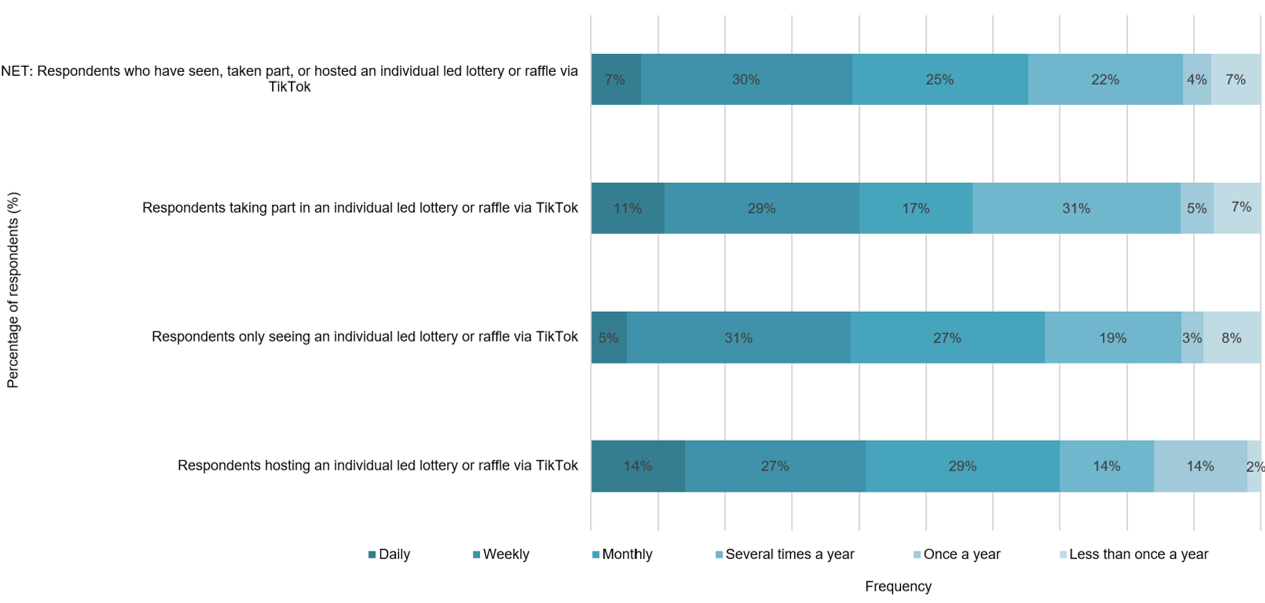
Figure 1: On average, how often do you do take part in, see, or host online individual-led lotteries or raffles via TikTok?
| People | Daily (percentage) | Weekly (percentage) | Monthly (percentage) | NET: Frequently (Daily, Weekly, Monthly) (percentage) | Several times a year (percentage) | Once a year (percentage) | Less than once a year (percentage) |
|---|---|---|---|---|---|---|---|
| People taking part in, seeing, or hosting an individual led lottery or raffle via TikTok | 7% | 30% | 25% | 62% | 22% | 4% | 7% |
| People taking part in an individual led lottery or raffle via TikTok | 11% | 29% | 17% | 57% | 31% | 5% | 7% |
| People only seeing an individual led lottery or raffle via TikTok | 5% | 31% | 27% | 63% | 19% | 3% | 8% |
| People hosting an individual led lottery or raffle via TikTok | 14% | 27% | 29% | 70% | 14% | 14% | 2% |
*Caution: low base size
Figure 1 highlights the frequency that quantitative survey participants report taking part in, seeing, or hosting online individual-led lotteries and raffles, specifically via TikTok. It shows that those who take part tend to do so frequently, with over half of those who participated saying they do so at least monthly on average. This is consistent with the pattern identified in the digital intelligence research, where repeated exposure on algorithm-led platforms may reinforce participation over time.
5 The 'Other websites' category was an open-text option in the survey where participants provided their own answers, which included names such as Raffall, BOTB, and Jammy. It is important to note that some of those listed are free draw operators that fall outside the remit of gambling regulation. The fact that participants listed them here highlights the ongoing consumer ambiguity in distinguishing between lawful free draws and illegal lotteries. This consumer confusion aligns with findings from previous phases of the Commission's Illegal Gambling research.
Routes into online individual-led lotteries and raffles
Social media platforms enable passive discovery of online individual-led lotteries and raffles
Digital intelligence highlights how seamlessly these draws blend into users' everyday feeds. Because they are often framed as 'competitions' or 'giveaways' rather than gambling, they can easily bypass a viewer’s caution, especially if they look legitimate. A user scrolling their TikTok 'For You' page might passively land on a highly animated LIVE stream offering a '£2 lucky dip' for a car. This low barrier to entry, combined with the exciting, fast-paced nature of the stream, makes it incredibly easy for viewers to make an impulse decision to join in without actively seeking out a gambling product. Social media platforms are powerful tools for widening access to these draws.
According to both the quantitative and digital intelligence phases, platform features play an important role in surfacing content about online individual-led lotteries and raffles. This is particularly evident on TikTok, where TikTok LIVE and the For You Page are the most common ways people discover this content, as seen in Table 3. The platform’s algorithm helps such content spread quickly, increasing visibility and reach.
Table 3: How do you typically find out about online individual-led lotteries or raffles via TikTok?
| Channels for discovering online individual-led lotteries or raffles via TikTok | People discovering raffles and/or lotteries using that channel (percentage) |
|---|---|
| TikTok LIVE | 49% |
| TikTok ‘For You Page’ | 41% |
| Influencer posts on other social platforms | 31% |
| TikTok hashtags | 31% |
| Chat groups in instant messaging apps | 24% |
| Word-of-mouth | 23% |
| Paid ads on other social media platforms | 21% |
For most players, the route into these draws is accidental rather than deliberate
Both the qualitative and quantitative phases found that most players do not actively seek out online individual-led lotteries and raffles. They usually come across them while scrolling, through reposts, or because a friend has shared them. The qualitative interviews also suggest some differences between TikTok and Facebook routes into participation.
On TikTok, these draws are typically encountered incidentally, driven by the algorithm rather than personal recommendation. Participants were drawn to them because they were seen as fun and worth watching, particularly due to the live, high-energy format.
As one participant put it:
"I love the fact they’re so animated…They’re so engaging, the commentary, the sort of excitement. They usually have an assistant spinning the tombola. It's so convenient, you don't need to go anywhere, it's… it's right on your phone."
– Participant taking part in an illegal lottery, TikTok, Male, 33 years old
On Facebook, online individual-led lotteries and raffles were more likely to appear through friends, local businesses and community members. This social proximity created a sense of borrowed trust, making the draw feel more familiar and credible. In some cases, it also created a feel-good factor, where people felt they were supporting a local business or contributing to a charitable cause.
As one participant explained:
"…It [an individual-led lottery or raffle she entered] was a local baker. She makes cakes and things, and you could win a cake decorated of your choice. And my daughter had a big birthday coming up, so I entered it…that's the sort of thing that I will take part in."
– Participant taking part in an illegal lottery, Facebook, Female, 66 years old
A mix of prize appeal, ease of entry and visible winners encourages participation
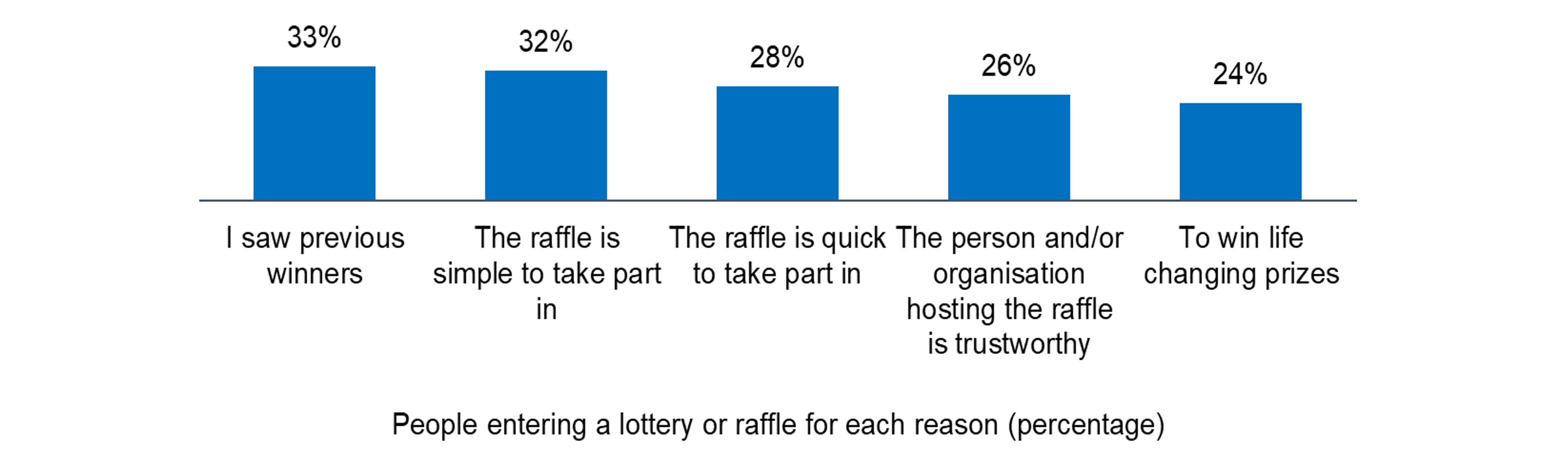
Figure 2: Which of the following statements, if any, best describes why you choose to enter an online individual-led lottery or raffle
| Why people enter online individual-led lotteries or raffles via TikTok | People entering a lottery or raffle for each reason(percentage) |
|---|---|
| I saw previous winners | 33% |
| The raffle is simple to take part in | 32% |
| The raffle is quick to take part in | 28% |
| The person and/or organisation hosting the raffle is trustworthy | 26% |
| To win life changing prizes | 24% |
As shown in Figure 2, seeing previous winners was the most commonly cited reason for entering an online individual-led lottery or raffle on TikTok, mentioned by 33 percent of participants. For many, visible winners made the draw feel more credible and transparent, helping to reassure them that prizes were genuine and that real people did receive them.
As one participant put it:
"They [raffle hosts] do post that somebody's won, and sometimes they'll post the names, and people post underneath, saying, “Great, I'm so glad I won”, so you think, they have won, and it is legitimate."
– Participant taking part in an illegal lottery, Facebook, Female, 54 years old
Ease also played an important role. Around a third said the raffle was simple to take part in (32 percent), while 28 percent said it was quick to enter. Participants described TikTok as making entry feel straightforward and convenient, with draws often integrated into the content they were already watching.
They also mentioned:
"I just prefer TikTok mainly, because it's just easy to use, there's a lot more variety and content. It just feels more fun and natural."
– Participant taking part in an illegal lottery, TikTok, Male, 33 years old
Trust in the host was another factor, with 26 percent saying they entered because the person or organisation hosting the raffle felt trustworthy. In practice, this trust was often built gradually through repeated exposure to the host’s content, regular posting and visible interaction with other players.
In the survey, 24 percent of those who had taken part in an online individual-led lottery or raffle via TikTok said they entered to win life-changing prizes (Figure 2), indicating that prize value is a meaningful driver for a sizeable minority.
Qualitative interviews suggest prizes ranged from small, community-based rewards (for example, a local baker offering a decorated cake on Facebook) to higher-value, aspirational prizes more commonly associated with TikTok raffles (for example, cars, technology and large cash sums).
One participant spoke of the prizes offered and their appeal:
"Some [hosts put up prizes of] £5,000, £3,000, 10,000 pounds… Some put it up with a product that, if you are a winner, you win a motorcycle. If you are a winner, you win a car or you win something good."
– Participant taking part in an illegal lottery, TikTok, Male, 32 years old
Pre-draw content and live engagement help sustain interest
The content leading up to the draw does more than simply provide information about the prize and draw date. The digital intelligence phase showed that prize-led posts, teaser content, countdowns and ‘last chance to enter’ messaging are used to build urgency, anticipation and fear of missing out. Hosts also tend to post repeatedly in the run-up to increase reach and keep the draw front of mind.
Participants in the qualitative phase often emphasised that these draws felt less like formal gambling and more like live entertainment. Real-time commentary, hype and direct interaction created a sense of momentum and community that was distinct from more traditional gambling products. For some, this social energy made participation feel more engaging and immediate.
As one participant explained:
"When they do the lottery on Saturday, it's so boring, it's just literally spinning the balls… there's not much fun and excitement or build-up or anticipation. The thing with the live influencers, they really hype it up, you could win this… they're talking to you."
– Participant taking part in an illegal lottery, TikTok, Male, 33 years old
Trust and legitimacy
Prize-led, live and winner-led content helps build trust
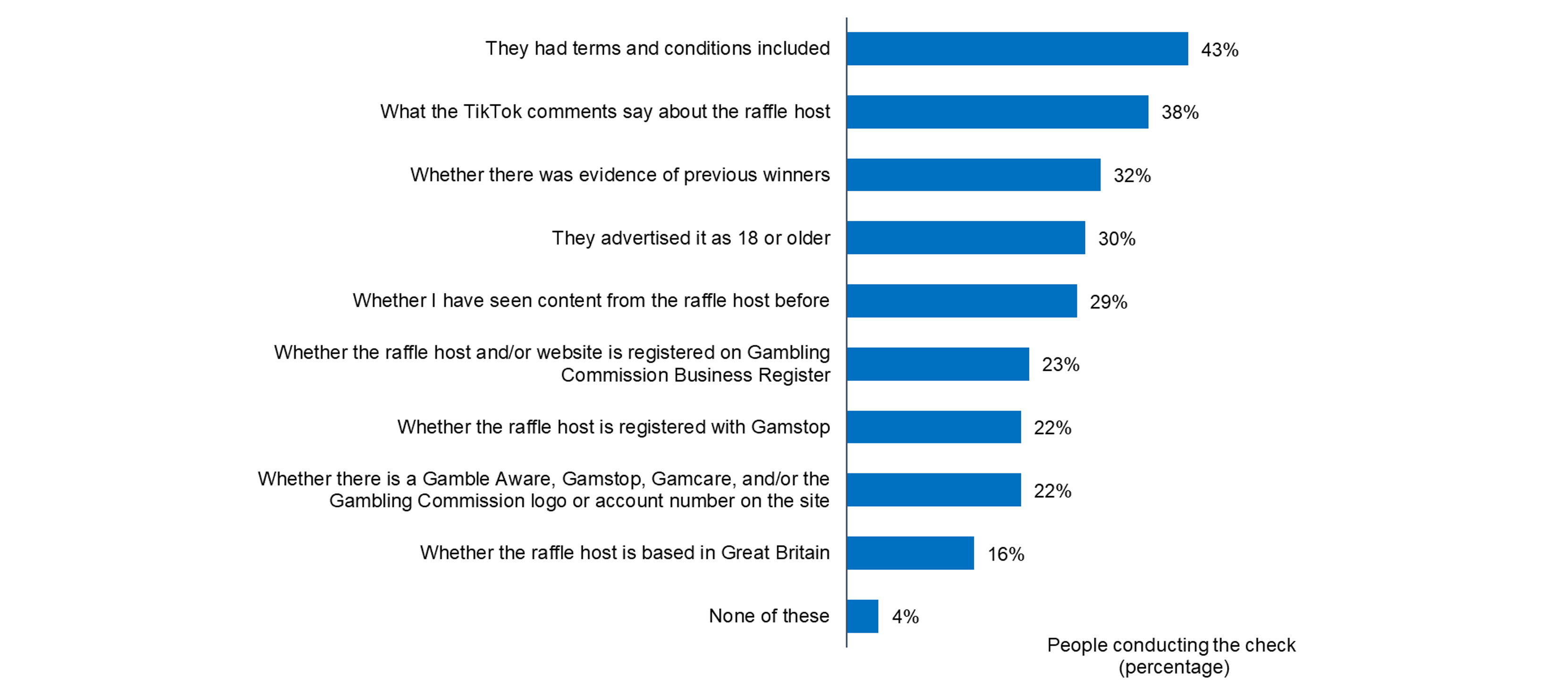
Evidence from the qualitative and quantitative phases suggests that most players are not carrying out formal due diligence before entering a draw. Figure 3 shows the checks that quantitative survey participants report doing before entering an individual-led lottery or raffle.
Figure 3: When choosing which individual-led lotteries or raffles to take part in via TikTok, what checks, if any, do you do on the provider?
| Checks done on an online individual-led lottery or raffle provider | People conducting the check (percentage) |
|---|---|
| They had terms and conditions included | 43% |
| What the TikTok comments say about the raffle host | 38% |
| Whether there was evidence of previous winners | 32% |
| They advertised it as 18 or older | 30% |
| Whether I have seen content from the raffle host before | 29% |
| Whether the raffle host and/or website is registered on Gambling Commission Business Register | 23% |
| Whether the raffle host is registered with Gamstop | 22% |
| Whether there is a Gamble Aware, Gamstop, Gamcare, and/or the Gambling Commission logo or account number on the site | 22% |
| Whether the raffle host is based in Great Britain | 16% |
| None of these | 4% |
As seen in Figure 3, instead of formal checks and visible signs of regulation, participants more commonly cited relying on simple, visible cues and more practical signals that a draw feels legitimate enough to enter. This appears to reflect both limited awareness and convenience. Qualitative participants were often unclear about what formal checks were possible, or whether they should be checking legitimacy at all. In that context, they also tended to rely on signals that were easy to see within the platform itself, such as long-running raffles, platform verification, polished branding and visible players and winners in comments or live content.
Participants within the interviews described these visible interactions and engagement between players and hosts as reinforcing trust and making the draw feel genuine.
"A lot of the companies, they'll do a live draw for the raffle, so you can actually, see it live… It's really good, because then you know it's genuine. And, it just makes it a little bit more exciting, rather than just saying, oh, this was the winner."
– Participant taking part in an illegal lottery, Facebook, Female, 54 years old
Seeing winners announced, prizes handed over, and players engaging publicly gave the impression that other people were already taking part and benefiting. This helped make the draw feel legitimate enough to enter. In some cases, winners also posted about receiving their prize, further reinforcing the sense that the draw was genuine.
Hosts also encourage winners to post about their win, helping to demonstrate to others that the draw is genuine and increasing participation.
As one participant explained:
"I took a screenshot of the payments. After taking the screenshots, I sent it to their Instagram handle. I backed it up with some messages, and they put it up on their post."
– Participant taking part in an illegal lottery, TikTok, Male, 32 years old
Hosts’ personality, values and familiarity also shape participation
Evidence from the qualitative phase suggests that players are more likely to take part when they feel a sense of familiarity or affinity with the host. This can reflect the host’s personality, perceived values, or the sense that they are already known through repeated exposure on social media. In some cases, this created a halo effect, where positive feelings about the host appeared to extend to the activity itself.
Participants often said that engaging and entertaining hosts made raffles seem more appealing. Others were drawn to hosts whose proceeds were said to be going to charity, which helped create a sense of community around the host and their cause.
Familiarity was also important. This included hosts that players knew directly, either through a personal relationship or because the host was an influencer they had followed for some time. Familiarity could also be indirect, such as when hosts had been recommended, reposted or vouched for by a friend or another community member.
As one participant explained:
"The person who organised it is one of the admins in the group. He’s been a member of that group for several years now. He has an online presence, and he's been quite active, so we could rely on him. It's not someone who's just signed up to Facebook."
– Participant taking part in an illegal lottery, Facebook, Male, 41 years old
The off-platform journey
Payment usually happens off-platform, where familiar methods create a false sense of reassurance
Evidence from the qualitative and digital phases suggests that, once players decide a draw feels legitimate enough to enter, they are usually sent off-platform to complete payment. This often happens through external websites, payment links, PayPal flows or bank transfers.
For many, this did not feel unusual. Instead, it often mirrored everyday online payment journeys and could therefore feel routine, convenient and, in some cases, more official. Where the destination looked polished and the process was quick and familiar, players often paid limited attention to where they were being sent, provided the draw had already passed their initial trust threshold.
As one participant explained:
"It was as if you were buying something from Amazon, you know, just like a normal purchase…"
– Participant taking part in an illegal lottery, Facebook, Female, 41 years old
Another participant mentioned:
"Sometimes they have a raffle website and I do not pay much attention to it, if I’m honest. I just go on the website and buy the ticket."
– Participant taking part in an illegal lottery, TikTok, Male, 33 years old
In the survey, PayPal was the most commonly used payment method, followed by debit card payments and TikTok gifts. Bank transfers, TikTok coins and credit cards were also mentioned by a sizeable minority. Cryptocurrency was used less often overall but was more commonly reported among those with PGSI 8 to 27.
While TikTok Gifts and cryptocurrency were not mentioned spontaneously by participants during the qualitative interviews, incidence rates from the survey suggest these are emerging payment methods to watch, as they may be less regulated. The rates for payment methods that online individual-led lottery and raffle participants report using can be seen in Table 4.
Table 4: Which form(s) of payment do you use when taking part in, see being accepted on, and/or accept when hosting online individual-led lotteries or raffles via TikTok?
| Forms of payment used or seeing being accepted for online individual-led lotteries and raffles | People using the payment method (percentage) |
|---|---|
| PayPal | 49% |
| Debit card (including Apple Pay and/or Google Pay) | 35% |
| TikTok gifts | 30% |
| Bank transfer | 29% |
| TikTok coins | 27% |
| Credit card | 26% |
| Cryptocurrency* | 16% |
| Using in-game items, including skins | 9% |
| Other | 5% |
Base: All who have engaged in a TikTok raffle (395)
A low-friction journey may feel convenient, but can leave vulnerable participants more exposed
Evidence from the qualitative and digital phases suggests that the absence of checks commonly associated with licensed gambling, such as identity verification or Anti-Money Laundering (AML) checks, can make it faster and easier to move from discovery to payment. For many participants, this did not trigger concern. Once a draw felt legitimate enough, the smoother journey was often interpreted simply as more convenient.
Familiar payment methods could reinforce this further, particularly where participants felt that money might be recoverable if something went wrong.
This creates an important tension. The journey can feel safer because it is smoother, when in practice that smoothness may reflect the absence of protections players would normally encounter on licensed sites.
For some, paying through PayPal or a bank card appeared to create reassurance because these methods were associated with chargebacks, payment disputes or the ability to contact a bank or payment provider if a problem arose.
Digital intelligence also surfaced examples of potential risk among people already vulnerable to gambling-related harm, particularly through the off-platform journey. This unregulated ecosystem can leave players vulnerable to financial loss and scams, while also making it harder to know what recourse is available if something goes wrong.
This suggests that while a smooth experience may feel convenient or even reassuring to many participants, it can be actively harmful for those already vulnerable to gambling-related harm by removing key pause points and protections. In practice, the low-friction, off-platform journey can encourage impulsive participation and make recourse harder when problems arise.
Awareness of legality
Understanding of licensing requirements and regulated activity is limited
Most players showed only a limited understanding of when an online individual-led lottery or raffle may require a licence in Great Britain. In the qualitative phase, no participant demonstrated a clear understanding of the point at which activity requiring payment for a chance to win a prize might require a licence.
Participants were also not well equipped to distinguish between legal and illegal activity. Many did not know what a regulated gambling company or website should look like, including the checks and safeguards more typical of licensed gambling environments. Awareness of the Gambling Commission was also generally low. This mirrors findings from other research the Gambling Commission has conducted into the illegal online gambling market. Even where participants had heard of it, its role was more often associated with larger mainstream gambling companies than with smaller-scale activity promoted through social media.
"I’ve never really checked if they [individual-led lotteries or raffle hosts] had a licence or not online. I don’t know if I’ve heard of the Gambling Commission itself…If it’s pennies though to enter I don’t think I’d check."
– Participant taking part in an illegal online lottery, Facebook, Female, 28 years old
As previously seen in Figure 3, this pattern was also reflected in the quantitative findings. Formal checks relating to licensing or registration were among the least commonly performed checks on TikTok raffle providers by participants. Only around 1 in 5 players said they checked whether a host or website was registered on the Gambling Commission’s business register, registered with GAMSTOP, or displayed gambling-related logos or account information.
More broadly, the findings suggest that players do not approach these draws with any clear or consistent set of checks. No single check was used by a majority of players. Instead, participants appeared to make a more informal judgement about whether a draw looked safe enough to enter, relying on cues such as familiarity with the host, visible winners, repeat exposure and comments from others.
As one participant explained:
"They’ve got the ticks on their own profile… and there's hundreds of thousands of people entering and commenting."
– Participant taking part in an illegal online lottery, Facebook, Female, 41 years old
Regarding visible winners, another participant mentioned:
"When they do the raffle and somebody wins, they actually talk about those people, and you can see on the chat, they're talking about it. And sometimes they even invite them as part of the chat, and they get so excited that they've won."
– Participant taking part in an illegal online lottery, TikTok, Male, 33 years old
For some, the live nature of the draw also adds to the sense of legitimacy, with participants suggesting that drawing the winner live, sometimes using a random number generator, made the outcome feel harder to manipulate.
Ambiguous language lowers scrutiny
The language used to describe these activities appears to play an important role in lowering scrutiny and shaping how players frame them. Participants described hosts using softer or more ambiguous terms such as giveaway, competition or live draw, even when the mechanics of the activity indicate it was an individual-led lottery or raffle. Similar language was also observed in the digital intelligence phase across captions, posts and commentary promoting these activities.
For example, hosts would often describe their activities as “live draws” or refer to them as competitions in video captions or voiceovers, using wording such as: “Good luck to everyone taking part in this exciting competition… win a stunning Volvo XC90 for just 20p.”
Most participants did not consciously question this wording at the point of exposure. Instead, these labels often helped the activity feel more casual, socially acceptable and less obviously gambling-related. It was often only when discussing the mechanics in more detail during an interview that some participants reflected on the mismatch between the label used and the activity itself.
"I don't think they've ever called it a raffle. They've never even called it tombola or anything like that. It's always been competition time, pick a number."
– Participant taking part in an illegal online lottery, Facebook, Female, 66 years old
Concern focuses more on scams than licensing
Where participants did think about risk, this was usually in practical rather than legal terms. Players were generally less concerned with formal registration than with whether they might be scammed, lose money, or share payment details unsafely.
"I think I’m quite a good judge. When it comes to things like raffles, I think they've got to be trustworthy. If a newer, smaller one [individual-led lottery or raffle] came up I'd kind of wait and see. I'd let them do a couple of raffles first, and judge the feedback from other people, and then I'd sort of join in afterwards when I know other people haven't lost any money."
– Participant taking part in an illegal online lottery, Facebook, Female, 54 years old
This suggests that for many players, the key question is not whether an activity is licensed or unlawful, but whether it appears genuine enough to trust. The issue is therefore not simply low awareness of legality, but that legal status carries less weight in decision-making than visible signs that a draw looks real.
Host awareness of legality is mixed
Evidence from the qualitative and digital phases suggests that host awareness of legality is mixed. Some smaller-scale hosts appeared to have only a limited understanding of the rules and described their activity in ways that suggested confusion rather than deliberate evasion. For example, one host believed that the activity would be lawful provided the amount of money involved stayed below a certain threshold.
"I know that there is a certain amount threshold, above which you have to get a licence from local authorities, but my understanding, I might be wrong though, is if you're hosting one and the prize money doesn't exceed that amount of the threshold, then I don't think you need a licence."
– Participant taking part in an illegal online lottery, Male, 41 years old
At the same time, there were signs that some hosts may be more aware of the legal risks and may take steps to reduce visibility or scrutiny. Participants described the use of ambiguous language, as well as payment practices such as asking players to send PayPal payments as family and friends, even where the payment was clearly for participation in an online individual-led lottery or raffle. Evidence from the digital phase supports this, with creators often blurring the lines between lawful and unlawful activity through misleading language and off-platform handoffs.
Taken together, this suggests a mixed picture. Some activity may be driven by poor understanding or misinformation, while some hosts appear to use language and payment practices in ways that help obscure what they are doing.
Low stakes reduce the likelihood of reporting
Even when players became aware that a lottery or raffle activity may be illegal, they often have little incentive to report it. Losing on its own was not usually seen as a sign that something improper had happened; many participants assumed that the draw itself was genuine and that their number simply had not been selected.
Low ticket prices further reduce concern. When entry costs are only a few pounds, most feel it is not worth pursuing a complaint or escalating the issue. As a result, these activities were rarely seen as serious or harmful enough to report, even when participants had some awareness of the legal issues. For the small minority who had reported behaviour, evidence from the digital intelligence phase suggested that a lack of visible consequences or enforcement could also feel frustrating.
For the small minority who do recognise these draws as illegal lotteries, digital intelligence suggests that a lack of visible platform enforcement causes deep frustration and suppresses further reporting. When users feel platform reporting is futile, they sometimes attempt to escalate the issue externally.
As one online user expressed on a Reddit forum:
"We report it EVERY LIVE & TikTok doesn't care about it. 😡"
Another user noted the need to go beyond the social media platform entirely:
"It's not only against TikTok rules but also against UK law... It's illegal to profit from a raffle in the UK... So I have reported them to Trading Standards and the Gambling Commission. Hope they get what they deserve."
However, the wider community often dismisses these concerns due to the low stakes involved, leading on some occasions to a degree of victim-blaming. As one commenter put it:
"Don't see why everyone is crying about this raffle. Literally £2 lucky dip... it is ur fault if you put more money into it."
This dynamic protects the ecosystem: if users believe nothing happens when they report, and peers dismiss their concerns, operators face far less friction.
This report continues in the Conclusions section.
Conclusions
Broadly, the research suggests that participation in online individual-led lotteries and raffles promoted through social media remains relatively low at a population level, but that these activities can feel familiar, credible and low risk to those who encounter them.
Across the digital, quantitative and qualitative phases, the findings point to an ecosystem in which trust is often built socially rather than formally, and where engaging content and low-cost entry can reduce scrutiny of what may, in some cases, be illegal activity.
This project sits within the Gambling Commission’s wider Evidence Roadmaps, particularly the themes of Illegal gambling and crime, and Early gambling experiences and gateway products. It strengthens the Commission’s evidence base on how illegal online activity emerges and operates on social media, how individuals may first encounter these activities and potential risks this may pose to the consumer. The insights are intended to support the Commission and the wider research community in addressing priority evidence gaps identified in the Roadmaps.
How do these online individual-led lotteries and raffles become appealing and credible?
The evidence suggests that these activities are often encountered passively rather than actively sought out, with participants coming across them while scrolling on social media, through reposts, live content, community groups or recommendations from friends. Prize teasers, countdowns, winner announcements and live draws help make the activity feel visible, active and established.
Participants appear more likely to rely on social proof and familiarity than on formal checks relating to licensing or regulation. Low ticket prices and the social presentation of the activity also make participation easy to justify.
What does this mean for consumer risk and protection?
The research suggests that the point of greatest risk often sits beyond the original social media post. While platforms such as TikTok and Facebook help build visibility and trust, payment and entry often take place elsewhere, through external websites, payment links or peer-to-peer payment methods. These journeys may still feel routine to players while offering weaker protections than they realise.
Awareness of legality also appears to be low among both players and, in some cases, hosts. Participants were generally more concerned with whether they might be scammed than with whether an activity was licensed or lawful. Even where concerns were raised, low ticket prices and the perception that losses were minor often meant that the activity was seen as too low stakes to report.
What have we learnt?
Our research indicates that consumer participation is dictated less by an activity's formal legal status and more by its perceived legitimacy. Consumers are primarily concerned with avoiding scams, and they use tangible cues (such as a professional appearance, ease of use, or recommendations from others) to assess this risk.
At the same time, hosts can actively shape these cues, for example through selective use of tags and language (such as describing raffles as “competitions” or “giveaways”), and in other ways that make activity appear more legitimate than it may be in practice. Taken together, these social and familiarity cues can build a sense of trust that effectively replaces formal safeguards and ultimately determines participation.
The mixed-methods design has been important in building this picture. The digital intelligence phase mapped how this activity appears and circulates online. The quantitative phase provided context on exposure and participation. The qualitative phase added depth on how consumers experience these journeys in practice, including how trust is formed, how payment takes place and why legality is not front of mind.
Next steps
Areas for future research
Younger adults and gateway products
The quantitative phase suggests that 18 to 24-year-olds are more likely than older age groups to have taken part in or seen online individual-led lotteries and raffles on TikTok. Future research could explore in more depth how these activities fit within broader gambling and digital entertainment journeys for younger adults, and whether they act as a gateway into other forms of gambling.
Given the recruitment challenges we experienced with this age group in the qualitative phase, it may be helpful to test alternative approaches for engaging younger participants (for example different recruitment channels, incentives or formats).
This aligns particularly with the Gambling Commission’s evidence themes of Early gambling experiences and gateway products, as well as wider questions around the range and variability of gambling experiences.
Deeper host perspectives and illegal market dynamics
Only 1 qualitative participant in this study was primarily a host. Further qualitative or mixed-methods research focusing on hosts could deepen understanding of motivations, awareness of legality, business models and responses to enforcement, contributing to the illegal gambling and crime roadmap.
Areas for consideration
Based on the evidence from all 3 phases, 5 key considerations emerge for the Gambling Commission and partners.
1. Recognise that legal status is not a key decision factor for participation
Players are more focused on whether the draw feels genuine and whether the prize can really be won than on whether the host is licensed.
As a result, greater awareness of legal status alone is unlikely to create a meaningful barrier to entry or substantially reduce participation.
There may therefore be more value in focusing on tackling this issue at its source, including how these activities are run and promoted, rather than relying primarily on raising awareness of illegal practice among consumers.
2. Focus intervention at the off-platform point of payment
The greatest consumer risk often sits beyond the social post itself, where sign-up, payment and terms are less visible and protections feel weaker.
Interventions are therefore likely to be most effective if they also target the off-platform journey, including external websites, payment links and peer-to-peer payment methods used to facilitate these draws.
3. Regulation should not rely on consumer reporting alone
Low ticket prices, casual framing and familiar payment methods mean players are unlikely to see problems as serious enough to report, even where activity is illegal.
Reporting mechanisms remain important, but cannot be the primary line of defence. Proactive monitoring, intelligence-sharing and platform-level interventions will be needed alongside consumer reports.
4. Address both deliberate evasion and genuine confusion among hosts
Some smaller-scale hosts may not fully understand the rules, while others appear to use language and payment practices to obscure what they are doing.
The response may therefore need both clearer guidance for individuals and small businesses on what is and is not permitted, and stronger, visible enforcement where activity appears deliberate or repeated.
5. Embed these findings within the Evidence Roadmaps and future research
The study supports the Gambling Commission’s Evidence Roadmaps, particularly the themes on illegal gambling and crime.
These insights suggest that future research should prioritise younger adults, as their higher engagement levels make them a key demographic to understand. Important areas for exploration include their pathways into gambling, the surrounding off-platform ecosystem, and the impact of different enforcement and communication approaches.
Appendices
Appendix A – Digital intelligence list of platforms evidence was sourced from
The digital intelligence phase drew primarily on publicly available content from the following platforms:
TikTok
Public videos, content and comments using raffle‑related search terms and hashtags, while including alternative names associated with such raffles (for example, live draw, live draws, spots left, tickets).
Creator profiles and bios for hosts promoting individual‑led lotteries and raffles.
Links and hand‑offs from TikTok to external websites, payments and other social platforms (for example link‑in‑bio tools, direct Uniform Resource Locators (URLs) in captions or comments)).
Public posts and comment threads in UK‑focused and gambling‑related subreddits where users discussed:
- taking part in social‑media raffles and lotteries
- concerns about scams or illegal lotteries
- experiences of harm linked to social‑media‑based draws.
Appendix B – Quantitative survey
Question 1 - Gambling activities
Asked to all participants.
For the next series of questions, we would like you to think about gambling activities; by gambling we mean both spending money on games of chance where you can win money (in essence, betting) and/or free-to-play games where you do not have to pay to gamble.
When, if ever, have you spent money on the following activities in the last 12 months?
Response options were presented in a random order:
a. Online fruit, slot or virtual gaming
b. Online bingo
c. Online betting on horse or dog races, including virtual races
d, Online betting on football
e. Online raffles (including prize draws)
f. Online betting on other sports, including virtual sports and e-sports
g. Online betting on events (for example, political, entertainment, topical, current affairs, novelty)
h. Online roulette, card and/or dice games, Poker, or non-lottery instant win games
i. Tickets for National Lottery draws online
j. National Lottery online instant win games
k. Tickets for other charity lotteries online
l. Other online instant win games
m. Another form of online gambling activity
For each activity, participants selected one response:
- In the last 7 days
- In the last 4 weeks
- In the last 12 months
- More than 12 months ago
- Have never spent money on this
Participants who selected "Have never spent money on this" for all activities were screened out of the survey.
Question 2 - Problem Gambling Survey Index (PGSI)
Asked to all participants.
And thinking about the last 12 months…
a. Have you bet more than you could really afford to lose?
b. Have you needed to gamble with larger amounts of money to get the same feeling of excitement?
c. When you gambled, did you go back another day to try to win back the money you lost?
d. Have you borrowed money or sold anything to get money to gamble?
e. Have you felt that you might have a problem with gambling?
f. Has gambling caused you any health problems, including stress or anxiety?
g. Have people criticised your betting or told you that you had a gambling problem, regardless of whether or not you thought it was true?
h. Has your gambling caused any financial problems for you or your household?
i. Have you felt guilty about the way you gamble or what happens when you gamble?
For each statement, participants selected one response:
- Almost always
- Most of the time
- Sometimes
- Never
Question 3 - Engagement
Asked to all participants.
Some social media influencers or creators sell tickets for a chance to win a prize.
This can include things like raffles, lotteries, tombolas, “paid giveaways,” or any similar prize‑draw activity run by influencers or social media creators.
(To be clear, we are not referring to activities run by well‑known organisations such as the National Lottery, Omaze, Macmillan, and so on).
Thinking about these individual-led lotteries or raffles, have you ever done any of the following through your account on…
Response options were presented in a random order.
a. TikTok b. Facebook c. Instagram d. Twitch e. Discord f. Telegram g. Reddit h. WhatsApp i. Other raffle and/or lottery websites (please specify) j. Other social media (please specify)
For each platform, participants could select all that applied:
- Taken part in one or more I saw on…
- Saw one or more, but have never taken part I saw on…
- Hosted one or more on…
- I have never seen, nor hosted, one
- Not applicable – I do not have an account on this platform
Certain response options were mutually exclusive and could not be selected together.
Question 4 - Frequency of Engagement
Asked to participants who had seen, taken part in, or hosted an individual-led lottery or raffle via TikTok.
From this point on in the survey, any activities run by influencers or social media creators in which tickets are sold for a chance to win a prize will be referred to as individual-led lotteries or raffles.
Participants who had taken part in a raffle were asked how often they took part. Participants who had only seen raffles were asked how often they saw them. Participants who had hosted raffles were asked how often they hosted them.
On average, how often do you [take part in; seen; host] individual-led lotteries or raffles via TikTok?
- Daily
- Weekly
- Monthly
- Several times per year
- Once per year
- Less than once per year
- Don’t know
Question 5 - Prizes
Asked to participants who had seen, taken part in, or hosted an individual-led lottery or raffle via TikTok.
Dependent on their previous answers, participants were asked what types of prizes had been offered in, seen in, or provided through individual-led lotteries or raffles on TikTok.
What types of prizes have been in [individual-led lotteries or raffles you have taken part in; you seen on offer; do you offer in individual-led lotteries or raffles] via TikTok?
Response options were presented in a random order:
- Cash or cash equivalents
- Electronics
- Cars and/or vans
- Plush toys (for example, Labubu’s, Jellycats)
- Exclusive and/or rare items (please specify what)
- In-game prizes (please specify game)
- Mystery boxes
- Cosmetics
- Clothing and/or shoes
- Jewellery and/or watches and/or accessories
- Event tickets
- Hampers (in essence, holiday themed hampers)
- Other prizes (please specify)
- Can’t remember
Participants could select all that applied.
Question 6 - Discovery of Lotteries & Raffles
Asked to participants who had taken part in an individual-led lottery or raffle via TikTok.
How do you typically find out about individual-led lotteries or raffles via TikTok?
Response options were presented in a random order:
- TikTok ‘For You Page’
- TikTok LIVE
- TikTok hashtags
- Paid ads on other social media platforms
- Influencer posts on other social media platforms
- Chat groups in instant messaging apps (in essence, WhatsApp, Discord, Telegram)
- Online discussion forums
- Word-of-mouth through someone that I personally know
- Other (please specify)
- Can’t remember
Participants could select all that applied.
Question 7 - Location of Lotteries & Raffles
Asked to participants who had seen, taken part in, or hosted an individual-led lottery or raffle via TikTok.
Depending on their previous answers, participants were asked where the draws for individual-led lotteries or raffles via TikTok were held. The question referred to lotteries or raffles that participants had taken part in, seen, or hosted.
Where are the draws for individual-led lotteries or raffles that you [find; have seen; host] via TikTok held?
Response options were presented in a random order:
- Directly on TikTok
- Raffle provider’s own website
- Discord
- Telegram
- WhatsApp groups
- Other (please specify)
- Don’t know
Participants could select all that applied.
Question 8 - Payment Methods
Asked to participants who had seen, taken part in, or hosted an individual-led lottery or raffle via TikTok.
Depending on their previous answers, participants were asked which forms of payment they used when taking part in, saw being accepted for, or accepted when hosting individual-led lotteries or raffles via TikTok.
Which form(s) of payment do you [use when taking part in; see being accepted on; accept when hosting] individual-led lotteries or raffles via TikTok?
Response options were presented in a random order:
- Bank transfer
- Debit card (including Apple Pay and/or Google Pay)
- Credit card
- PayPal
- Cryptocurrency
- Using in-game items (in essence, skins)
- TikTok gifts
- TikTok coins
- Other (please specify)
Participants could select all that applied.
Question 9 - Vigilance
Asked to participants who had taken part in an individual-led lottery or raffle via TikTok.
When choosing which individual-led lotteries or raffles to take part in via TikTok, what checks, if any, do you do on the provider?
Response options were presented in a random order:
- Whether the raffle host is based in Great Britain
- Whether I have seen content from the raffle host before
- What the TikTok comments say about the raffle host
- Whether the raffle host and/or website is registered on Gambling Commission Business Register
- Whether there is a Gamble Aware/Gamstop/Gamcare/the Gambling Commission logo/account number on the site
- Whether the raffle host is registered with Gamstop
- They advertised it as 18 plus
- They had terms and conditions included
- Whether there was evidence of previous winners
- Other (please specify)
- None of these
Participants could select all that applied.
Question 10 - Reasons for Playing
Asked to participants who had taken part in an individual-led lottery or raffle via TikTok.
Which of the following statements, if any, best describes why you choose to enter an individual-led lottery or raffle via TikTok?
Response options were presented in a random order:
- The excitement of potentially winning
- Limited tickets and/or Fear of Missing Out
- The raffle is simple to take part in
- The raffle is quick to take part in
- I saw previous winners
- I have heard about it on other websites
- Tickets are cheap compared to the value of the prize
- To win life changing prizes
- Better odds of winning versus mainstream raffles and/or lotteries
- People that I know are entering the contest
- The person and/or organisation hosting the raffle is trustworthy
- I repeatedly receive advertising about the raffle
- The prizes offered are exclusive items
- To help a specific charity or cause
- It is giving away a prize that I want
- Other (please specify)
Participants could select all that applied.
Question 11 - Close
Asked to all participants.
Thank you for answering those questions. If these questions have raised any topics of concern, you can contact:
Samaritans on 116 123.
GamCare on 0808 8020 133.
The questions you have just answered were on behalf of our client, the Gambling Commission. We are also looking to conduct some follow-up interviews to explore a range of pathways and experiences, as well as gauging knowledge and understanding of TikTok raffles. This would involve taking part in a 1-hour online interview in Summer 2026, where we would look to explore your perceptions and experience of raffles further. There may also be a ‘homework’ task that we would ask you to complete before the interview which would take between 15-30 minutes of your time.
Please note, your details will only be passed on if you agree and only for the purposes of this study. All details will be stored and transferred securely and will be deleted once the study is over and note your details will NOT be passed on to the Gambling Commission.
If you agree to take part and are selected to do the 60-minute online interview you would be provided with a voucher for your time and as a thank you for taking part of £50 (for the interview only) or of £65 (for the interview + completion of the homework). You will need to provide your contact details to the researchers who will then send you the voucher.
The client would also like to see your answers to these question, but they will not be directly attributable to you.
If you agree to take part, we (Yonder Consulting) will collect your name, email address and phone number. We would then get in touch with you to further assess your eligibility and provide further details.
Would you be interested in taking part?
- Yes
- No THANKS AND CLOSE
Question 12 - Details
Asked to participants who expressed interest in taking part in further research.
Do you give permission to collect your name, email address, phone number and responses to this survey to contact you regarding this additional research, should you be eligible?
- Yes
- No CLOSE
Question 13 - Give details
Asked to participants who gave consent to be contacted.
If you are no longer interested in taking part in this further research, please close your browser without sharing your details.
Appendix C – Quantitative sample
| Gender | Percentage |
|---|---|
| Male | 48% |
| Female | 51% |
| Age | Percentage |
| 16 to 17 | 2% |
| 18 to 24 | 11% |
| 25 to 34 | 16% |
| 35 to 44 | 16% |
| 45 to 54 | 16% |
| 55 to 64 | 16% |
| 65 and over | 23% |
| Segment | Percentage |
| AB | 25% |
| C1 | 30% |
| C2 | 21% |
| DE | 24% |
| Region | Percentage |
| Scotland | 8% |
| North East | 4% |
| North West | 11% |
| Yorkshire and the Humber | 8% |
| West Midlands | 9% |
| East Midlands | 7% |
| Wales | 5% |
| East of England | 9% |
| London | 13% |
| South East | 14% |
| South West | 9% |
| Northern Ireland | 3% |
Appendix D – Depth Interview Discussion Guide
Interview structure
Introduction and warm-up (5 mins).
General gambling habits and context (5 mins).
Individual-led lotteries and raffles: discovery and participation (15-20 mins).
Perceptions of legality, fairness and risk (10 mins).
Reflections, thank and close (5 mins).
Research and interview objectives:
Following quantitative research and social listening, deep-dive further into experiences and perceptions of those participating in or hosting individual-led lotteries and raffles (TikTok, Facebook, other platforms). In particular, focusing on:
- motivations for taking part and the experience: decision points, positive aspects and points of tension or friction
- routes into participation: how content is encountered, whether discovery is accidental or intentional, and routes in which are most influential
- how users move between TikTok and other platforms for participation and extent to which users are consciously aware of this
- legality of these activities: whether raffles are recognised as gambling, how framing of content shapes perceptions, the role of regulation and expectations around fairness, refunds and complaints.
Discussion Flow
1. Introduction and warm-up (5 minutes)
Moderator to introduce themselves and Yonder as an independent research organisation.
Explain that the interview is about individual‑led lotteries and raffles promoted online (including on TikTok and other social platforms), and that Yonder is conducting the research on behalf of the Gambling Commission.
Clarify that the discussion will last up to 45 minutes, is confidential, and there are no right or wrong answers. Participation is voluntary and participants can skip questions, take a break or stop at any time.
State that the session will be audio‑/video‑recorded for research purposes only, stored securely for up to 6 months and accessed only by authorised researchers and the client. Obtain explicit consent to record.
Confirm that any personal data will be handled in line with GDPR and MRS guidelines, and that anonymised quotations may be used in reporting.
Note that the interview may cover gambling, which can be a sensitive topic, and that the moderator can signpost to relevant support services if needed.
2. General gambling habits and context (5 minutes)
To get started, I’d like to understand a little more about you. Let’s go over some of the bits which were covered in the pre-task:
- can you tell me a bit about yourself – your name, living situation, what you do for a living, what you like to do in your spare time?
- how would you describe your general relationship with gambling?
- what types of gambling do you like to do? This could include things like sports betting, horse racing, casino games like slots, bingo, scratch cards, playing the national lottery and/or other charity lotteries, and so on.
- how often do you do it?
- what do you enjoy most about it and why?
3. Individual-led lotteries and raffles: discovery and participation (15-20 minutes)
Now I’d like to focus on the main topic for today: individual-led lotteries and raffles. Just to reiterate, by “individual-led lotteries and raffles”, we mean: paid-entry, chance-based draws promoted by social media individuals or influencers, where payment is required to participate. These activities may be described as raffles, lotteries, tombolas, competitions, or “paid giveaways”.
We are not referring to: the National Lottery or charity-run lotteries (society lotteries), or free giveaways and prize draws where there is a free entry route available (even if there is also a paid route), such as Omaze.
Moderator note: People may use “raffle” as a catch-all. Treat labels as TikTok vernacular and probe mechanics (payment, chance, prize, free entry route clarity)
Moderator note: Be clear we are not referring to large, well-known organisations like the National Lottery or Omaze.
You mentioned in your pre-task that you’d taken part in/hosted an individual-led lottery or rafffle:
- how familiar are you with these?
- how much do you know about them?
Ask for those who have taken part:
- how did you first learn about these types of lotteries and/or raffles?
- what drew you to them in the first place? (Probe on whether sought out intentionally or accidentally.)
- how do you typically find out about these lotteries and/or raffles now?
- what makes you decide to take part in a particular draw? (Probe on role of: prize available, chance to win, platform used, person and/or account running the lottery and/or raffle)
- how often do you take part in these types of lotteries /raffles?
- what sites or social media platforms do you use for this? (Probe on whether they use multiple platforms or sites and why; make sure to probe on TikTok specifically)
- do you have a preferred platform? Why?
- do you ever move between different sites or platforms for these draws? Why? (Probe on whether this differs depending on the type of lottery or raffle, stage of play (for example, registering, payment, finding out results, claiming prizes), or something else?)
Tell me about the last social media lottery and/or raffle you took part in. Could you walk me through it step-by-step, from how you first saw it to finding out the result?
Moderator note: if TikTok not most recent experience cited, make sure to probe on last time they did this through TikTok as well.
- how did you first hear about it?
- what made you want to take part?
- when and where did it take place?
- how did you enter?
- how did you pay?
- how did you feel during the process?
- what makes for a positive lottery and/or raffle experience?
- have you ever had a negative experience when taking part? What happened? (Probe on issues with payment, fairness, receiving the prize, communication from the host)
- do you consider these lotteries and/or raffles to be a form of gambling? Why?
Ask for those who have hosted:
- you mentioned you’ve hosted lotteries and/or raffles before. What made you decide to do that?
- how often do you host them?
- what platforms do you use to host them, and why? (Moderator to probe on TikTok specifically)
- what kinds of prizes do you typically offer?
- how do you go about promoting the draw and attracting people to it? What seems to work best?
- how do you handle payments from participants?
- from your perspective, what do you think is the main appeal for the people who take part?
- what has your experience of facilitating these lotteries and/or raffles been like?
- what parts are easy?
- what parts are difficult or create friction? (for example, taking payments, drawing a winner, communicating with participants, arranging the prize)
Tell me about the last time you hosted a lottery and/or raffle online:
Moderator note: if TikTok not most recent example cited, make sure to probe on last time they did this through TikTok as well.
- what made you decide to host or run this lottery and/or raffle?
- where and when did you host it?
- how did people enter the lottery and/or raffle?
- how many people took part?
- what kind of prize did you offer?
- overall, was this a positive or negative experience for you, or somewhere in between? Why?
- do you consider these lotteries and/or raffles to be a form of gambling? Why?
4. Perceptions of legality, fairness and risk (10 minutes)
Ask only for those who have taken part:
- when you see these lotteries and/or raffles online, do you ever think about whether they are legal or legitimate?
- what, if anything, makes a lottery and/or raffle look official or trustworthy to you? (Probe on whether they do any checks to ensure legitimacy)
- is there anything that would put you off taking part? Or which would make you think it was not legitimate?
- how do you expect a winner to be chosen with these lotteries and/or raffles? What feels fair? - hWhat would you do if you had an issue for example, if you felt a draw was unfair or you didn’t receive a prize you won? (Probe on whether they would query or complain and who to.)
Ask for those who have taken part and for those who have hosted:
- before this research, were you aware that individual-led lotteries and/or raffles where people pay to enter, require a special licence from the local authority or the Gambling Commission?
- moderator to further explain if participant struggles to understand: a special licence is not required for individual-led lotteries and/or raffles which are free to enter.
- moderator note: If required, reassure the participant that we are interested in their honest opinion for research purposes only, there will be no negative consequence and/or action taken.
- how do you feel knowing this? (Probe on whether this changes perceptions.)
- and were you aware of the Gambling Commission and its role before today?
If not familiar, Moderator to explain: The Gambling Commission is an organisation which seeks to make gambling fairer and safer. It does so by licensing and regulating in the public interest and providing advice and guidance. It wants a fair and safe gambling market where all consumers and the interests of the wider public are protected.
- how do you feel knowing this?
- does this affect whether you would participate in (or host them) prize draws in the future?
5. Reflections, thank and close (5 minutes)
Do you have any final thoughts you’d like to share on participating in or hosting online prize draws?
Is there anything else you’d like to share that we haven’t covered today?
Thank participant for their tie and contributions, confirm incentive payment and close.
Appendix E – Qualitative sample breakdown of 10 participants
| ID | Age | Gender | PGSI status* | Role | Main platforms used |
|---|---|---|---|---|---|
| H1 | 41 | Male | Non‑problem gambler | Host and Player | TikTok, Facebook |
| P1 | 33 | Male | Moderate‑risk gambler | Player | TikTok, Facebook, Instagram, Reddit |
| P2 | 28 | Male | Problem gambler | Player | TikTok, Facebook, other social media |
| P3 | 41 | Male | Non‑problem gambler | Player | TikTok, Instagram |
| P4 | 32 | Male | Problem gambler | Player | TikTok, Facebook |
| P5 | 28 | Female | Non‑problem gambler | Player | TikTok, Facebook |
| P6 | 41 | Female | Non‑problem gambler | Player | Facebook, Instagram |
| P7 | 54 | Female | Non‑problem gambler | Player | |
| P8 | 42 | Female | Non‑problem gambler | Player | |
| P9 | 66 | Female | Non‑problem gambler | Player |
*PGSI band based on self‑reported Problem Gambling Severity Index score: 0 = non‑gambler and/or no reported gambling in past 12 months; 1–2 = low‑risk; 3–7 = moderate‑risk; 8+ = problem gambling.