
Report
Initial findings from new data on consumer trust – GSGB
Initial findings from new data on consumer trust – GSGB
Composite Trust Score
The overall composite trust score for all those who gambled in the past 12 months is 47.9. This appears to be driven by higher scores for statements relating to regulatory accountability and the understandability of odds and offers, and lower scores for fairness of games and machines and the protection of young and vulnerable people. Across the sample scores varied by demographic factors, the types of activities people participate in, and people’s feelings towards their most recent gambling experience.
Table 2: Composite trust score by 5 core statements
| Composite score statements | Score |
|---|---|
| Gambling companies are held accountable by a regulator if their conduct falls short of standards | 66.3 |
| Activities, offers and odds provided by gambling companies are clear, easy to understand and not misleading | 50.1 |
| Gambling companies are free from corruption | 42.8 |
| Effective measures are in place to protect young, and other vulnerable, people when gambling | 41.6 |
| Gambling games and machines are fair and free of errors | 40.1 |
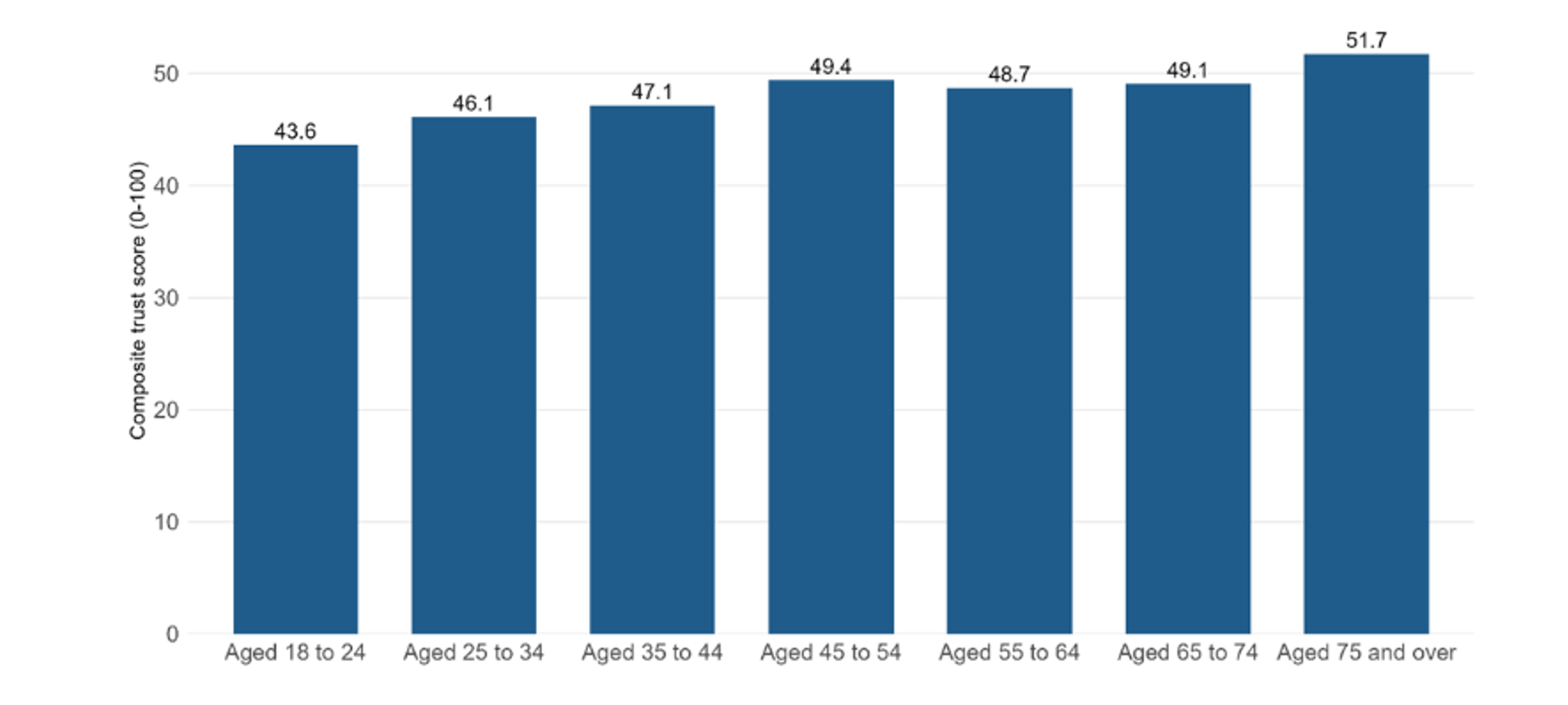
The composite score increases as age rises with 18 to 24-year-olds reporting lower levels of trust (43.6) and those aged 75 and over reporting the highest levels (51.7), as shown in Figure 1.
For each of the 5 core statements, respondents aged 18 to 24 scored lower than those aged 75 and over. The biggest differences were seen for regulatory accountability (59.5 compared with 73.7), corruption (37.8 compared with 48.5) and fairness of games and machines (36.8 compared with 43.8). Age differences were less pronounced for statements around the understandability of offers and odds (46.5 compared with 51.8) and protection of young and vulnerable people (40.3 compared with 42.7).
Figure 1: Composite trust score by age group
| Age group | Composite trust score (percentage) |
|---|---|
| Aged 18 to 24 | 43.6 |
| Aged 25 to 34 | 46.1 |
| Aged 35 to 44 | 47.1 |
| Aged 45 to 54 | 49.4 |
| Aged 55 to 64 | 48.7 |
| Aged 65 to 74 | 49.1 |
| Aged 75 and over | 51.7 |
There are also differences in trust scores when looking at different gambling activities. People who had participated in casino and fruit and slot games in the past 4 weeks had higher trust scores than people who had played lottery draws.
Table 3: Composite trust score by past 4 week gambling activity
| Gambling activity in past 4 weeks1 | Composite trust score | Base size |
|---|---|---|
| Lottery draws | 48.6 | 6,388 |
| Scratchcards | 50.1 | 1,954 |
| Instant win games | 50.4 | 1,257 |
| Betting | 52.6 | 1,616 |
| Bingo | 52.3 | 714 |
| Casino games | 53.2 | 466 |
| Fruit and slots | 53.1 | 757 |
Participants were asked how they felt about the last time they spent money on gambling. Responses were given on a scale of 0 to 10 with 0 being ‘hated it’ and 10 being ‘loved it’. Participants who assigned a score of 0 to 4 were grouped as having a ‘negative’ experience, those who assigned a score of 5 were grouped as ‘neutral’, and those who scored 6 to 10 were grouped as having a ‘positive’ experience.
For statements relating to ‘accountability’ and ‘understandability of odds and offers’, participants who rated their most recent gambling experience as ‘positive’ had higher scores compared with those who rated their experience as neutral or negative. Statements relating to ‘corruption’, ‘player protection’, and ‘fairness’, were less strongly associated with participants’ most recent gambling experience as shown in Table 4.
Table 4: Composite trust score by most recent gambling experience
| Statement | Negative | Neutral | Positive |
|---|---|---|---|
| Gambling companies are held accountable by a regulator if their conduct falls short of standards | 64.5 | 63.7 | 69.1 |
| Gambling companies are free from corruption | 39.7 | 41.9 | 44.6 |
| Gambling games and machines are fair and free of errors | 37.1 | 38.9 | 42.3 |
| Activities, offers and odds provided by gambling companies are clear, easy to understand and not misleading | 44.0 | 48.7 | 53.9 |
| Effective measures are in place to protect young, and other vulnerable, people when gambling | 39.1 | 39.4 | 44.2 |
| (Base size2) | (1734) | (3390) | (3849) |
Taken together, these findings highlight that trust in the gambling industry varies based on the types of activity people play, as well as the emotional tone of recent interactions. While we are unable to conclude that these factors directly influence people’s trust in the industry, our findings highlight the variability of consumer attitudes.
References
1 Note: Participants may have taken part in more than one gambling activity in the past 4 weeks.
2 Base sizes for the statement 'Gambling companies are held accountable by a regulator' are shown. Base sizes for other statements are similar.
Overall agreement levels
Last updated: 23 July 2026
Show updates to this content
No changes to show.