
Report
Initial findings from new data on consumer trust – GSGB
Initial findings from new data on consumer trust – GSGB
Advertising and promotion
Advertising and promotions in gambling are an external influence to the play experience. Promotions are popular among people who gamble, but the balance between reward and over-promotion is frequently questioned. There are a number of themes that influence this driver, including the volume and targeting of offers and promotions, the visibility of advertising online, and the role of social media and influencers.
"The betting companies nowadays know exactly what games you like to play and when you usually place a bet; they notify you with tailored promotions which sometimes feel a bit intrusive!"
– Qualitative Research Participant
Participants in the earlier phase of research also identified the risk that advertising and promotions pose to people who may be struggling with their gambling.
“I’ve seen how offers and bonuses can tempt people. It’s hard to say if they lead to excessive gambling but they definitely encourage more play.”
– Qualitative Research Participant
People’s views on advertising and promotion were assessed using the following statement:
Gambling promotions and incentives don’t encourage excessive gambling.
Gambling promotions and incentives don’t encourage excessive gambling
Overall, 10 percent of people who had gambled in the past 12 months agreed with this statement, with a further 18 percent responding neutrally, and 72 percent disagreeing. However, the data show clear age-related differences. Respondents aged 18 to 24 were more likely to agree that promotions do not encourage excessive gambling, compared with older participants. Men are also more likely to agree that promotions do not encourage excessive gambling than women (12 percent compared to 9 percent).
As we see throughout all themes, the type of activities participated in in the past 4 weeks is associated with agreement levels to different aspects of trust. Those that played casino games or fruit and slots in the past 4 weeks have the highest levels of agreement that promotions and incentives don’t encourage excessive gambling as shown in Figure 9. Agreement with the statement did not differ based on whether participants rated their most recent gambling experience as ‘positive’ (13 percent), ‘neutral’ (7 percent) or ‘negative’ (11 percent).
Figure 9: Agreement level with ‘promotions and incentives’ statement by gambling activity in the past 4 weeks
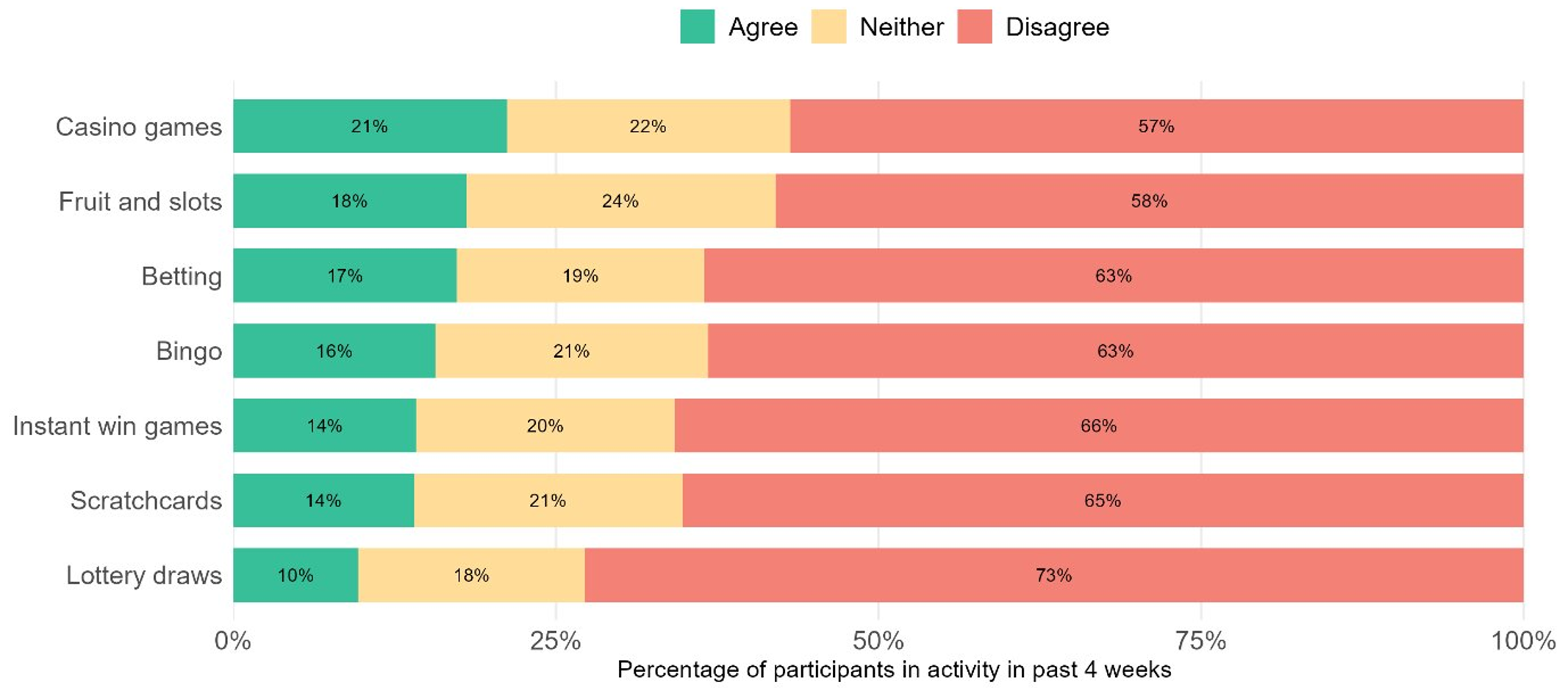
| Activity | Agree (percentage) | Neither (percentage) | Disagree (percentage) |
|---|---|---|---|
| Casino games | 21 | 22 | 57 |
| Fruit and slots | 18 | 24 | 58 |
| Betting | 17 | 19 | 63 |
| Bingo | 16 | 21 | 63 |
| Instant win games | 14 | 20 | 66 |
| Scratchcards | 14 | 21 | 65 |
| Lottery draws | 10 | 18 | 73 |
The next page in this section is Customer experience and support.
Last updated: 23 July 2026
Show updates to this content
No changes to show.