
Report
Gambling Survey for Great Britain (GSGB): Trends report 2023 to 2025
The data in this report shows comparisons between the 2023 and 2025 GSGB annual reports for 6 key survey estimates.
Findings
Overall, there were few differences in specific gambling behaviours examined for this report between 2023 and 2025. In 2023, 48 percent of participants reported gambling in the past 4 weeks; in 2025, 47 percent of participants reported the same. Likewise, in 2023, 76.1 percent had a Problem Gambling Severity Index (PGSI) score of 0, with 76.9 percent reporting the same in 2025. This pattern of stability is evident across most metrics presented. The following commentary focuses on where differences were observed.
There were some notable differences for male participants aged 55 and over. The proportion of male participants aged 55 and over who gambled on activities other than lotteries in the past year increased between 2023 and 2025 (from 27 percent to 32 percent, figure 1). The same pattern was evident for gambling on activities other than lotteries in the past 4 weeks, which increased from 18 percent in 2023 to 22 percent in 2025 (figure 2). This pattern was not observed for other age groups and was not evident among female participants.
Figure 1: Gambling participation in the past 12 months (excluding lottery draw only players) among males, by age
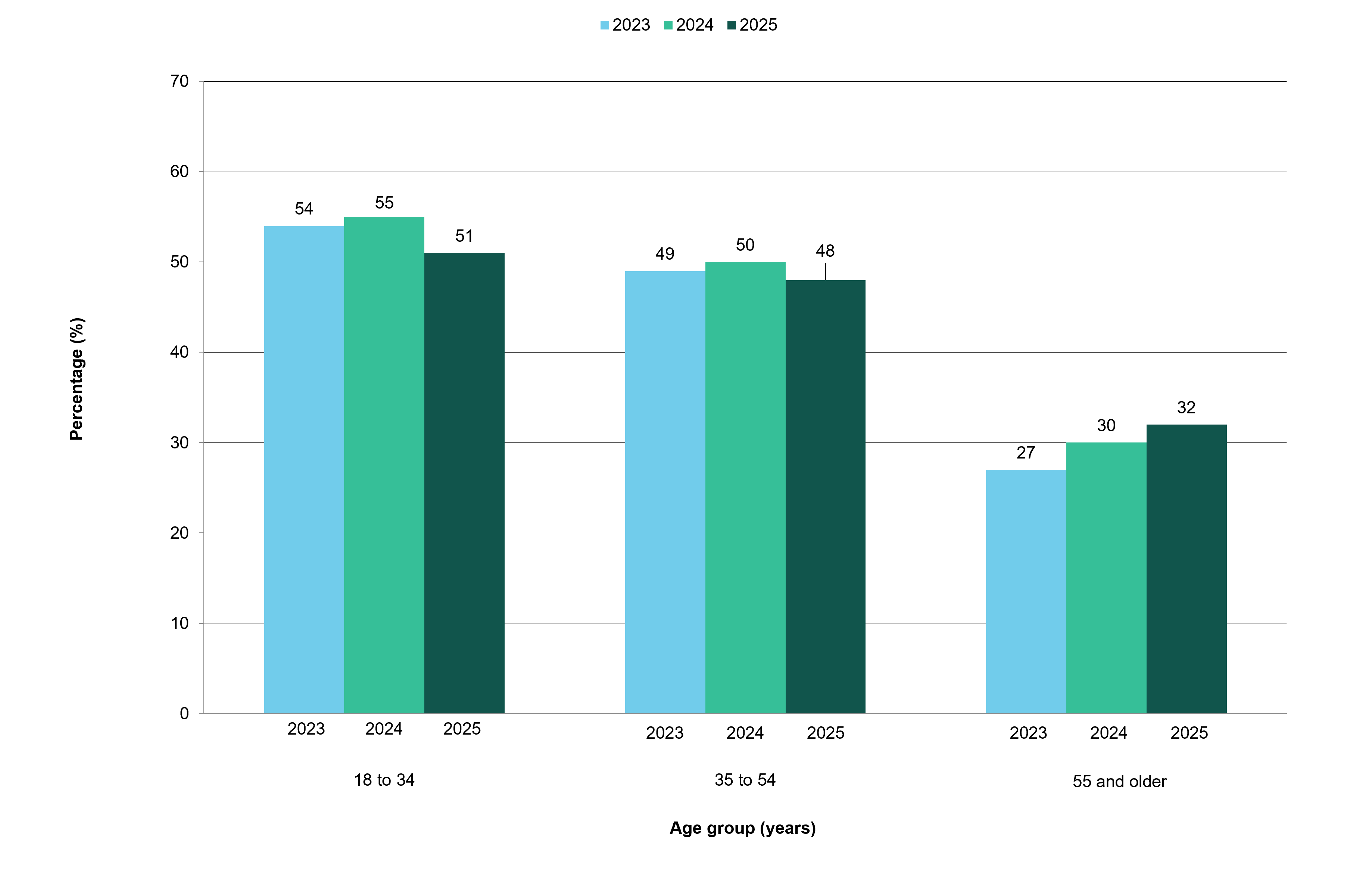
Base: Males adults aged 18 and over who had gambled in the past 12 months, excluding lottery draw only players (unweighted: Year 1 (2023) 4,215; Year 2 (2024) 8,628; Year 3 (2025) 9,102).
Figure 1 information
| Sex and age group (years) | Gambling participation in the past 12 months excluding lottery draw only players (percentage) | Statistical difference 2025 compared with 2023 (p-value)1 | ||
|---|---|---|---|---|
| 2023 | 2024 | 2025 | ||
| Males 18 to 34 | 54% | 55% | 51% | 0.211 |
| Males 35 to 54 | 49% | 50% | 48% | 0.859 |
| Males 55 and older | 27% | 30% | 32% | 0.003 |
Figure 2: Gambling participation in the past 4 weeks (excluding lottery draw only players) among males, by age
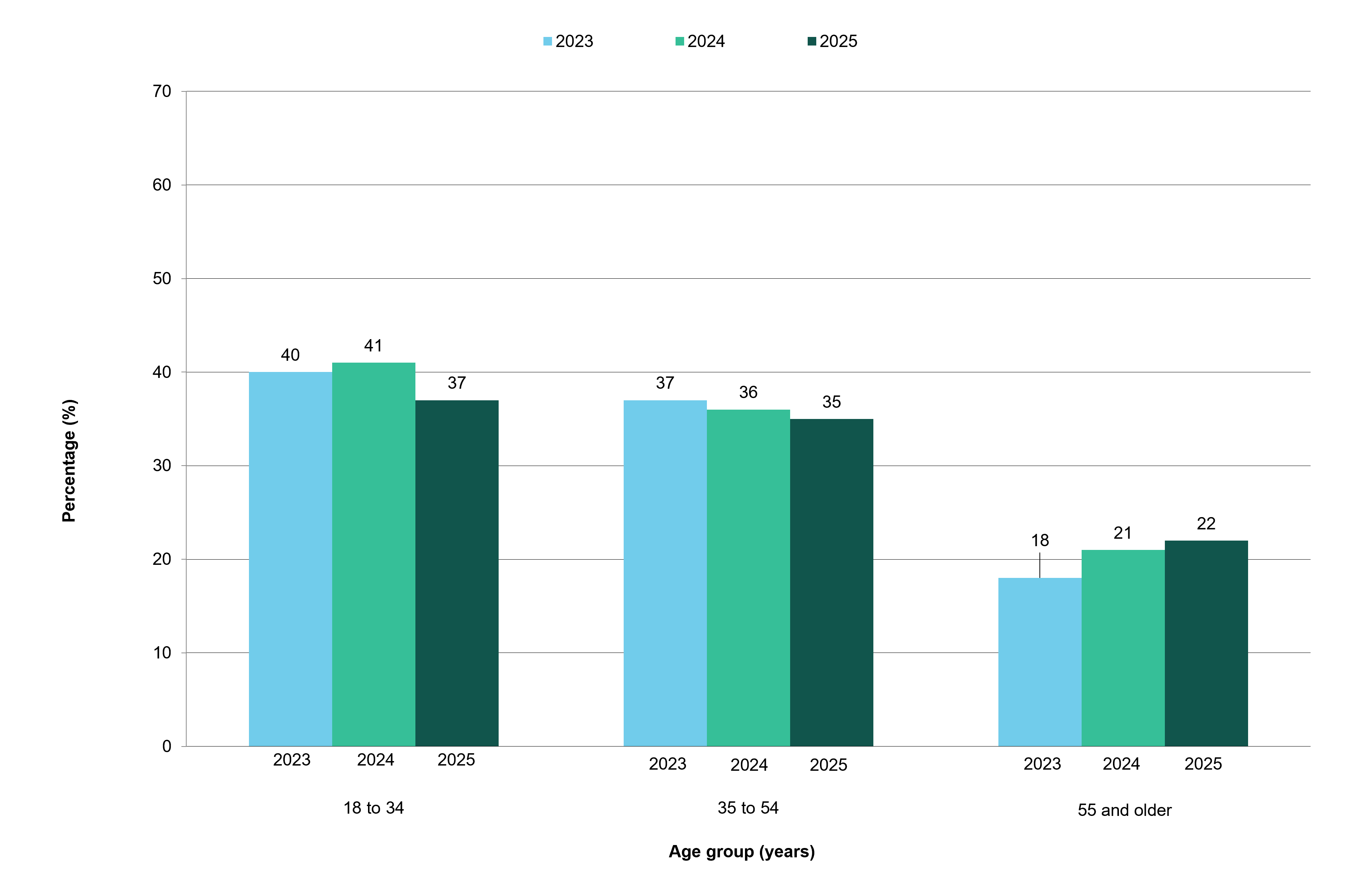
Base: Males aged 18 and over who had gambled in the past 4 weeks, excluding lottery draw only players (unweighted: Year 1 (2023) 4,219; Year 2 (2024) 8,644; Year 3 (2025) 9,020).
Figure 2 information
| Sex and age group (years) | Gambling participation in the past 4 weeks excluding lottery draw only players (percentage) | Statistical difference 2025 compared with 2023 (p-value)1 | ||
|---|---|---|---|---|
| 2023 | 2024 | 2025 | ||
| Males 18 to 34 | 40% | 41% | 37% | 0.177 |
| Males 35 to 54 | 37% | 36% | 35% | 0.453 |
| Males 55 and older | 18% | 21% | 22% | 0.001 |
There was an increase in the proportion of adults aged 35 to 54 seeking help and support for their own gambling, rising from 2.4 percent of adults aged 35 to 54 in 2023, to 3.8 percent of adults aged 35 to 54 in 2025. In the context of stable estimates in PGSI scores and the experience of adverse consequences from gambling, this suggests a modest improvement in help seeking behaviours among this age group.
The opposite was true for those seeking help and support due to others’ gambling, where those aged 55 and over were less likely to report this in 2025 (1.1 percent) than in 2023 (2.3 percent). This was particularly true for female participants aged 55 and over where seeking help and support due to others’ gambling decreased from 2.9 percent in 2023 to 1.2 percent in 2025. Because of sex differences in gambling, females were more likely to be affected others than males. Taken together, this data suggests a growing treatment and support gap for females aged 55 and over as an affected other, while gambling among the same age cohort of males is increasing.
Finally, only a select range of key survey metrics were examined for this report. There may be other changes evident across a wider range of gambling metrics (for example, changes in gambling frequency; changes in the prevalence of regular gambling on certain products). This requires further investigation. For example, additional analysis should examine which kinds of activities male participants aged 55 and over are now more likely to undertake.
References
1 Estimates are statistically significant at the 99 percent level (p < 0.01).
Method - GSGB Trends report 2023 to 2025
Last updated: 16 July 2026
Show updates to this content
No changes to show.