- Print the full document
- Save the page as a HTML document to your device
- Save the page as a PDF file
- Bookmark it - it will always be the latest version of this document
This box is not visible in the printed version.
Illegal online gambling - Phase 3: Understanding push factors for consumer engagement with illegal gambling websites
The Gambling Commission's research into consumer engagement with the illegal online gambling market.
Published: 20 October 2026
Last updated: 20 October 2026
This version was printed or saved on: 20 October 2026
Online version: https://www.gamblingcommission.gov.uk/report/illegal-online-gambling-phase-3-understanding-push-factors-for-consumer-engagement-with-illegal-gambling-websites
Executive summary
Background and approach
Responding to the illegal online gambling market is a primary focus of the Gambling Commission’s corporate strategy. To do this effectively requires a robust, evidence-led understanding of this complex and often hidden market. This report represents the culmination of a multi-phase research programme, conducted by Yonder, designed to move from a position of limited knowledge of the nature of the market to one of robust statistical measurement of the engagement in the market.
This journey has been key in building a complete picture of illegal gambling website engagement. It began with qualitative discovery to identify the core consumer personas (Phase 1), moved to quantitative validation of these personas and the indicators of illegal website use (Phase 2), and then to the development of a composite Illegal Incidence Index for use on the Gambling Survey for Great Britain (GSGB)1.
This report details the findings from Phase 3, which uses a mixed-method approach: combining digital intelligence, a large-scale quantitative survey and in-depth qualitative interviews, to provide a comprehensive picture of who uses illegal gambling websites; both in terms of their demographics, but also crucially their wider motivations and attitudes, and how they apply these views to gambling.
It is important to contextualise the findings in this report; using illegal gambling websites remains a behaviour that is undertaken by a small minority of all individuals who gamble. This report deliberately focuses in on this specific subset to understand their motivations, rather than reflecting the habits of all those who gamble in general, where illegal gambling website use is not prevalent,
Among the broader audience of people who gamble, this research found there is in fact an appetite for more rules and regulation within the gambling market.
Key insights and findings
1. The illegal online gambling market is a complex space, with distinct audiences driving engagement
Illegal gambling website users are neither a homogenous group, nor do they strictly segment into distinct groups, based on our research. However, they do tend to align with the below personas, each with their own attitudes. This phase of the research has built on previous phases by including this attitudinal picture as an integral part of the quantitative survey, enabling the cross-analysis of personas with their broader societal mindsets and motivations, as well as their gambling-specific attitudes. Below is a short summary of how each persona group is defined, and the key attitudinal themes we see arising in both the qualitative and quantitative phases of the research.
Self-Excluders: Defined as users who acknowledge using illegal gambling websites by their circumnavigation of GamStop. When looking at their attitudes, they tend to be community-influenced, with a tendency to explore new game types, sites and products.
Skilled Advocates: Those that self-report intentionally gambling on illegal websites. When assessing their attitudes, they are driven by a strong sense of distrust of the licensed market and the pursuit of better value and personal freedom.
Social Explorers: Those that do not self-report intentionally gambling on illegal websites, but have given an indication of illegal gambling website use through some self-reported experiences. Looking at their wider attitudes, they are experience-led deal seekers who particularly trust peer recommendations. While they can find friction in the licensed market frustrating, they generally view it with pragmatic acceptance.
Accidental Tourists: Another group that have given at least some indication of illegal gambling website use through self-reported experiences but also do not self-report intentionally gambling on illegal websites otherwise. Qualitatively, their use of illegal gambling websites appears as typically unintentional and casual, driven by a desire for frictionless play and a growing frustration with the licensed market.
2. The search for ‘not on GamStop’ has become a primary gateway to the illegal online gambling market
Digital intelligence reveals that the language individuals use online provides a clear window into how they find illegal gambling websites. The term ‘not on GamStop’ has evolved far beyond its literal meaning. It is no longer a niche term used only by those who are self-excluded. It has become a widely understood shortcut for a suite of features believed to be associated with the illegal online gambling market: less friction, fewer identity checks, faster payouts, and the availability of features like credit card or cryptocurrency betting.
While we know from the quantitative phase of the research that some users are genuinely circumnavigating Gamstop by using illegal gambling websites, the existence of this practical, code-like language demonstrates that an additional, select group of users are not passively stumbling upon these websites but are actively and deliberately seeking them out using specific, known terminology. This search behaviour creates a well-trodden and normalised pathway to illegal online gambling for these individuals.
3. A clear hierarchy of push factors has emerged, with friction over access and data in the legal market being key
The quantitative phase of this research, undertaken with over 4,000 people who had gambled in the last 4 weeks (excluding lottery-only players), uses a Key Drivers Analysis to demonstrate how strongly each surveyed factor is linked to illegal gambling website usage, relative to the other factors measured. Across the whole sample, the key factors found are not common experience-focused factors such as searching for better odds, but instead are deliberate, access-related issues, namely:
- looking for sites not blocked by Gamstop, whether to circumnavigate Gamstop itself, or as a coded shortcut for illegal gambling websites
- using gambling websites that the consumer knew would not ask for much personal data.
At a whole sample level these are not common factors, but the frequency with which they are reported does increase among Self-Excluders and Skilled Advocates in particular.
These 2 factors are the most strongly linked to illegal gambling website usage across all personas, except for Accidental Tourists, where self-reported trouble with withdrawals emerges as a more strongly linked factor than looking for websites not blocked by Gamstop.
It is worth noting upfront that push factors that are present in the legal market, for example, Know Your Customer (KYC) ID or finance-related checks, are also reportedly present in the illegal market. This creates a cycle where users, frustrated by certain push factors in the licensed market, move to illegal gambling websites only to face the same issues in a less protected environment.
4. Underlying attitudes towards trust and authority fundamentally shape behaviour and risk
The qualitative phase of this research found that different groups react differently to the same push factors.
Skilled Advocates often display an anti-establishment or anti-authority mindset, being significantly less likely to trust gambling companies, the government and the regulator. For many in this group, an overarching sense of ‘friction’ on licensed websites is perceived as an injustice that validates their decision to operate outside the system. This friction includes elements such as ID, KYC checks and slow payouts, which act as independent frustrations that while experienced separately, cumulatively drive a broader sense of injustice.
Social Explorers and Accidental Tourists tend to be more pragmatic. They often view friction as an inconvenience rather than an injustice. Their journey to an illegal gambling website is driven by convenience and primarily by a search for a more seamless and trusted user experience, often guided by recommendations from friends and family.
Implications
The findings from this research provide the Commission with a robust toolkit for ongoing monitoring of illegal gambling website usage and a clear evidence base to inform future strategy.
For monitoring
The validated Illegal Incidence Index and a forthcoming allocation method for the Illegal Gambling Personas will enable indicative tracking of illegal gambling website user composition via the GSGB, and how regulatory interventions and gambling company practices may impact on this composition.
For communications and disruption
Early indications from this research suggest that a one-size-fits-all approach will likely be ineffective according to differences in audience perspectives. Further research is needed to explore this, but findings suggest that interventions should be tailored: education and awareness campaigns are likely to be more effective for Social Explorers and Accidental Tourists, whereas disrupting the ecosystem through enforcement and addressing core friction points will likely be more effective for Skilled Advocates. Dedicated research to explore in more detail is recommended.
1 A technical report outlining the development of the Index will be published by the Commission alongside findings from the first four waves of GSGB illegal gambling data. These publications are scheduled for release in November 2026, and thus will form Phase 4 of this research series.
Introduction
Under the Gambling Act 2005 (opens in new tab), a core licensing objective of the Gambling Commission, is to prevent gambling from being a source of, or associated with, crime . Any proliferation of websites offering gambling products to consumers in Great Britain without a Gambling Commission licence, making them illegal gambling websites, directly challenges this objective.
Combating this illegal activity is a primary focus of the Commission's Corporate Strategy 2024 to 2027, which aims to make it difficult to provide illegal online gambling at scale to consumers in Great Britain. Enforcement activity is already accelerating; as former Chief Executive Andrew Rhodes recently noted, the "unsafe, unfair, and criminal" nature of these websites has prompted a ten-fold increase in disruption activity since April 2024, alongside the launch of a new Illegal Gambling Hub. However, sustaining this success requires a robust, evidence-led understanding of how the complex network of illegal gambling websites operates and who uses them.
Both historically and today, the hidden nature of illegal online gambling makes it difficult to research. The Commission’s work is designed to directly address the ‘Illegal gambling and crime’ roadmap within the Commission’s Evidence Gaps and Priorities. To build a complete picture, this research is being triangulated with a pioneering data project that integrates web monitoring, online traffic and search data with enforcement disruption activity to measure trends across different points in the illegal online gambling supply chain. Ultimately, this combined insight will support the Commission’s indicative tracking of illegal online gambling website user composition via the Gambling Survey for Great Britain (GSGB) and measure the ongoing impact of both enforcement disruptions and regulated policy changes on user engagement.
Throughout this report, it should be noted that while insights are rich and detailed, they represent the attitudes and behaviours of a minority of individuals who gamble. This report focuses on this specific subset of individuals who use illegal gambling websites but should not be mistaken as widespread amongst the majority of people who gamble on licensed websites.
Phases of the illegal gambling research
Phase
Description of phase
April to June 2024
Aim: To conduct initial discovery into a previously un-researched area. The goal was to move from a position of limited knowledge to one of foundational understanding by exploring the motivations of illegal gambling website users and identifying the core consumer groups.
Method: Informed by a quantitative incidence test with 1,000 individuals who gamble online, Yonder conducted 10 qualitative depth interviews with suspected illegal gambling website users and 2 focus groups with individuals with lived experience (recruited via the Gambling Commission’s Lived Experience Advisory Panel (LEAP).
Outputs: The qualitative element of this phase provided the foundational framework for all subsequent research by identifying 4 key consumer personas: Self-Excluders, Skilled Advocates, Social Explorers, and Accidental Tourists.
The full report from Phase 1 is avaliable to read.
December 2024
Aim: To build on the qualitative discovery from Phase 1 by assessing a suite of behavioural indicators for illegal website usage, the result of which is the Illegal Incidence Index, a core measurement framework to be used for ongoing tracking in the Gambling Survey of Great Britain (GSGB). Phase 1 and Phase 2, cumulatively, provide a detailed picture of the pull factors to the illegal market and the ways in which illegal gambling website gambling companies make themselves attractive to consumers.
Method: Quantitative survey with a sample of 2,043 individuals who gamble online. The questionnaire was designed to test awareness, motivations, and indications of illegal gambling website usage.
Outputs: This phase developed the measurement framework for the entire research programme. It explored the suite of indicators and the index methodology that would be integrated into the GSGB in Phase 4.
The full report from Phase 2 is available to read.
February to July 2026
To build upon all previous learnings, building an analytical methodology through which to quantify persona composition, and identify the primary 'push factors' contributing to consumer usage of unlicensed gambling websites.
Method: A multi-method approach that triangulated findings from 3 distinct streams:
- Digital Intelligence to analyse online conversations and form hypotheses
- Quantitative survey of 4,000 individuals who gamble online to measure behaviour
- Qualitative exploration with focus groups to understand the human experiences and the 'why' behind the data.
Outputs: Creation of the Illegal Incidence Index, a tool which was subsequently integrated into the Gambling Survey of Great Britain (GSGB), enabling a robust, large-scale understanding of online illegal gambling website use.
January 2025 to November 20261
Aim: To create a single metric that would allow the Gambling Commission to track consumer engagement with the illegal online gambling on a national scale over time.
Method: A composite index approach was developed, combining statistical data from the Phase 2 survey with expert qualitative input from the Commission, industry stakeholders, and individuals with lived experience (the Gambling Commission’s LEAP).
Outputs: Creation of the Illegal Incidence Index, a tool which was subsequently integrated into the Gambling Survey of Great Britain (GSGB), enabling a robust, large-scale understanding of online illegal gambling website use. Release of a technical report outlining the development of the Index will be published by the Commission alongside findings from the first 4 waves a year’s worth of GSGB illegal gambling data. These publications will form Phase 4 of this research series and are scheduled for release in November 2026.
While the wider research project spans 4 phases, the findings detailed in the remainder of this report focus specifically on phase 4. Building directly on the groundwork of previous stages, this phase used a multi-method approach, combining digital, quantitative and qualitative research to build upon all previous learnings.
Overarching study objectives
Specifically, this research sought to understand a number of objectives:
- Audience sizing: understanding the user composition of those that engage with illegal gambling websites
- Pathways and triggers: the specific routes, search processes, and triggers that lead consumers to illegal gambling websites
- Consumer motivations: delving into the emotions and rationale behind the numbers to understand the underlying drivers for using illegal gambling websites and factors that may influence future usage
- Knowledge gaps: consumer awareness of licensing and the ability to differentiate between licensed and illegal online gambling companies
- Regulatory and gambling company impact: exploring whether specific regulatory factors or licensed gambling company practices have a role to play in influencing consumers use of illegal gambling websites, and whether consumers can distinguish between the two
- Consumer attitudes and control: exploring consumer attitudes towards illegal gambling websites and whether consumers attempt to control their usage of illegal gambling websites.
Although the development of the Illegal Index and technical report was underway prior to Phase 3 beginning, it was not completed until the Commission analysed the first 4 waves of GSGB illegal gambling data, which occurred after the conclusion of Phase 3.
How to read this report
This report is structured around the main findings from each phase of the research: digital intelligence, quantitative and qualitative, and explains how each stage informed the next.
Unless otherwise stated, charts, tables and written analysis refer to the total sample which consists of individuals surveyed who gamble on illegal websites. For more detailed findings, including demographic breakdowns, please refer to the data tables. When discussing quantitative subgroup differences, this report will reference the subgroup result versus the total (for example, “Subgroup A is more likely to say this (X% vs. Y% of the total average”). The report only uses this language where the subgroup in question is statistically significantly higher or lower than the total average, which represents the result across the whole sample.
The qualitative findings are illustrative rather than representative and are intended to provide depth and context to the wider patterns seen in the digital and quantitative phases.
All findings take a consumer-focused approach. Consumer understanding of the regulatory landscape is often limited and this influences the responses provided in each phase of research. However, when combined with other data sources (such as estimated web-traffic on illegal gambling websites and online search data), it provides a holistic view of the illegal online gambling market in Great Britain.
Terminology used
Specific terminology is used within this report, the definitions and rationale behind which can be found in the following paragraphs.
Illegal online gambling
Terminology used throughout this report to describe gambling websites and providers used by consumers in Great Britian which are not licensed by the Gambling Commission, for more details on the requirements for a gambling company to obtain a licence, visit the Licence Conditions and Codes of Practice on the Commission's website.
We utilise this term consistently throughout the report, with the exception being where participants have quoted the term ‘unlicensed’ directly, within qualitative interviews or in online posts or discourse.
Participants, personas and players
In this report, we use participants when referring to individuals who took part in the research directly, including those involved in the qualitative focus groups and quantitative survey. When referring to groups of illegal website users (Self-Excluded, Skilled Advocates, Social Explorers, Accidental Tourists), we use the term ‘persona’ or ‘group’. Where findings relate specifically to the digital intelligence phase, we use players or online users to refer to individuals. This distinction is used for clarity and applied consistently throughout the report.
Return to player (RTP)
The average percentage of all wagered money that a game or gaming machine is programmed to return to players over time. As outlined by the Commission, RTP is an average measured over an extensive volume of plays (often millions), rather than a guarantee for an individual player’s single session. More information can be found on the Return to player - how much gaming machines payout page on the Gambling Commission's website.
GAMSTOP
A free tool that allows individuals to self-exclude from all licensed gambling websites in Great Britain. More information can be found on the GAMSTOP website (opens in new tab).
PGSI
The Problem Gambling Severity Index (PGSI) is a screening tool used to measure problem gambling, defined as gambling to a degree that compromises, disrupts or damages family, personal or recreational pursuits. A PGSI score of 8 or more indicates that a person is likely to have experienced adverse consequences from gambling and may have lost control of their behaviour. A PGSI score of 3 to 7 indicates moderate-risk gambling. A PGSI score of 1 to 2 indicates low-risk gambling.
Know Your Customer (KYC) checks
Know Your Customer checks are used to verify a customer’s identity in order to ensure compliance, help prevent financial crime and protect both customers and businesses. They are used by regulated businesses, including banks and other financial institutions, and form part of wider legal obligations under anti-money laundering and counter-terrorism financing regulations.
Source of funds checks
Source of funds checks prove where money used for a specific transaction or period of gambling came from for the purposes of preventing money laundering. This involves high customer involvement since they may need to provide documentation such as a recent payslip, bank statement, or proof of a property sale. For more information, see the Commission's page on what gambling businesses want to know about your finances.
Financial checks
Refers to assessment of a customer’s financial circumstances. These include the following checks that are either directly or indirectly named in this research.
Gambling company-led financial checks: Help identity customers at risk of financial distress and triggered by loss limits set by individual gambling companies. These checks may involve customers providing their bank statements, payslips, P60, or related financial documents to assess whether a consumer is at risk of harm due to their gambling1.
Financial vulnerability checks: Financial vulnerability checks are a targeted and non-intrusive way of using publicly available information to establish if a customer is subject to publicly recorded credit events such as bankruptcy orders, county court judgements, or individual voluntary arrangements. Introduced as a requirement from 31 August 2024 and must include at a minimum a customer-specific public record information check for significant indicators of potential financial vulnerability.The customer is not asked to provide any data as part of a check. However, if a check identifies potential financial vulnerability such as bankruptcy, the gambling operator may take some customer interaction actions to support a customer (such as setting a deposit limit) or they may choose to ask for financial information if they consider that appropriate. From 28 February 2025, the relevant threshold is where the customer’s deposits minus withdrawals exceeds £150 in a rolling 30-day period. For more detail on financial vulnerability checks, visit the Gambling Commission's LCCP, Condition 3.4.4.
It is important to note that participants generally do not distinguish between the different types of checks. Indeed, they often conflate different checks with one another, and use checks as a blanket term for both different types of identity verification, age verification, financial checks, KYC and source of funds checks for anti-money laundering purposes. Additionally, they are often not always clear on how they work.
References to financial checks in this report do not include Financial Risk Assessments, as these checks have yet to be implemented within the gambling market. That being said, due to the aforementioned consumer confusion surrounding different types of checks, they can mistakenly assume they have been subjected to a Financial Risk Assessment.
Account restrictions
Measures implemented by gambling companies to limit a customer's activity. These restrictions are applied for 2 primary reasons:
- Commercial Risk: To manage profitability by limiting the activity of skilled or successful players (a practice colloquially known as 'gubbing').
- Safer Gambling: To protect vulnerable customers from harm by intervening when behaviour indicates a risk of problem gambling.
Restrictions can include limiting maximum stakes, removing eligibility for bonuses, or imposing deposit limits. From the customer's perspective (and from the perspective of this research), it is not possible to distinguish between a commercial or a safer gambling restriction, as operators rarely disclose the specific reason.
Crypto casinos
Gambling websites that are currently not regulated, which allow customers to deposit, wager, and withdraw funds using cryptocurrencies such as Bitcoin and Ethereum.
1 The Betting and Gaming Council's website has the Industry Voluntary Code on customer checks and documentation requests based on spend (opens in new tab) (PDF).
Methodology
Digital intelligence
In Phase 3 of the research, Yonder conducted digital analysis of online conversations about illegal online gambling over the last 6 months (28 February 2026 to 1 September 2026) to gain a deeper understanding of the real-life experiences of individuals who use or are considering using illegal gambling websites. This phase also helped to inform the quantitative questionnaire and qualitative discussion guide utilised in later phases of the project.
In particular, the digital intelligence phase was based around 3 key groups of hypotheses:
1. Value and user experience
We explored consumer frustrations with licensed gambling websites, which included perceptions of slow or arduous deposits and withdrawals, poorer value (for example worse odds, return to player (RTP) or promotions), and product restrictions that reduce enjoymentand make illegal online gambling companies seem more attractive (especially if they feel faster, easier, or more exciting to use). This also includes those who may turn to illegal online gambling because they feel their demand cannot be met via licenced gambling websites.
2. Checks and controls
We looked at whether verification requirements, financial checks, and other account controls feel intrusive or unfair to some consumers, and whether consumers feel that this pushes them or could push them towards illegal alternatives.
3. Loss of access
We examined whether individuals who lose access to licensed gambling websites, through self-exclusion, account restrictions, may turn to illegal online gambling as either an alternative or, in some cases, the only available option.
The full list of sources and online platforms searched within the digital intelligence phase can be found in Appendix D.
Key findings from this phase included:
- an ecosystem map of how illegal online gambling is discussed online to identify push factors to illegal online gambling
- evidence supporting or challenging each hypothesis
- quantification of key terms and language across the three groups of hypotheses
- an analysis of the differences between gambling company and regulator push factors
- a robust breakdown of the data sources (YouTube, Reddit, Facebook, X, Dark web, forums, blogs) and their share of voice in the online conversation.
These findings were then used to inform subsequent stages.
How digital intelligence shaped the quantitative survey and qualitative phases
Themes and language identified through digital intelligence were then tested and explored with participants in the survey and focus groups.
For example, in the quantitative phase, the questionnaire was designed to include questions on push factors, such as account restrictions (commercial or otherwise), alternative payment options via crypto casinos, browsing for better odds, and better games. Questions around general attitudes also included detail about the importance of privacy and trust in regulation, which were themes that surfaced in online discussion.
The push factors were defined during the digital intelligence phase, and then tested across both focus groups during the qualitative phase, including low odds or RTPs, limited game types, difficulty withdrawing winnings, and wanting to gamble using cryptocurrency.
Additionally, the digital intelligence identified a number of findings around where conversations of illegal online gambling happen, and what users are seeking. Specifically:
- YouTube drives volume (in terms of the sheer number of videos containing search terms), but Reddit drives insight: YouTube over-indexes on creator-led, promotional content designed to push traffic off-platform. Reddit is the peer-to-peer problem-solving space where users share experiences, compare websites and exchange “how to” advice.
- Illegal online gambling’s appeal is practical: faster cashouts, fewer limits and “easier” play. Users openly seek non‑GamStop casinos (especially crypto casinos), with fast payouts a key priority and recommendations frequently framed around speed and simplicity.
- Low trust remains a constant, driving continuous validation: Even while exploring illegal options, users repeatedly “legit versus scam” check, using Reddit to validate reliability and avoid being caught out.
Digital intelligence further helped to provide an early identification of the push factors from licensed gambling websites and how they create pathways to illegal website play.
GB-licensed play is perceived by consumers as a weaker value proposition: Restrictions, trimmed odds and/or lower RTPs and weaker rewards are framed as worsening value. Terms and Conditions and/or fine print is the most prominent “value” complaint (a perceived bait‑and‑switch, hidden or changed rules, hard-to-withdraw bonuses). Users talk proactively about finding better odds and/or higher RTPs, not just complaining.
Experience and enjoyment are central: from a consumer perspective, licensed gambling websites feel slower and stale. Crypto casinos position simplicity as reliability. While boring or unenjoyable experiences can push some individuals away from licensed gambling companies, a clean, straightforward user experience, alongside fast payouts, builds trust in crypto casinos.
Checks, controls and exclusions act as tipping points, sometimes redirecting demand: consumers in the digital intelligence phase believe Know Your Customer (KYC) checks are the biggest friction point and “no‑KYC” is a key trigger for illegal online gambling exploration (even if it becomes “delayed KYC”). Financial checks and source of funds checks (where the customer has to provide documentation) are described by some users as intrusive and polarise behaviour (privacy-led switching).
Quantitative phase
Following the digital intelligence phase, Yonder conducted a large-scale online quantitative survey with 4,007 individuals who had gambled online in the past 4 weeks, with fieldwork occurring between 1 and 15 May 2026. The sample was weighted to be representative across age, gender and region, as per the most recently available Gambling Survery for Great Britain (GSGB) data on those that had gambled in the past 4 weeks (excluding National Lottery only players).
The survey was designed to identify consumer engagement with illegal gambling websites, develop a robust statistical methodology for future measurement of the persona audiences identified in earlier phases, and establish which push factors have most influence on engagement with illegal gambling websites. It was built around 3 pillars:
- Illegal Incidence Index. The index scores individuals who gamble online from 0 to 100 based on self-reported indicators of illegal website usage. This phase accounts for those changes and re-establishes the threshold of 18.75, the point at which we can be confident someone has used an illegal website.
- Sizing the persona audiences. Using a combination of rules-based segmentation and factor analysis, the survey provides a method through which to estimate the illegal gambling website user composition, and a method for tracking how that composition shifts over time.
- Assessing push factors. Statistical key drivers analysis was used to assess how different push factors have different levels of importance in driving suspected illegal gambling website usage. These factors were designed with input from the Commission and from the digital intelligence phase.
Qualitative phase
The qualitative phase was designed to build a deeper understanding of how participants experience and interact with illegal gambling websites. While the quantitative phase assessed the proportions of each of the 4 audience groups and identified broad ‘push factors’ of the consumers within these groups, the qualitative phase explored how these journeys unfold in practice and the human rationale behind the numbers.
In particular, the qualitative phase focused on:
- identifying participants' broader online behaviours, pathways into illegal gambling websites, and how they first encounter them
- exploring the underlying motivations that attract individuals to the illegal market and mapping the relative importance and impact of these factors in encouraging usage
- understanding the specific role that licensed gambling companies, gambling regulation, and other relevant agencies or authorities play in influencing use of illegal gambling websites.
The qualitative research consisted of a multi-stage methodology designed to build rapport and capture uninfluenced perspectives. It began with an independent online pre-task where participants detailed their online habits and were introduced to the concept of push and pull factors (in relation to illegal website use). This was followed by a pre-recorded webinar, shared with participants to watch in their own time, which outlined the research purpose and prepared them for the main discussion.
Finally, participants attended one of two 2-hour online focus groups. To ensure relevant and productive conversations, these groups were split based on intentionality (those intentionally gambling on illegal online websites versus unintentionally gambling on illegal online websites).
The sample consisted of 15 participants who gamble using illegal gambling websites:
- Group 1, intentionally gambled on illegal websites: 7 Skilled Advocates
- Group 2, unintentionally gambled on illegal websites: 4 Social Explorers, 4 Accidental Tourists.
Participants were recruited directly from the quantitative phase, and during the recruitment process, participants were re-screened and their answers were re-verified, particularly in regard to the frequency and recency of indicators of illegal gambling website usage.
Fieldwork for this qualitative phase was conducted in July 2026.
Strengths of the approach
The mixed-methods design of this study is a core strength, allowing findings to be triangulated across 3 distinct phases.
Complementary insights
The stages were designed to build on one another. The digital intelligence phase mapped the online landscape, ensuring the quantitative and qualitative phases were grounded in real-world behaviours and consumer language.
Balancing breadth and depth
The quantitative survey provides a robust, statistically significant view of the prevalence of key push factors, scale of the audiences and the most statically significant drivers of illegal website usage. The qualitative interviews complement this by explaining the ‘why’, uncovering the nuances, emotions and rationale behind the numbers, bringing consumer experiences to life.
Capturing the full consumer journey
By combining the observed online behaviour (digital intelligence) with self-reported actions (quantitative) and lived experiences (qualitative), the research provides a comprehensive view of the underlying motivations and drivers that influence use of illegal gambling websites, enabling a deep and holistic view of the illegal market.
Integration of expert and lived experience
To ensure the research was grounded in real world perspectives, we conducted a joint workshop with the Gambling Commission’s [Lived Experience Advisory Panel (LEAP)] and Industry Forum (IF). This collaborative session focused on exploring key push factors with expert groups early on to directly shape the design of the quantitative questionnaire, strengthening the relevance and validity of the research.
Limitations of the approach
Despite the strengths of the work, these research methodologies also each have their own limitations. Findings should therefore be read as a triangulated account of the overall story rather than as a single definitive measure.
Digital intelligence
Digital intelligence provides insight into public social media content and conversation and can help identify behavioural trends and patterns. However, it reflects expressed rather than confirmed behaviour and cannot be treated as representative of the wider population. Digital intelligence naturally tends to capture those who are more vocal or hold stronger opinions on subjects. For example, individuals who feel strongly about certain regulatory measures, are often more vocal in digital spaces, whereas those with more neutral feelings may be less likely to post. Furthermore, mentions of intent can’t reliably verify actual migration to illegal online gambling, or provide a robust quantitative sizing of the prevalence of the activity.
The analysis is also limited to publicly available content. Because of the sensitive nature of the topic, the anonymity provided by platforms like Reddit allows space for those who illegally gamble to share their experiences more honestly. On social media platforms like X and Facebook, discussion was more limited, and while YouTube contained a high volume of promotional videos, it lacked genuine conversations between those who gamble. This method therefore cannot capture the full extent of activity taking place, and instead sets up measurement for the quantitative phase.
Quantitative research
Quantitative research provides a broad view of attitudes and behaviour across a defined sample. However, it is less adept on its own explain why participants hold particular views or what factors shape their behaviour.
As outlined in the methodology section, this research focuses on those who have gambled online. The findings should therefore not be treated as representative of all those who gamble. Caution should also be taken when interpreting subgroup differences, such as those relating to gambling frequency or Problem Gambling Severity Index (PGSI) score, as these groups may not themselves be representative, given the research was conducted with an online panel, which naturally over-index for online gambling frequency and PGSI compared to the full population, where online engagement is more varied.
Qualitative Research
By their nature, qualitative sample sizes are small and exploratory. Therefore, qualitative findings should be treated as illustrative and directional unless explicitly contextualised by the quantitative data. Furthermore, qualitative research relies on interpretation, introducing the possibility of researcher bias. This was mitigated through a grounded theory approach and the systematic analysis of all focus group and pre-task data and notes.
Qualitative participants were recruited directly from the quantitative survey. Due to natural drop-off, including participant availability and willingness to engage, the qualitative focus groups consisted of 15 participants in total: 7 Skilled Advocates, 4 Social Explorers, and 4 Accidental Tourists. Because of the limited sample size for the latter 2 groups, Social Explorers and Accidental Tourists, this limited our ability to fully unpick qualitative differences in attitude between the 2 cohorts. Readers should keep this in mind, as the quantitative data analyses these segments separately. To compensate, quantitative findings have been woven throughout the qualitative reporting to ensure distinct insights for all audiences are accurately reflected.
It should also be noted that while the quantitative phase provided insight into Self-Excluders as a distinct audience, this group was deliberately excluded from the qualitative phase of the research. This was a necessary safeguarding measure to avoid any potential distress or discomfort associated with discussing gambling-related harm in a live group setting. It was also due to previous phases of research providing an existing understanding of the Self-Excluder group’s motivations and pathways into illegal online gambling.
Qualitative insights gathered in this study are based on self-reported, rather than observed, behaviour. Consequently, findings are limited to what participants felt comfortable disclosing. Because group dynamics can sometimes inhibit a participant's willingness to share sensitive behaviours or perceptions, independent pre-tasks were deliberately included in the qualitative design. This enabled the qualitative phase to capture private recollections without the influence of the group dynamic. However, reliance on self-reporting remains an important caveat to keep in mind.
Ethics and governance
All research was conducted in accordance with standard market research guidelines and aligned with the Gambling Commission’s Research Governance Framework.
Participants across the quantitative and qualitative phases were fully informed about the purpose of the study and gave their explicit consent to take part. To ensure participants were safeguarded throughout the process, all data was anonymised and individuals were assured of their confidentiality. Given the sensitive nature of gambling research, qualitative participants were also signposted to independent support services, such as the National Gambling Helpline, at the conclusion of the focus groups, should the discussion have raised any concerns.
Findings
Exploring the persona audiences
Key findings:
- Skilled Advocates are highly engaged and intentional: this group tends to be boundary-pushing, and money-motivated. They often actively seek recommendations from friends, family, forums and socials, and are frustrated with gambling rules and restrictions.
- Social Explorers are experience-led deal seekers: they are more likely to browse for better odds or return-to-player (RTP), and are excited about deals and new experiences, which can leave them vulnerable to migrating to illegal websites.
- Accidental Tourists are motivated by a desire for frictionless play: they prioritise speed and ease, but operate in a more cautious, isolated fashion, with recommendations less important than for other groups.
Attitudes and behaviours of the personas: what sets them apart
Previous phases of our research into the illegal market led to the identification of 4 persona audiences: Skilled Advocates, Social Explorers, Accidental Tourists and Self-Excluders. Although we explored each of these audiences in the quantitative phase, the qualitative phase focused on Skilled Advocates, Social Explorers, and Accidental Tourists. Self-Excluders were not included in order to avoid any potential harm that could arise from exploring this topic in further depth, and also due to previous phases of research providing an existing understanding of the Self-Excluder group’s motivations and pathways into illegal online gambling. Therefore, a core objective of the qualitative research was to disentangle the motivations of the remaining 3 groups.
Here, it is important to note that the majority of those who gamble fall into the larger group of “Non Engagers” – those who have zero indication of engaging with the online illegal market. As such, the personas explored in this report represent a small minority of those who gamble.
For this project, the first 2 groups, Self-Excluders and Skilled Advocates, were defined through behavioural, rules-based criteria rather than factor analysis. This is because they can be defined solely by specific, self-reported engagements: Self-Excluders are individuals who report that they have been able to circumnavigate GamStop, indicating engagement with illegal gambling websites, while Skilled Advocates are individuals who self-report having intentionally used illegal gambling websites within the past 12 months.
Factor analysis was therefore applied to differentiate between Social Explorers and Accidental Tourists, 2 groups that we have previously been unable to clearly distinguish using survey questions alone. The following sections explore the factors that separate these audiences and provide a clearer understanding of how and why they differ.
Skilled Advocates: highly engaged, intentionally gambling on illegal gambling websites
The qualitative sample consisted of 15 participants who were identified as gambling using illegal websites. This consisted of 7 Skilled Advocates, who report intentionally gambling on illegal websites.
Skilled Advocates make up a small proportion of the illegal website users and are intentionally gambling on illegal online websites. They are defined by a rules-based approach; they are not self-excluded but have reported that they intentionally used an gambling website. Within our study, Skilled Advocates tend to skew younger, aged around 18 to 24, and have several active gambling accounts.
Skilled Advocates are strategic and analytical which carries over into gambling
When speaking with Skilled Advocates about their general online habits, they describe using the internet as a tool to strategically optimise their lives. Common activities that they report include consuming educational content on YouTube and other websites and utilising Artificial Intelligence (AI) chatbots for general research, as described by a participant:
“Love being able to ‘get on with it’ by accessing digital knowledge, from checking how to fix my washing machine to finding ESG funds to invest in through Copilot.”
Skilled Advocate, Female, 45 years old
Online gambling and research involved gambling such as placing bets with the best odds and making strategic choices, are described as a core part of Skilled Advocates’ internet activity. Compared to the total sample, those quantitatively surveyed were four times as likely to have more than 10 active online gambling accounts.
Their strategic nature carries over into how they approach gambling, and they tend to be systematic and analytical. They actively compare gambling companies and research the best odds, with some Skilled Advocates using specialist websites to research sporting events they gamble on:
“I start the day by researching the day’s football and tennis using specialist sites and then I make a plan using my own excel sheet and a list of the games going on in an app. I study sports via a scanner too.”
Skilled Advocate, Male, 51 years old
Skilled Advocates push boundaries and are money motivated
Skilled Advocates are boundary pushing; they are twice as likely than the total sample of illegal website users to seek out websites with minimal identity checks (72% versus 34% of the illegal website users surveyed) or to bet in cryptocurrency (62% versus 21%, and more curious to try restricted and/or banned things (54% versus 27%). In fact, they report being savvy at assessing whether a website is licensed or illegal. Amongst the Skilled Advocates spoken to, individuals mention being confident in spotting illegal website identifiers such as cheap branding, websites that often change names and logos, and prevalent advertising promoting more free spins than licensed websites. While these individuals feel they are savvy in assessing whether a website is licensed or illegal, they still choose to use them.
“The branding for legal bookmakers have nuances. William Hill looks a bit older than say Ladbrokes. But when you look at the illegal sites they look really cheap and less trustworthy.”
Skilled Advocate, Male, 34 years old
Skilled Advocates are reward chasing, motivated by making money fast (81% versus 61% of illegal website users surveyed) and recovering losses (78% versus 55%) rather than by the experience of playing.
Skilled Advocates are community driven and mistrustful of key stakeholders
They are also socially networked: their friends and family gamble (73% versus 35% of illegal website users surveyed), and they take their advice from forums, social media (71% versus 37%) and influencers (64% versus 28%), often ending up on the same websites as the individuals around them (58% versus 29 %).
Skilled Advocates are less likely to trust gambling companies, the government, and regulatory bodies. This is partially because they express high emotional investment in gambling. They see it as an expression of their personal freedom that provides autonomy over their time and money, which can feel restricted by regulation. They also report often feeling constrained by the identity checks required by licensed gambling companies.
The constraints that they feel often offer encouragement to use illegal websites, as described by a participant:
“They ask for your passport, drivers licence, and whole life story…this type of behaviour can encourage people to go elsewhere to these unlicensed sites.”
Skilled Advocate, Male, 37 years old
Skilled Advocates’ deep mistrust and entrenched views suggest that they are least likely to change their online gambling behaviours than other audiences.
Social Explorers: people-focused and experience-led deal seekers
As a reminder, qualitatively, the sample consisted of 15 participants who were identified as gambling using illegal websites. This included 8 of those who do not actively report intentionally gambling on illegal websites, split between 4 Social Explorers and 4 Accidental Tourists.
Social Explorers constitute a minority of those sampled but represent the most prevalent segment of unintentional engagement with illegal gambling websites. While they exhibit behavioural indicators of illegal website usage, there is no evidence of deliberate intent to circumvent the licensed market. The segment is empirically derived from the quantitative survey using factor analysis, which identifies a distinct pattern of attitudes and experiences associated with inadvertent illegal online gambling. Within our study, Social Explorers tend to skew younger, aged around 25 to 34, and have fewer active gambling accounts than Skilled Advocates.
Social Explorers are frequent recreational gamblers
Social Explorers treat the internet primarily as a medium for communication, completing tasks, and for passive entertainment. Unlike Skilled Advocates, online gambling is seen as a secondary activity as opposed to a core focus of their online behaviour:
“I spend around 7 to 9 hours a day on my phone and maybe a bit more as I work in security. The most used apps are YouTube and Tik Tok and WhatsApp. I love watching my shows and being updated on what goes on in the world through my phone.”
Social Explorer, Male, 25 years old
Despite gambling being a secondary activity when they are online, Social Explorers still gamble frequently.
Social Explorers like seeking the best deals and gambling experience
Social Explorers are deal seekers, seeking out the best offers (86% versus 76% of illegal website users surveyed), browsing for better odds (81% vs 58%) and return to player (RTP) (63% versus 37%), and moving quickly when a new promotion appears (57% vs 38%). One participant describes how they feel they are enticed to gamble by the deals offered:
“I like the casino games mainly and there are so many sign-up offers and bonuses which is great.”
Social Explorer, Male, 34 years old
In addition to seeking a variety of deals, Social Explorers are experience-led, actively exploring different websites (64% versus 36% of illegal website users surveyed) and games (78% versus 50%), excited to experiment with new technology (74% versus 60%), and look for different websites for fun (77% versus 53%). They sometimes find the games offered by licensed gambling companies to lack the variety found on illegal websites:
"I think there is more option on the unlicensed sites, especially with casino and arcade games, so you're more likely to continue your bets.”
Social Explorer, Male, 25 years old
Social Explorers are peer-driven in their approach to gambling
They are also community driven, taking their cues from friends and family (73% versus 46% of illegal website users surveyed), forums and socials (68% versus 37%) and influencers (55% vs 28%), and report being noticeably more receptive to gambling advertisements on social media than the average player (65% vs 49%).
Their emphasis on community is also evident in the way they gamble. They are more interested in the recreational and social aspects of gambling, as opposed to being money driven like Skilled Advocates. They describe using gambling as a way to connect with friends, such as gambling on football and other sports.
“For me personally, it is massive social thing. So if I’m watching any sporting event with my mates, there might be a group bet that goes on, everyone throws in a tenner.”
Social Explorer, Male, 34 years old
Their regular engagement, combined with implicit trust in peer recommendations, could make them vulnerable to exploring and potentially migrating to illegal gambling websites, often unwittingly at first.
Accidental Tourists: cautious gamblers focused on seamless play
As a reminder, qualitatively, the sample consisted of 15 participants who were identified as gambling using illegal websites. This included 8 of those who do not actively report intentionally gambling on illegal websites, split between 4 Social Explorers and 4 Accidental Tourists.
Accidental Tourists make up a smaller proportion of those unintentionally engaging with the illegal market. Within our study, Accidental Tourists tend to skew older, aged above 45 years old, and have fewer active gambling accounts than Skilled Advocates.
Accidental Tourists prioritise seamless gambling
Accidental Tourists have general online habits similar to Social Explorers, using the internet primarily for communication and passive entertainment. Gambling is also a casual hobby for them as opposed to a core part of their time online. However, unlike Social Explorers, they are less experience-led and more enticed by frictionless and easy interactions. Accidental Tourists prioritise speed and ease, with fast withdrawals mattering more to them than promotions (66% versus 54% of illegal website users surveyed), and they are focused on quick wins rather than the overall experience (54% versus 37%).
One participant says his desire for convenience is what primarily attracted him to gambling:
“Partly it's also because of where I live, I have 3 major bookmakers right next to where I live…I've got William Hill, I've got Coral, I've got Ladbrokes, so I'm spoilt for choice.”
Accidental Tourist, Male, 28 years old
They feel friction and frustration with the licensed market
Friction within the licensed market is nuanced, and can occur at multiple points along the gambling journey; often, it will be for distinct reasons, such as: initial ID verification checks upon sign-up, as standard; or, further checks by a gambling company that consumers are really who they say they are due to concerns in their play. While these are distinct, different experiences, the overall feeling for Accidental Tourists is one of friction: for example, 4 in 5 agreed with the statement that they ‘do not want to be bothered by the gambling company when gambling’ (79% versus 52% of illegal website users surveyed).
“What worries me about supplying my name and address is that I'm worried about it going to third parties because I don't want to be bombarded with gambling texts because I know what I like and I stick with what I like… don't like pushy sales people.”
Accidental Tourist, Female, 54 years old
Additionally, Accidental Tourists are more likely to agree with the statement "I get frustrated with gambling rules and restrictions", than average (43% versus 24% of illegal website users surveyed). Blockers to immediate gambling, such as identity checks are a major pain point and seen to be unnecessary, as explained by one focus group participant:
“They [gambling companies] already have your name, address, date of birth, phone number, bank details. Why do they need a photo document?”
Accidental Tourist, Male, 37 years old
They also operate in cautious isolation
Accidental Tourists are cautious when gambling. They tend to keep deposits small when trying a new website (77% versus 69% of illegal website users surveyed). Also, unlike the other personas, they are less community-influenced across friends and family (37% versus 46%), forums (27% versus 37%) and influencers (17% versus 28%).
“I always take influencers with a massive pinch of salt, because at the end of the day, you know that they're being paid for something.”
Accidental Tourist, Female, 54 years old
In addition to being cautious, qualitative insights indicate that they are the most likely of the personas to be responsive to education on illegal gambling websites. While not the focus of the research, broader focus group discussions revealed that once this group is made aware of the risks that can come with using illegal gambling websites they report that they won’t use them again, suggesting that they are the least likely to repeat this behaviour based on their self-reported intentions. This is shaped by more inherent caution amongst this group, as when the realities of illegal gambling websites were discussed qualitatively, members of this group expressed concern and hesitancy around engaging further.
“I was gambling once and then I scrolled down to the bottom of the page and realised the site didn’t have a licence, and then I started to worry. I start thinking about if I have been putting my card details in, and other stresses.”
Accidental Tourist, Male, 37 years old
This inherent caution and hesitancy are further demonstrated by some of this audiences’ fears of inadvertently supporting criminal operations through the usage of illegal gambling websites.
“You don't know where the money's going to. It could be going towards terrorism, child exploitation, prostitution, drug dealing. You don't really want to be supporting those sites.”
Accidental Tourist, Female, 54 years old
Attitudes towards gambling companies and regulation
Key findings:
- Broad support for regulation remains among the surveyed audience: There is an appetite for regulation among people who gamble online, with the vast majority saying there should be more rules and regulations in place. This even holds among those that have used illegal gambling websites, though Skilled Advocates are more likely to disagree than other groups.
- Skilled Advocates are more likely to view the industry with suspicion: Valuing personal freedom, they frequently perceive gambling companies as unfair and intrusive. They are more disposed to citing poor experiences in the legal gambling market, viewing operators with distrust.
- Social Explorers and Accidental Tourists hold more neutral views towards the industry: Viewing gambling as a casual recreational hobby, they tend to take a neutral stance towards gambling companies and regulation. They broadly assume regulation must exist to prevent harm and view illegal website usage as a complex area of shared responsibility, pointing specifically to consumer difficulties in identifying whether a site is legal or not.
Notes for readers
A definition of terminology mentioned in this section, such as PGSI, KYC checks, RTP and GamStop, can be found in our ‘How to read’ section.
Descriptions for each of the personas can be found in the ‘Exploring the persona audiences’ section.
Perceptions of gambling companies and regulation, among those who gamble online
As we have found in previous research, there is appetite for further regulation among the broader survey participants – that is, those that had gambled in the last 4 weeks. Around 4 in 10 (40% of illegal website users surveyed) think there should be more rules in place on gambling and just under half (47%) agree that adults should only be able to gamble on websites licensed by the Gambling Commission.
Table 1. Views on gambling regulation: Where do you sit on the below scales?1
| Statement | Total |
|---|---|
| There should be fewer rules in place on gambling (percentage) | 10% |
| Neither (percentage) | 47% |
| There should be more rules in place on gambling (percentage) | 40% |
| Don't know (percentage) | 3% |
Table 2. Views on gambling regulation: Where do you sit on the below scales?
| Statement | Total |
|---|---|
| Adults should be free to gamble on any website they like, even if they are not licensed by the Gambling Commission (percentage) | 14% |
| Neither (percentage) | 36% |
| Adults should only be able to gamble on websites licensed by the Gambling Commission (percentage) | 47% |
| Don't know (percentage) | 3% |
This is reflected in both attitudes and reported behaviours. Around three-quarters (74% of illegal website users surveyed) say they are ‘careful when choosing which gambling websites to gamble with’, and 72% consider ‘it is important for a gambling website to be licensed with the Gambling Commission’.
Most also support protective measures, with 68% agreeing that ‘Identity checks and/or Know Your Customer (KYC) checks on gambling websites are important to protect customers’ and 53% think ‘it is fair for gambling websites to ask for some of my financial information for large withdrawals’. It is worth noting that on occasion, operators can ask for proof of identity, which can be in the form of bank statements, for the purposes of preventing fraud or bonus abuse; these do not take the form of a ‘financial check’, however.
However, there are signs of friction with the licensed market; 52% ‘do not want to be bothered by the gambling company I am using whilst I'm gambling’, and 54% prioritise fast withdrawals over promotions or offers.
Perceptions of gambling companies and regulation, among illegal market personas
When it comes to what shapes these attitudes, within the qualitative focus groups, it was found that underlying attitudes towards authority, fairness and personal responsibility, fundamentally shape perceptions of the gambling ecosystem.
Skilled Advocates value their personal freedom and some see authority as a hindrance to this. Quantitatively, 21% of Skilled Advocates felt there should be fewer rules in place on gambling; double the overall proportion (10%) among people who gamble. In keeping, some members in the focus group spoke about how they often view gambling companies through a lens of suspicion, spontaneously referencing a lack of fairness in their practices, perceiving them to manipulate odds and hold back winnings in their favour of what they perceive to be “excessive” ID checking.
“The verification process for legal sites when it comes to ID checks can make it feel like gambling is a chore, rather than a hobby and it can feel really intrusive as well”
Accidental Tourist, Male, 28 years old
In contrast, Social Explorers and Accidental Tourists tend to view gambling as a recreational hobby. They tend to be less emotionally invested in gambling, which in turn impacts their wider perceptions of the gambling industry. They tend to take a more neutral stance toward gambling companies, simply seeing them as a business providing a service. Gambling companies are not top of mind for these individuals.
“I’d say my relationship to gambling is casual, and when I come across different gambling companies its just through browsing online and seeing sites pop up.”
Social Explorer, Female, 21 years old
When it comes to the Commission and its role, Skilled Advocates believe they have a moderate to strong awareness, however qualitative discussions exposed some discrepancies between reported awareness and true understanding, as well as some fragmentation in their knowledge. For example, better understanding was present around how the Commission is funded, while some other information regarding the Commission’s regulatory role was less accurate at times. Quantitative data indicates that Skilled Advocates as a whole remain broadly supportive of regulation. However, qualitative discussions provided a platform for a vocal minority to express strong sentiments. For instance, a small number of focus group participants described the Commission and regulation with words like ‘control’ and ‘collusion’, viewing these bodies as more authority figures who are not altruistic in their motives. For these select individuals, post-Covid, regulation is felt to be indiscriminate and unnecessarily heavy-handed, where too much personal information is required of individuals who gamble, and the Commission alongside regulation fail to fully understand the needs of the individual.
“The first word that pops into my head is control, they put together laws but they don’t really understand the topic.”
Skilled Advocate, Male, 35 years old
“Yes I know about the Gambling Commission and know of its aim to keep us safe”
Skilled Advocate, Female, 45 years old.
Social Explorers and Accidental Tourists report having a more limited awareness of the Commission and its role, though this can be slightly higher among Social Explorers, likely because they tend to be more engaged with gambling and are naturally more curious in nature. Regardless, both groups, when prompted, assume regulation must exist and can see there being a role for regulation in preventing gambling-related harm.
“Only briefly heard of the Gambling Commission, think I’ve seen them at the bottom of a site. But makes sense they are there.”
Social Explorer, Female, 21 years old
Views on roles and responsibility when it comes to illegal website use
Skilled Advocates tend to be more inclined to hold authority figures responsible when it comes to their use of illegal gambling websites. Some within this audience, see regulation, licenced gambling companies and the government as having a role to play, suggesting that strict rules and poor odds can inhibit their personal freedom and encourage them to migrate. Their antipathy towards authority appears, particularly for a select few, deeply ingrained, making them feel justified in their choice to use illegal gambling websites.
“Regulation and the Gambling Commission are manipulating the odds and then gambling companies, working with regulation, collect too much data they don’t even need.”
Skilled Advocate, Male, 35 years old
Social Explorers and Accidental Tourists point to an ecosystem of shared responsibility when it comes to individuals using illegal gambling websites. Of those spoken to, they are often not fully aware whether the websites they’re using are illegal or not, and they feel they recognise that this is a complex grey area no single party is responsible for. While this means they tend to feel more neutrally about gambling companies and regulation, it can also create a sense of apathy when it comes to this topic. It’s something they can’t control, nor can they easily identify illegal gambling websites, so ‘why should they try’.
"I think at the end of the day we are also responsible regardless of friends, family, influencers, other parties and whatever they're doing. We need to think for ourselves."
Accidental Tourist, Male, 28 years old
1For each of these 2 questions, respondents were shown a 10-point scale. Individual scale responses have been consolidated into broader categories for reporting purposes.
Influences shaping illegal gambling website usage
Key findings
- Awareness of industry tools and checks as a banner term is high, but true understanding of the mechanics is low: While self-reported awareness is highest for gambling management tools, the Gambling Commission, and identity checks, true understanding often lags. Respondents frequently confuse different types of checks with each other (such as identity, financial vulnerability, fraud and anti-money laundering source of funds), sometimes using Know Your Customer (KYC) as a catch-all term.
- Deliberate, low-frequency behaviours are the strongest factors tied to illegal gambling website use: Routine actions (like browsing for better odds) are common, but advanced analytics shows that deliberate, less frequent behaviours, such as looking for websites not blocked by GamStop or avoiding personal data checks, have stronger links to illegal gambling website use.
- Different push factors are stronger in different audiences:
- Skilled Advocates report the highest frequency of deliberate behaviours (for example, actively seeking non-GamStop sites), reflecting their more intentional use of illegal websites
- Accidental Tourists appear to be driven more by friction on licensed websites (such as trouble with withdrawals or account restrictions) rather than a deliberate search for alternatives
- Social Explorers sit between the two; these deliberate behaviours are relatively uncommon for them, but they act as a strong indicator of illegal website use when they do occur.
Notes for readers
A definition of terminology mentioned in this section, such as PGSI, KYC checks, RTP and GamStop, can be found in our ‘How to read’ section.
Descriptions for each of the personas can be found in the ‘Exploring the persona audiences’ section.
Awareness of, incidence and importance of these influences
As identified in previous phases of work, there are specific behaviours or ‘indicators’ associated with consumer usage of illegal gambling websites. The quantitative survey measured awareness and experience of a number of factors that influence gambling, including potential ‘push factors’ that may contribute to the use of illegal gambling websites.
Awareness and understanding
Self-reported awareness of factors that may influence play is highest for gambling management tools (83% of illegal website users surveyed), the Gambling Commission (82%) and identity checks (72%), with lower awareness of more technical or third-party mechanisms. Understanding broadly follows the same pattern, although understanding of the Commission stands out: while 82% are aware of it, only 26% report a good understanding.
Across all mechanisms tested, self-reported awareness is significantly higher among those scoring 8 to 27 on the Problem Gambling Severity Index (PGSI), and is also consistently higher among those who indicate they have engaged with illegal gambling websites. As shown in Table 3, the largest gaps in awareness between the personas versus the total sample of illegal gambling website users are for more specialist concepts such as Gamban and financial vulnerability checks.
Table 3: Awareness of potential push factors: Which of the following, if any, are you aware of in the context of online gambling?
| Net: Aware | Total (percentage) | PGSI 8+ (percentage) | Skilled Advocate (percentage) | Social Explorer (percentage) | Accidental Tourist (percentage) |
|---|---|---|---|---|---|
| Gambling management tools, such as financial limits, self-exclusion, reality checks | 83% | 89% | 90% | 87% | 86% | The Gambling Commission | 82% | 88% | 88% | 87% | 86% | Identity checks, also known as Know Your Customer (KYC) checks | 72% | 86% | 92% | 87% | 79% | Rules applying to online fruit, slot, or virtual gaming | 68% | 85% | 90% | 82% | 73% | Financial risk assessments | 66% | 83% | 87% | 83% | 75% | Account restrictions or bans (may also be referred to as "gubbing") | 65% | 83% | 86% | 81% | 75% | Financial vulnerability checks | 64% | 82% | 87% | 83% | 75% | Source-of-funds checks | 59% | 80% | 87% | 76% | 64% | GAMSTOP | 54% | 79% | 86% | 72% | 59% | Statutory Gambling Levy | 47% | 74% | 81% | 64% | 52% | Return to Player (RTP) | 46% | 76% | 84% | 68% | 48% | GamProtect | 43% | 72% | 81% | 63% | 48% | Gamban | 37% | 69% | 76% | 56% | 42% |
Base: All survey participants (N=4,007)
Table 3.1. Awareness of potential push factors: Which of the following, if any, are you aware of in the context of online gambling?
| Net: Aware | Total (percentage) | Aware of this but do not understand (percentage) | Aware of this and have some understanding (percentage) | Aware of this and have a good understanding (percentage) |
|---|---|---|---|---|
| Gambling management tools, such as financial limits, self-exclusion, reality checks | 83% | 13% | 32% | 38% | The Gambling Commission | 82% | 25% | 31% | 26% | Identity checks, also known as Know Your Customer (KYC) checks | 72% | 14% | 24% | 33% | Rules applying to online fruit, slot, or virtual gaming | 68% | 17% | 27% | 23% | Financial risk assessments | 66% | 19% | 25% | 22% | Account restrictions or bans (may also be referred to as "gubbing") | 65% | 13% | 24% | 28% | Financial vulnerability checks | 64% | 16% | 27% | 21% | Source-of-funds checks | 59% | 14% | 24% | 20% | GAMSTOP | 54% | 14% | 19% | 21% | Statutory Gambling Levy | 47% | 17% | 17% | 13% | Return to Player (RTP) | 46% | 12% | 17% | 17% | GamProtect | 43% | 12% | 16% | 15% | Gamban | 37% | 11% | 14% | 13% |
Base: All survey participants (N=4,007)
Taking total claimed ‘awareness’ specifically, Table 4 shows that Skilled Advocates have a higher claimed awareness across all factors, in particular checks or assessments.
Table 4: NET: Awareness of push factors that may influence experiences: Which of the following, if any, are you aware of in the context of online gambling? by Persona
| Net: Aware | Total (percentage) | Skilled Advocates (percentage) | Social Explorers (percentage) | Accidental Tourists (percentage) |
|---|---|---|---|---|
| Gambling management tools, such as financial limits, self-exclusion, reality checks | 83% | 90% | 87% | 86% | Identity checks, also known as Know Your Customer (KYC) checks | 72% | 92% | 87% | 79% | Rules applying to online fruit, slot, or virtual gaming | 68% | 90% | 82% | 73% | Financial risk assessments | 66% | 87% | 83% | 75% | Account restrictions or bans (may also be referred to as "gubbing") | 65% | 86% | 81% | 75% | Financial vulnerability checks | 64% | 87% | 81% | 70% | Source-of-funds checks | 59% | 87% | 76% | 64% | Return to Player (RTP) | 46% | 84% | 68% | 48% |
Base: All survey participants (N=4,007) NB. Low base sizes for persona groups, interpret with caution.
Where respondents said they were aware and understood identity and/or KYC checks, financial vulnerability checks, or Source of Funds checks, they were asked a follow up question to explain how they think it could impact their gambling. Broadly, respondents self-report that they are comfortable in describing checks in general, but often confuse the different types with each other, with ‘KYC checks’ sometimes acting as a catch-all term that sits all ‘checks’.
"I'm not entirely sure how this [financial checks] differs from 'source of funds' which I understand more clearly"
Skilled Advocate, Male, 51 years old.
Despite this potential gap between stated awareness and actual understanding, the perceived understanding, that is higher in Skilled Advocates than other groups, has a material impact on how they perceive their experience in the legal gambling market, and the factors they perceive to have driven them over to the illegal market.
Incidence of the push factors
Reported behaviours follow a clear pattern, with more common behaviours being more routine actions such as browsing for better odds (42% of illegal website users surveyed), avoiding websites where personal data felt unsafe (41%) and submitting identity documents (36%). Behaviours more closely associated with illegal gambling websites are less prevalent, including using websites with limited data requirements (19%), sites without financial checks (16%) and looking for websites not blocked by GamStop or Gamban (12%).
Incidence is significantly higher among those scoring 8 or 27 on the PGSI, and highest among Skilled Advocates. When reviewing these figures, readers should remember that these percentages represent proportions within these specific, minority users of those who engage in illegal online gambling, rather than the wider audience of those who gamble. As shown in Table 5, deliberate behaviours are particularly elevated among Skilled advocates; 52% report looking for sites not blocked by GamStop or Gamban and 64% using sites requiring limited personal data, compared with 12% and 19% overall.
Table 5: Potential push factors experienced: In the last 3 months, have you experienced any of the following while using gambling websites?
| NET: Yes, frequently and/or sometimes | Total (percentage) | PGSI 8+ (percentage) | Skilled Advocates (percentage) | Social Explorers (percentage) | Accidental Tourists (percentage) |
|---|---|---|---|---|---|
| Browsed for websites with better odds | 42% | 56% | 63% | 63% | 56% |
| Avoided sites where I didn't think my personal data would be safe | 41% | 53% | 61% | 54% | 52% | Submitted documents proving my identity | 36% | 53% | 62% | 54% | 43% | Looked for different gambling games to play | 35% | 55% | 64% | 54% | 41% | Looked for different websites to have fun on | 34% | 53% | 63% | 55% | 41% | Browsed for websites with better RTP (Return to Player) | 26% | 47% | 65% | 46% | 32% | Found sites where I could still use Autoplay / turbo / slam stops | 23% | 41% | 57% | 29% | 23% | Used sites that I knew would not ask for much personal data | 19% | 47% | 64% | 34% | 27% | Used sites without financial checks | 16% | 39% | 53% | 26% | 24% | Had trouble with withdrawals | 14% | 35% | 44% | 20% | 19% | Looked for sites not blocked by GAMSTOP / Gamban | 12% | 37% | 52% | 20% | 13% | Had my account restricted | 11% | 29% | 42% | 13% | 16% | Played on crypto casinos | 10% | 33% | 49% | 19% | 9% |
Base: All survey participants (N=4,007). Low base sizes for persona groups, interpret with caution.
Frequency and importance of the push factors
Key driver analysis was used to how strongly each factor is linked to use of illegal gambling websites, measured against the Illegal Incidence Index.
In the digital intelligence, we found that looking for websites not blocked by GamStop, has become a widely understood shortcut for a suite of features believed to be associated with the illegal online gambling market, rather than purely being a niche term for those who are self-excluded. When tested quantitatively, this behaviour has the strongest link to illegal gambling website use, despite being one of the least commonly reported behaviours, followed by using websites known to not ask for much personal data. The risk ratio analysis reinforces this; those reporting either of these 2 behaviours frequently or sometimes of illegal website users surveyed, are around 1.5 times more likely to use an illegal gambling website than those who reported that they do so rarely or never (see Figure 1). In contrast, more common factors such as browsing for better odds or different games have little independent link to illegal gambling website use.
Figure 1. Risk ratio: use of illegal gambling websites
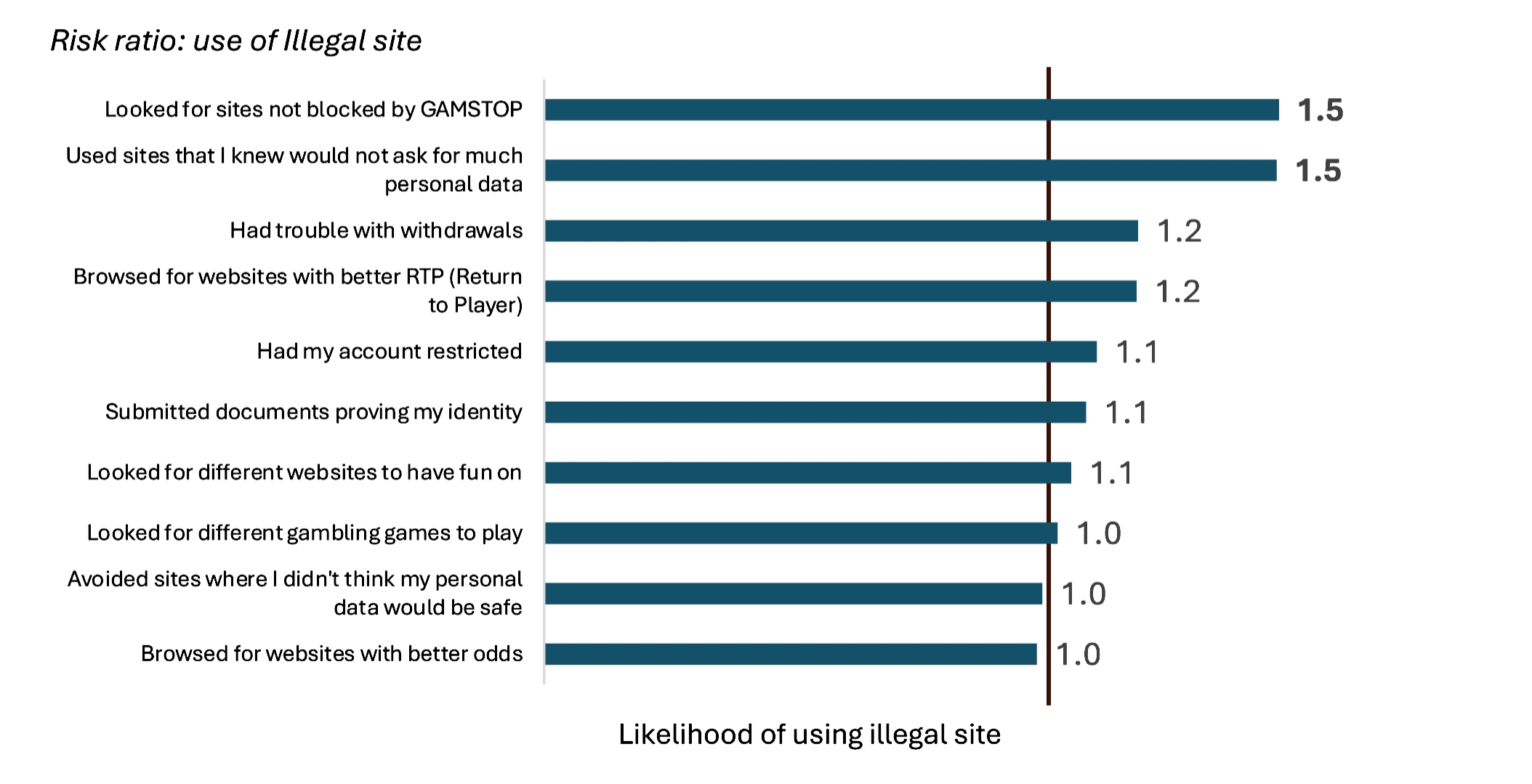
| Behaviour or experience | Risk ratio: likelihood of using illegal gambling websites |
|---|---|
| Looked for sites not blocked by GAMSTOP | 1.5 |
| Used sites that I knew would not ask for much personal data | 1.5 |
| Had trouble with withdrawals | 1.2 |
| Browsed for websites with better RTP (Return to Player) | 1.2 |
| Had my account restricted | 1.1 |
| Submitted documents proving my identity | 1.1 |
| Looked for different websites to have fun on | 1.1 |
| Looked for different gambling games to play | 1.0 |
| Avoided sites where I didn’t think my personal data would be safe | 1.0 |
| Browsed for website with better odds | 1.0 |
E5. In the last 3 months, have you experienced any of the following while using gambling websites?
Base: All survey participants (N=4,007).
Risk ratio analysis compares those that report a behaviour frequently/sometimes versus those that do so rarely and/or never.
As shown in Figure 2, the pattern shows that lower-frequency, more deliberate behaviours are the strongest drivers of illegal website usage, while more common behaviours tend to have less influence. This suggests that behaviours which appear marginal on incidence alone may be the most important to monitor.
Figure 2: Importance in driving illegal gambling website use, against frequency experienced
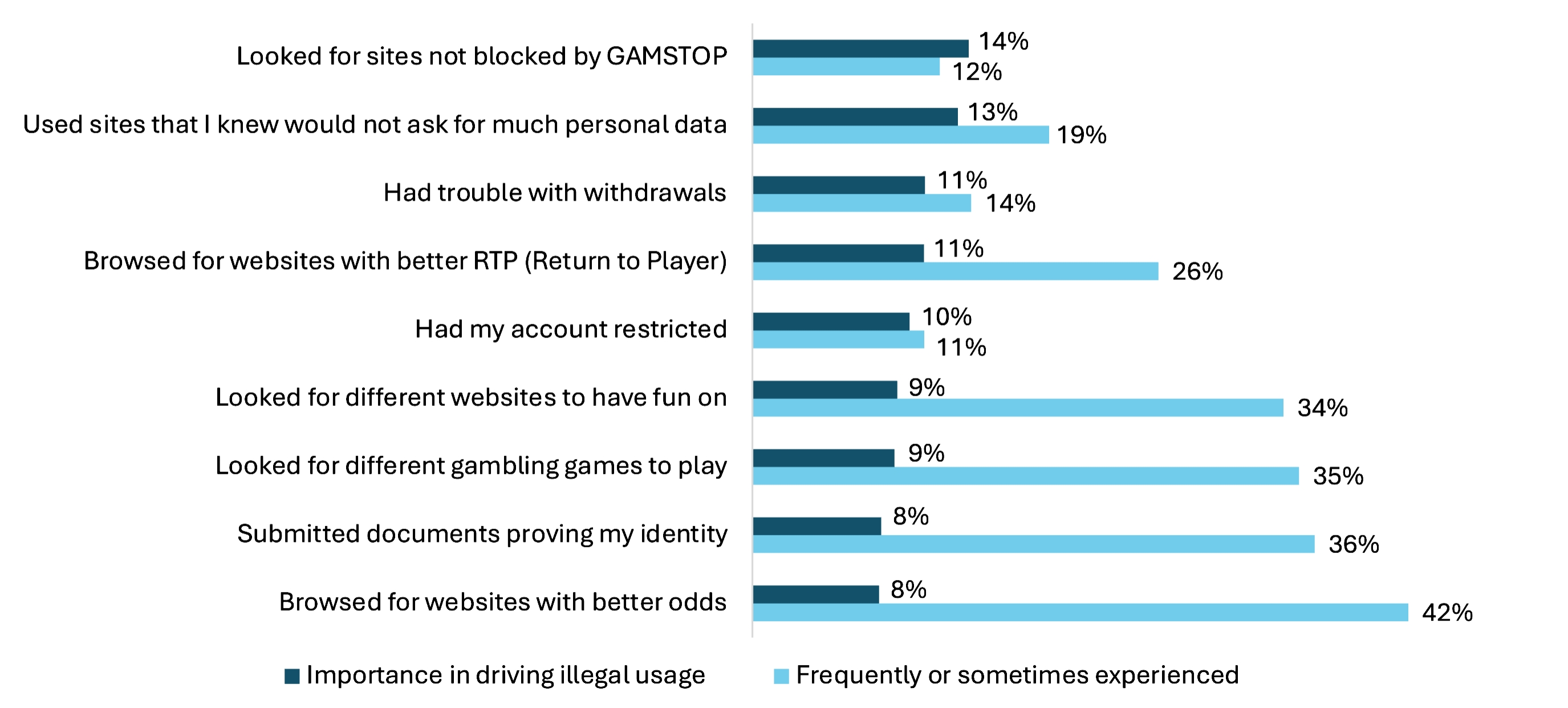
| Push factor | Importance (percentage) | Frequently experienced or sometimes (percentage) |
|---|---|---|
| Looked for sites not blocked by GAMSTOP | 14% | 12% |
| Used sites that I knew would not ask for much personal data | 13% | 19% |
| Had trouble with withdrawals | 11% | 14% |
| Browsed for websites with better RTP (Return to Player) | 11% | 26% |
| Had my account restricted | 10% | 11% |
| Looked for different websites to have fun on | 9% | 34% |
| Looked for different gambling games to play | 9% | 35% |
| Submitted documents proving my identity | 8% | 36% |
| Browsed for website with better odds | 8% | 42% |
Base: All survey participants (N=4,007). Key drivers analysis, conducted using the full scale of likelihood to report each activity plus E5. Frequency of experiences.
How this differs by group
Looking for non-GamStop websites and websites that are known for not asking for much personal data broadly remain the top drivers across all 4 groups, but both how often each behaviour is experienced and how much weight it carries vary considerably.
Table 6. Push factors reportedly experienced ‘frequently’ or ‘sometimes’, by group
| Push factor | PGSI 8+ (percentage) | Skilled Advocates (percentage) | Social Explorers (percentage) | Accidental Tourists (percentage) |
|---|---|---|---|---|
| Looked for sites not blocked by GAMSTOP | 37% | 52% | 20% | 13% |
| Used sites that I knew would not ask for much personal data | 47% | 64% | 34% | 27% | Browsed for websites with better RTP (Return to Player) | 47% | 65% | 46% | 32% |
| Had trouble with withdrawals | 35% | 44% | 20% | 19% |
| Had my account restricted | 29% | 42% | 13% | 16% |
| Submitted documents proving my identity | 53% | 62% | 54% | 43% |
| Looked for different websites to have fun on | 53% | 63% | 55% | 41% |
| Looked for different gambling games to play | 55% | 64% | 54% | 41% |
| Avoided sites where personal data did not feel safe | 53% | 61% | 54% | 52% |
| Browsed for website with better odds | 56% | 63% | 63% | 56% |
Base: All survey participants (N=4,007). Percentage experiencing each behaviour frequently or sometimes in the last three months.
Table 7: Relative importance of each reported push factor in driving illegal online gambling website use, by persona group
| Push factor | Skilled Advocates (percentage) | Social Explorers (percentage) | Accidental Tourists (percentage) |
|---|---|---|---|
| Looked for sites not blocked by GAMSTOP | 13% | 17% | 12% |
| Used sites that I knew would not ask for much personal data | 11% | 16% | 14% | Browsed for websites with better RTP (Return to Player) | 11% | 10% | 10% |
| Had trouble with withdrawals | 10% | 12% | 13% |
| Had my account restricted | 10% | 9% | 12% |
| Submitted documents proving my identity | 9% | 7% | 4% |
| Looked for different websites to have fun on | 10% | 6% | 8% |
| Looked for different gambling games to play | 10% | 8% | 10% |
| Avoided sites where personal data did not feel safe | 6% | 7% | 4% |
| Browsed for website with better odds | 10% | 7% | 7% |
Base: All survey participants (N=4,007). Key drivers analysis, showing relative importance within each group.
Skilled Advocates have a lower range of importance across the factors, with results spread between 9% and 13%. They also report the highest incidence of deliberate behaviours, including looking for non-GamStop websites (52% of illegal website users surveyed) and websites known for not asking for much personal data (64%), reflecting the more ingrained nature of their use of illegal gambling websites. Browsing for better return to player (RTP) is also prominent, reported by 65% and accounting for 11 percent of importance, consistent with the deal-conscious, value-seeking profile outlined in previous sections.
Social Explorers show the clearest gap between frequency and importance, across some measures: for example, using websites known for not asking for much personal data is reported by only 34% of Social Explorers, but accounts for 16% importance (which is second highest importance of all the factors). This behaviour is therefore relatively uncommon but highly diagnostic when they occur. Browsing for better return to player is the exception, reported by 46% and still acting as a moderately important driver.
Accidental Tourists are the clearest exception. Their drivers are more evenly spread and centre on relatively innocuous experiences, with trouble with withdrawals (13% of illegal website users surveyed), having an account restricted (12%) and looking for different games (10%) among the strongest. Searching for non-GamStop websites are both their least common behaviour (13%) and least important driver (12%). This suggests that, for Accidental Tourists, friction within the licensed market is more likely to push them towards illegal gambling websites than a deliberate search for alternatives.
Exploring attitudes towards push factors and influences in more depth
The quantitative findings show a number of factors within the licensed market can act as factors that influence individuals who gamble to explore illegal gambling websites. The digital intelligence work reveals a widespread and practical conversation around these influences, with users proactively seeking alternatives rather than simply complaining.
Digital intelligence provides a broad view of what is being discussed online, while the qualitative research with Skilled Advocates, Social Explorers, and Accidental Tourists reveals the specific motivations that underpin these conversations. By combining these 2 lenses, we can build a nuanced picture of individuals’ attitudes and the role this plays in influencing illegal website use.
Notes for readers:
- Digital intelligence provides insight into public social media content and conversation and can help identify behavioural trends and patterns. However, it reflects expressed rather than confirmed behaviour and cannot be treated as representative of the wider population. Digital intelligence naturally tends to capture those who are more vocal or hold stronger opinions on subjects. For example, individuals who feel strongly about certain regulatory measures, are often more vocal in digital spaces, whereas those with more neutral feelings may be less likely to post. Furthermore, mentions of intent can’t reliably verify actual migration to illegal online gambling, or provide a robust quantitative sizing of the prevalence of the activity.
- Digital intelligence analysis is also limited to publicly available content. Because of the sensitive nature of the topic, the anonymity provided by platforms like Reddit allows space for those who illegally gamble to share their experiences more honestly. On social media platforms like X and Facebook, discussion was more limited, and while YouTube contained a high volume of promotional videos, it lacked genuine conversations between those who gamble. This method hence cannot capture the full extent of activity taking place and instead sets up measurement for the quantitative phase.
Social proof and peer recommendations
Digital intelligence shows that because trust in gambling companies (both licensed and illegal) is low, community validation is key. Anonymous forums like Reddit have become essential sources of validation where users conduct legitimacy checks, share advice, and exchange recommendations. This peer-to-peer ecosystem is where decisions are often made. The conversation is not abstract; it is highly practical, with users seeking direct advice on which websites to use, particularly to circumvent GB-based restrictions like GamStop.
"I'm trying to find a decent non Gamstop UK casino because I'm currently excluded on the main network but fancy a few spins on the weekend."
Verbatim, Reddit: Person seeking a peer recommendation for an illegal alternative.
While the digital landscape shows that these conversations are happening, qualitative research reveals how they influence different groups, exposing 2 different types of risk.
Skilled Advocates are largely immune to recommendations from their friends and family, as they view gambling as a solo, income-focused activity rather than a social one. However, they place significant trust in a select group of respected peers on forums like Reddit. For them, these forums are not for social connection but for sharing skills and gaining a strategic edge. Trust is earned through a proven track record of successful tips and reliable information.
"I get advice occasionally from people that I follow on Reddit who follow me back, and who I have gotten good advice from before.”
Skilled Advocate, Female, 45 years old
While these forums may not be the initial reason a Skilled Advocate seeks out illegal gambling websites, they serve to validate their decision and make them more effective and confident navigators of the illegal market. This reinforces their belief that they can operate successfully outside the regulated system, making them less likely to return to the licensed market.
Social Explorers and Accidental Tourists are more likely to be influenced by word-of-mouth from their immediate social circle: friends and family. For them, a recommendation from a trusted person acts as a powerful behavioural shortcut that bypasses the need for rigorous evaluation. They operate with an implicit trust, assuming that a friend or family member would not recommend a dangerous or illegitimate website.
"I’d be more willing to give a new website a go if it was recommended by my family or friends, rather than someone like an influencer”
Accidental Tourist, Male, 37 years old
This poses a risk of unintentional migration to the illegal market. A casual recommendation can lead Social Explorers and Accidental Tourists to use an illegal gambling website without consciously assessing its licensing status. It is a pathway through which they can stumble into a high-risk environment, often only realising the lack of protections when something goes wrong.
Financial friction: slow withdrawals and the promise of faster payouts
Digital intelligence shows that financial friction is a key route through which illegal online gambling gains appeal. Online, the speed of access to funds is a recurring priority, with users reacting to slow withdrawals in the licensed market by actively seeking illegal alternatives. Many illegal alternatives, especially those using cryptocurrency1, are perceived as offering faster payouts. However, trust remains a key concern, driving users to community validation hubs like Reddit to confirm which websites pay out reliably.
The appeal is therefore not based on inherent trust in illegal online gambling companies, but on the perception that they may offer a more straightforward and efficient experience.
“I've tested a few online casinos over time, but the biggest issue I keep running into is slow withdrawals. Some platforms advertise fast payouts, yet approvals still take days with vague excuses."
Verbatim, Reddit: Person discussing slow withdrawals in the legal gambling space
“The non-GamStop landscape is a bit of a mixed bag here… From my experience and what I’ve read, platforms that support multiple payment methods and instant withdrawals tend to be the most reliable.”
Verbatim, Reddit: Person giving advice on non-GamStop options
Qualitative research adds a layer of nuance, revealing that attitudes towards withdrawal friction differ significantly by audience. Skilled Advocates see slow withdrawals not as a system issue but as an intentional hurdle created by licenced gambling companies to serve their own interests. This reinforces their deep-seated mistrust and validates their belief that the licensed market is working against them.
“There is a sense that licensed sites are quick to take your money and slow to pay out."
Skilled Advocate, Male, 44 years old
For Social Explorers and Accidental Tourists, however, withdrawal delays are more of an accepted annoyance. With lower financial and emotional investment in the outcome, they are more likely to see it as ‘just the way it is.’ While some more frequent players in this group report searching for websites with faster payouts, for most it does not significantly detract from their enjoyment.
"I disagree that licensed sites make it more difficult to withdraw winnings. I think it's more about them being cautious to check if you cheated or more of a safety measure."
Accidental Tourist, Male, 37 years old
Perceived decline in value: odds, RTP, and bonuses
Digital intelligence shows that a perceived decline in value weakens consumer loyalty to the licensed market. Users online frequently describe licensed play as offering poorer value, specifically citing reduced odds, lower return to player (RTP) percentages, and restrictive rewards. This conversation is not just complaint-driven; users are proactively searching for better value, framing illegal online gambling as a way to find more ‘freedom’ and better returns.
“I've played at UKGC-licensed sites for years. Lately I've noticed they've become stricter with limits and slower with withdrawals. Some even have lower RTPs than casinos not on Gamstop”
Verbatim, Reddit: Person discussing the perceived decline in value in the licensed market
"One thing no one mentions is the RTP. A lot of the big UK bookies are nerfing the odds to 92% or 94% to pay for their license fees. It makes a massive difference over a long session.”
Verbatim, Reddit: Person discussing poorer RTP and odds on UK websites
However, this search for value is tempered by concerns around hidden terms and lack of reliability of illegal gambling websites, particularly regarding bonuses that appear attractive but are difficult to withdraw. This reinforces the need for peer validation before choosing a new website amongst those within the digital intelligence.
Qualitatively, this perception of unfairness is a primary motivator for Skilled Advocates. They express a deep-seated mistrust, with certain individuals of this persona, believing that licensed gambling companies collude to lower odds to boost their own profits. This belief encourages them to look for value beyond the licensed online gambling websites.
“It's not just one site, you can see they [the sites] all move together. It feels the sites are working together to squeeze the value out for themselves, not for the player. That's what makes you look for an edge somewhere else”
Skilled Advocate, Male, 44 years old
In contrast, Social Explorers and Accidental Tourists are far less focused on value. In the focus groups, they rarely mention poor odds unprompted, as their focus is on the enjoyment of the activity itself rather than optimising financial returns. For them, the impact of slightly worse returns is negligible and more easily ignored.
"You know the odds are probably not the best, but you don't really think about it. You're just there to have a bit of fun with the game."
Social Explorer, Male, 25 years old
Product experience and enjoyment
The digital conversation suggests that licensed UK gameplay is often perceived as slow, repetitive, and less enjoyable, with some individuals citing forced delays between spins and the loss of features like autoplay as sources of frustration. This prompts some to seek out something new in illegal gambling websites. However, this reflects expressed views and stated intent among more vocal online users, rather than verified behaviour or a representative measure of migration to illegal online gambling.
“Been a casual player for years, but recently UKGC changes have killed the vibe for me. The delay between spins and no autoplay just makes everything feel slow and boring.”
Verbatim, Reddit: Person discussing reduced enjoyment in the licensed space.
In the illegal cryptocurrency space, a ‘boring’ or ‘uneventful’ experience can become a signal of trust and reliability. Users praise simple, straightforward gameplay without interruptions as a sign that the website is legitimate and won't create problems mid-session.
“I tried a crypto casino recently, and the weird part is how uneventful it felt… just a straightforward experience that didn't mess with my head. It honestly felt closer to playing a game and calling it a day, than getting stuck in a loop.”
Verbatim, Reddit: Person discussing simplicity as a trust signal
Qualitative findings show that for Skilled Advocates, game variety is a low-priority factor. Driven by a desire to master specific games to maximise returns, those spoken to report seeing a wide variety of games as a distraction. The only time it becomes relevant is when they are unable to place a specific type of bet (such as on certain international markets) within Great Britian.
"It's not about having a thousand slot games. It's that there are specific types of bets, certain markets, that you just can't place on UK sites. If you want to bet on those, you have no choice but to look elsewhere."
Skilled Advocate, Male, 51 years old
For Social Explorers and Accidental Tourists, the existing variety on licensed websites is largely seen as sufficient. However, some more engaged Social Explorers mention that games can feel repetitive, which can spark a desire for novelty and encourage them to look elsewhere.
Attitudes towards verification
Verification fatigue emerged in the digital intelligence as one of the strongest friction points for licensed gambling websites. Users describe feeling worn down by repeated verification loops that interrupt sign-up, play, or withdrawals. This frustration makes low or ‘no-KYC’ options feel appealing.
“No KYC loops are the biggest thing for me and what has turned me away from other platforms and casinos.”
Verbatim, Reddit: Person discussing the importance of no-KYC
However, users online also recognise that ‘no-KYC’ claims on illegal gambling websites can be misleading, warning peers that verification requests often reappear after a win. This creates a cycle where users, frustrated by checks in the licensed market, move to illegal gambling websites only to face the same issues in a less trusted environment.
“The whole ‘no kyc’ thing is kinda misleading. Most sites are fine until you win something decent then suddenly need docs. It's not really no KYC it's more like delayed KYC.”
Verbatim, Reddit: Person discussing "delayed" KYC on illegal gambling websites
Qualitative research indicatively suggests this factor has an influence for all groups. Skilled Advocates report having a better grasp on the different types of checks, and are especially more likely to say they have a ‘good understanding’ of how Identity checks, fraud or commercial checks, anti-money laundering and/or source of funds checks (KYC), customer interaction taken where financial difficulties have been identified through frictionless ‘financial vulnerability’ checks and ‘financial risk assessments’ could impact their gambling experience, compared to accidental tourists and non-engagers, in particular. Qualitative insight and verbatim analysis proves that this reported ‘good understanding’ does not always correlate with an accurate understanding of each factor, however, the perceived understanding of impact on their experience causes Skilled Advocates to reflect on verification checks as a significant point of resistance and an infringement on their personal autonomy. Social Explorers and Accidental Tourists are less likely to differentiate between different types of checks but generally hold a more balanced view, sometimes viewing them as an unpleasant necessity and a frustrating chore, with others understanding their need to an extent.
“Yes checks are annoying, but I can kind of understand in some cases why they exist”
Social Explorer, Female, 21 years old
Privacy concerns
Separate from the mandatory verification process, a significant area of the customer journey revolves around how operators use the personal data gathered during sign-up for marketing purposes. A key concern for all groups is privacy.
Both Skilled Advocates, Social Explorers and Accidental Tourists question who has access to their information and how it is used. The Social Explorers and Accidental Tourists spoken to, often feel they are sharing too much information and subsequently receive large volumes of unsolicited marketing, while Skilled Advocates worry more about the security of their personal information and the risk of hacking.
Source of funds and verification checks
Digital intelligence shows that source of funds and verification checks are a significant factor for those taking part in online conversations on the topic. Online conversations, particularly on Reddit, frame these checks as intrusive and disproportionate, especially when they interrupt play and involve requests for bank statements. For some, this privacy concern may create a push towards illegal gambling websites. For others, however, the checks reinforce the legitimacy of licensed websites.
“I've had it with the UKGC stuff tried to log in last night and got with another 'source of wealth' request just to deposit 50 quid… I just want to play some slots in peace without sending my bank statements to a stranger.”
Verbatim, Reddit: Person expressing privacy concerns
“Sticking to the proper, regulated sites might feel a bit more restricted with the newer affordability checks we’ve seen in 2026, but at least you know the RTP isn’t rigged and your money is actually protected”
Verbatim, Reddit: Person choosing to stay in the licensed market for trust2
Qualitative research shows that these divergent reactions are tied to the underlying attitudes of the different personas. However, a consistent theme across all groups is a generally low understanding of the various checks being applied. As observed in previous research, conducted for the Commission, consumers frequently conflate different types of financial checks. Research suggests that consumers often do not understand the underlying regulatory or safety purpose of checks unless they are taken through the process step by step. Without this contextual understanding, verification checks are often confused with financial checks or action taken following a check due to concerns identified is simply experienced as unexplained friction.
For Skilled Advocates, source of funds and verification and/or financial checks are a point of resistance, viewed as a direct challenge to their personal autonomy and freedom. With their more extensive experience of the gambling market, those in the focus groups often distinguish between initial identity verification (which they may tolerate) and what they view as ongoing requests for documents such as at withdrawal (which they often see as financial scrutiny and resent). They feel they should be able to gamble their money without such restrictions and be trusted to manage their own finances. The ask for bank statements or financial documents is perceived not just as an inconvenience, but as an intrusive infringement.
"I understand the anti-money laundering checks but the ones around losing a certain amount of money seem intrusive and stifling.”
Skilled Advocate, Female, 45 years old
The Skilled Advocates spoken to discuss a sense of feeling judged by gambling companies and the regulator which reinforces their anti-authority mindset. As a result, they use financial checks as a justification for them to actively seek out illegal alternatives, where they believe they can regain the control and privacy they feel has been taken from them. They are less likely to differentiate between check types, often grouping all verification under the same banner.
In contrast, Social Explorers and Accidental Tourists, who form the majority of illegal gambling website users, view financial checks as an unpleasant necessity. Significantly, these users also appear to conflate financial checks with identity verification, viewing any request for information as part of the same burdensome process of checks. From their perspective, the distinction between providing proof of identity and proof of funds isn’t clear, and it’s the active interruption of their game playing that causes frustration; having to stop their gambling to provide extra documentation is perceived as a chore. While they find the process frustrating and a chore that gets in the way of enjoyment, their reaction is one of pragmatic acceptance rather than principled opposition.
They tend to accept the rationale that these checks are a means of consumer protection and a necessary part of adhering to government policies. For them, the security offered by the licensed market outweighs the inconvenience of the checks.
“I am okay with checks for regulation purposes, but my cynical side is also thinking the checks are for marketing so they can send you information...”
Social Explorer, Female, 21 years old
For these groups, the friction caused by checks is a source of annoyance but is not strong enough to make them actively seek out illegal alternatives. They are willing to trade a degree of privacy and convenience for the assurance that they are playing in a safe and fair environment.
Additionally, for a few individuals spoken to within these groups, this friction, and the feeling that checks are a chore, is exacerbated by perceived inconsistency in how and when different gambling companies request them. In such cases, these individuals feel as though they aren’t quite sure of what document is requested of them or when a check might be triggered.
“I think its very inconsistent when it comes to gambling sites, some might just want your address and email, others want passport, drivers licence, face scan.. others say birth certificate.”
Accidental Tourist, Female, 34 years old
Account control and player management
Loss of access and control is a source of frustration identified in the digital intelligence. Some users online describe having their accounts with licenced gambling companies restricted or closed with little explanation, often framing this as being punished for winning. These users report this typically occurring after a ‘decent win’ and is followed by sudden document requests or withdrawal holds, often leading to suspicion that gambling companies are intentionally delaying payouts.
"You can get banned or gubbed3
for literally anything and they don't give you a reason."
Verbatim, Reddit: Person discussing their account being restricted.
“They just don't want to pay out. If this was crypto… would have transferred it in 1 min but because it's [licensed gambling company] they're trying to make me work for my money.”
Verbatim, Reddit: Person contrasting perceived gambling company unfairness with the speed of cryptocurrency
Loss of access: exclusion and blocking
Digital intelligence shows that when self-exclusion tools such as GamStop remove access to GB-licensed websites, users who still want to gamble often see their only option as leaving the licensed market. The conversation in peer communities then shifts from why someone excluded themselves to how to bypass the block, with users signposting each other to illegal options.
“Being blunt mate, you can't. I tried everything emailed them, called them, even tried to say my account was hacked. They won't budge until the exact date your term ends.”
Verbatim, Reddit: Person discussing the difficulty of reversing Gamstop
“I'm trying to find a decent non Gamstop UK casino because I'm currently excluded on the main network but fancy a few spins on the weekend.”
Verbatim, Reddit: Person seeking illegal alternatives to bypass Gamstop
Qualitative findings show that for those not subject to self-exclusion, GamStop is seen as personally irrelevant. Skilled Advocates, Social Explorers and Accidental Tourists view it as a tool for those experiencing problems with their gambling, which they do not believe applies to them. However, they can see how its ‘blanket block’ nature, despite knowing that GamStop is a personal choice, could infringe on personal autonomy and push others toward the illegal market.
"It's like stopping your human rights because even though it's in your best interest, it's stopping you from doing something you want to do.”
Accidental Tourist, Male, 37 years old
Alternative payments methods: crypto, credit cards, and foreign currency
Within the digital intelligence, alternative payment methods, particularly cryptocurrency, are often framed online as part of a faster, smoother, and more modern experience. The qualitative findings show the influence of these payment methods varies between audience groups.
For Skilled Advocates, the availability of alternative payment methods is a key functional requirement, not just a preference. They view these options as essential instruments for better and more efficient money management. Credit Cards are seen as a tool for managing cash flow, providing flexibility that is otherwise unavailable. Cryptocurrency is often viewed as a safer, more private option that is separate from their main bank account, giving them a greater sense of security and control.
"Crypto feels safer and more secure; if you are hacked and you have a crypto wallet then at least it's just that hacked, not your wallet.”
Skilled Advocate, Female, 35 years old
For this group, the inability to use these methods on licensed websites is a significant operational hurdle. It directly conflicts with their income-focused goals by preventing them from managing their funds with the speed and efficiency they desire.
“It's about control. If I want to use crypto for security or a credit card to manage my cash flow, I should be able to. The restrictions on licensed sites feel like they don't trust you to manage your own money, which is frustrating when you're trying to be efficient.”
Skilled Advocate, Female, 45 years old
For Social Explorers and Accidental Tourists, the issue of alternative payments is less functional and more about personal relevance and modernity. Their interest is not driven by a need for financial control, but by a desire for convenience and a feeling of being up to date. The ability to use cryptocurrency is seen as ‘modern’ and in line with an increasingly digital society, even if they don't use it themselves. The use of foreign currency is often a practical need for those with strong ties to another country, rather than a desire to circumvent rules.
"Having payments in crypto and a different currency isn't just a nice thing to have, it's all more modern as well. It's more fast and efficient and we are a digital society."
Social Explorer, Female, 21 years old
"I'm from Cyprus which uses the Euro, so having foreign currency is important to me.”
Accidental Tourist, Male, 28 years old
While this group may find the lack of these options on licensed websites to be outdated or inconvenient, it is not a primary factor pushing them towards illegal alternatives. In fact, some view the ban on credit cards for licensed online gambling websites as a responsible action that protects players from incurring debt. Overall, alternative payment methods, they report, have little influence on their behaviour.
1 Although the use of gambling companies which offer cryptocurrency isn’t technically illegal, there are no licensed sites that offer it, as it’s very difficult for a licensed site accepting cryptocurrency to pass money laundering assessments. For more information, see the Commission’s guidance on Blockchain technology and crypto-assets.
2 Affordability checks are not being implemented in the gambling market, consumer is most likely referring to bank statements or other documents required by operators for a range of reasons ranging from commercial to checks where indicators of harm have been identified. It is possible that following a financial vulnerability check, operators have followed up with the consumer due to identified financial vulnerability such as bankruptcy.
3Gubbed is a colloquial term to describe of experience of having a gambling account restricted by a gambling company. Therefore, being "gubbed" typically refers to the removal of a player's eligibility for promotional offers, bonuses, and free bets, or the imposition of severe stake limits.
Conclusions and next steps
Notes for readers:
- A definition of terminology mentioned in this section, such as know your customer (KYC) checks and GamStop, can be found in our How to read’ section
- More information on each phase of research discussed is in the ‘Introduction’ of this report
- The ‘Findings’ section includes a description of the personas and detailed results for each of the conclusions discussed in this section.
From foundational insight to robust measurement
This report represents the culmination of a multi-phase research journey designed to understand the complexities of the illegal online gambling market. The Gambling Commission’s series has evolved deliberately, starting from a point of limited knowledge and building progressively towards a more robust form of statistical measurement of consumer engagement in this market. Each stage of the journey has added incremental value to get to where we are today:
- Phase 1 provided the initial discovery, using qualitative methods to identify the core consumer personas (Skilled Advocates, Social Explorers, Accidental Tourists and Self-Excluders) that form the foundation of our understanding
- Phase 2 began the process of quantification, using a survey to validate these audiences and identify the most reliable indicators of illegal gambling website engagement
- This report, Phase 3, provides the granular detail behind the numbers. By deploying a large-scale quantitative survey and advanced analytical techniques, it has explored the attitudes of self-excluders, skilled advocates, social explorers and accidental tourists, and identified the specific push factors that are most influential in driving consumers towards the illegal market. The qualitative deep dive then brought this data to life, explaining the human motivations and attitudes behind the statistics.
The work to-date allows the Commission to now move forward with a high degree of confidence, using robust evidence to understand who is using illegal gambling websites and why.
Core conclusions from Phase 3
Before detailing these conclusions, it is important to reiterate the overarching context of this research: individuals who use illegal gambling websites represent a small minority of those who gamble. The following insights explore the specific dynamics amongst this audience and within this space.
1. Illegal gambling websites are a significant and complex space, with distinct audiences driving engagement
Illegal gambling website users are not a homogenous group, nor do they strictly segment into distinct groups, based on our research. However, they do tend to align with the below personas, each with their own attitudes.
Self-Excluders: A small group, that use illegal gambling websites to circumnavigate GamStop.
Skilled Advocates: Those that self-report intentionally gambling on illegal websites. When assessing their attitudes, they are driven by a strong sense of distrust of the licensed market and the pursuit of better value and personal freedom.
Social Explorers: Those that do not self-report intentionally gambling on illegal websites, but that have given an indication of illegal gambling website usage through some self-reported experiences. Looking at their wider attitudes, they are experience-led deal seekers who particularly trust peer recommendations. While they can find friction in the licensed market frustrating, they generally view it with pragmatic acceptance.
Accidental Tourists: Another group that have given at least some indication of illegal gambling website use through self-reported experiences but also do not self-report intentionally gambling on illegal websites otherwise. Qualitatively, their use of illegal gambling websites appears as typically unintentional and casual, driven by a desire for frictionless play and a growing frustration with the licensed market.
Pulling apart the latter groups – social explorers and accidental tourists – was a key aim of this phase of research. Where previous phases had provided a rules-based approach to defining Self-Excluders and Skilled Advocates, a forthcoming allocation tool, based on learnings from this phase will enable this analysis to take place on the GSGB. The Commission will be able to distinguish between 2 groups that, although aligned on behaviour (that is, illegal gambling website use), are not always aligned on attitudes and motivation.
2. The search for ‘not on GamStop’ has become a primary gateway to illegal gambling websites
This research concludes that, for those who intentionally gambling on illegal websites, their pathway is facilitated by a specific and widely understood language of search. Digital intelligence reveals that the term ‘not on GamStop’ has evolved far beyond its literal meaning. It no longer refers only to circumventing self-exclusion.
Instead, it now functions as a shortcut for a suite of features associated with the illegal market: less friction, fewer identity checks, faster payouts, and the availability of features like credit card or cryptocurrency betting. This search behaviour creates a well-trodden and normalised pathway to the illegal market, making it easier for a broad range of consumers to find and use these websites.
3. A clear hierarchy of 'push factors' has emerged, with friction over access and data in the legal market being key
The Key Drivers Analysis demonstrates how strongly each surveyed factor is linked to illegal gambling website use, relative to the other push factors measured. Across the whole sample, the key factors found are not common experience-focused factors like searching for better odds, but instead are deliberate, access-related issues, namely:
- looking for sites not blocked by Gamstop, whether to circumnavigate Gamstop itself, or as a coded shortcut for illegal gambling websites
- using websites that the consumer knew would not ask for much personal data.
As earlier findings display, there is an element of confusion across all groups as to whether a check is identity, commercial, anti-money laundering and/or source of funds (KYC), financial, or something else, with Consumers often using KYC as a blanket term.
However, this research found that push factors that are present in the legal market, for example KYC-ID or finance-related checks, are also reportedly present in the illegal market. This creates a cycle where users, frustrated by checks in the licensed market, move to illegal gambling websites only to face the same issues in a less trusted environment.
4. Attitudes towards trust and authority fundamentally shape behaviour
Underlying mindsets have a significant impact on likelihood to use illegal gambling websites. Skilled Advocates' anti-establishment views mean they distrust gambling companies and the regulator equally, justifying their use of illegal gambling websites as an expression of personal freedom. In contrast, Social Explorers and Accidental Tourists are more ambivalent, placing trust in peer recommendations over official channels and viewing friction as an inconvenience rather than an injustice. This highlights that for these personas, the journey to an illegal website is not driven by a desire to break rules, but by a search for an easier, more rewarding and trusted user experience.
Implications and next steps
Monitoring and measurement
The findings from this research provide the Commission with a robust toolkit for ongoing monitoring of consumer usage of illegal gambling websites and a clear evidence base to inform future strategy.
The validated Illegal Incidence Index and a forthcoming allocation method for the Illegal Gambling Personas will enable indicative tracking of illegal gambling website user composition via the GSGB, and how regulatory interventions and gambling company practices may impact on this composition.
Future research priorities
This research has established a strong foundation, but specific knowledge gaps remain:
Longitudinal tracking: continue to measure the key drivers to illegal gambling websites and user composition to understand the real-world impact of market interventions.
Exploring the role of educational interventions: while exploring the role of education when it comes to illegal website usage was not the central focus of the project, broader qualitative conversations provided valuable groundwork for future research priorities. From these discussions, several early-stage hypotheses emerging regarding how different personas might respond to interventions.
Strengthening understanding and identification of Skilled Advocates: currently Skilled Advocates are defined as individuals who we’ve identified as illegal gambling website users, who self-report intentionally engaging with illegal gambling websites within the past 12 months. This approach has some limitations associated with recall, misunderstanding of the question and the potential overstating of actions. Future, forthcoming allocation design is needed to strengthen the identification of this audience to ensure more accurate understanding.
Initial indications suggest that Social Explorers and Accidental Tourists are likely to be more receptive to education. These groups would theoretically respond well to communications focused on raising awareness of the indicators of illegal gambling websites and increasing hesitancy by highlighting the real risks of no legal recourse, data theft, and unfair practices. Highlighting the danger of relying solely on peer recommendations is also likely to be important within this.
Conversely, early-stage hypotheses suggest that Skilled Advocates are most unlikely to be persuaded by educational messaging.
For this group, future research could examine the impact of enforcement action aimed at disrupting the illegal gambling website ecosystem, particularly the extent to which any interventions affect the ease of accessing and using illegal websites. Research could also explore the factors that these consumers identify as validating their use of illegal gambling websites, and understand the potential for modifying these factors, and the impact of any resulting changes to them.
Appendices
Appendix A – Qualitative pre-task
Pre task structure (completed via Word)
- Introduction and getting to know you
- exploration of the online world engagement
- experiences of gambling online (website specific)
- perceptions and engagement with unlicenced gambling websites
- reasons for using unlicenced gambling websites and thank you.
Research and pre task objectives:
This pre-task to warm up participants ahead of a focus group, was used to gather foundational context on the participants’ online gambling behaviors and explore their experiences and perceptions of unlicensed gambling websites, alongside preparing them for the upcoming group. In particular, focusing on:
- General digital and gambling routines: how website-based gambling fits into their daily lives, preferred platforms and activities, and motivations for online gambling
- Routes into unlicensed gambling: how unlicensed websites are encountered, and baseline awareness, usage, and future consideration of the unlicenced websites
- Drivers for using unlicensed sites: briefly introducing push factors and exploring early reactions to these.
- Focus group preparation: establishing the research as a non judgmental research context to help participants feel comfortable discussing their behaviors in the upcoming group.
Pre task flow
Introduction
Firstly, we’d like to thank you for completing our questionnaire about your gambling habits and for agreeing to take part in this research with us today to discuss your experiences in more detail!
To better prepare for our session, please send us your answers to the questions on the next couple of pages ahead of your focus group date
Please email your answers to: INSERT EMAIL
This will not take more than 20 to 30 minutes in total.
Participation is voluntary. You can withdraw your participation in the task and focus group at any time by emailing EMAIL PROVIDED.
About you
Can you please start by telling us a little bit about yourself?
- What is your name and what you do for a living?
- Whereabouts do you live? Who do you live with?
- What do you like to do in your free time?
Please type your answer in this box, include any screenshots and pictures where relevant as well: Please type here…
Your online world
We now want you to think about what you do online in your spare time, outside of work. This can be on your phone, on a computer or other device.
- How much time do you spend online, in a typical day? How does this fit in with your wider routine?
- What sites, platforms, apps, do you use most often? Why?
- What do you enjoy doing online? What, if anything, feels more like habit, or a chore?
Please type your answer in this box, include any screenshots and pictures where relevant as well: Please type here…
Your experience of gambling online (website specific)
Now we’d like you to think about gambling online; specifically thinking about gambling on websites rather than apps. Please tell us…
- How would you describe your relationship with gambling?
- What types of online gambling via websites do you like to do? What do you enjoy most about it and why? This could include things like sports betting, horse racing, casino games like slots, bingo, scratch cards, playing The National Lottery etc.
- How long have you been gambling via websites for?
- How do you find out about or come across different gambling sites?
- Besides the chance of winning, what else motivates you to gamble online via websites?
Please type your answer in this box, include any screenshots and pictures where relevant as well: Please type here…
Unlicensed gambling websites
We’d now like you to think about unlicensed gambling websites. These are gambling websites that do not have a licence to operate in Great Britain. People find and use these websites in different ways. Some may come across them without realising they are unlicensed, while others may seek them out intentionally. We want to assure you that individuals who gamble with unlicensed websites are not doing anything wrong. We are just interested in learning about your experiences for the purpose of this research.
- Before doing this research, were you aware of these sites? If so, how and when did you first find out about them? How do you come across them?
- What do you know about these sites, if anything?
- Have you ever used an unlicensed gambling website? If so…
- When was the last time you used one of these sites?
- How often do you use these types of sites?
- What makes you want to use them?
- If not knowingly…
- How do you feel about these sites?
- Would you consider using them in the future?
Please type your answer in this box, include any screenshots and pictures where relevant as well:
Please type here…
Reasons for using unlicensed gambling websites
Please look at the below list of factors as to why some people may choose to use unlicensed gambling websites, which we've gathered from previous research. They are not intended to be an exhaustive list, and your own views might be completely different.
- Licensed gambling websites don’t have very good odds or returns.
- There are limited game types available on licensed gambling websites.
- I’m registered with Gamstop via licensed gambling websites but I still want to gamble.
- Licensed gambling websites require too much information from customers.
- I want to gamble using crypto, foreign currencies or credit cards which I can’t do with licensed gambling websites.
- Licensed sites make it difficult to withdraw winnings.
- My family, friends, influencers or people on forums and X recommend using other, unlicensed sites.
What are your initial reactions to each of these?
Do any of these resonate with you?
Have you experienced any of them personally?
Please type your answer in this box, include any screenshots and pictures where relevant as well:
Please type here…
Once again, thank you so much for your time and contributions, they are very helpful, and we look forward to speaking to you again during the focus group!
If anything here has raised concerns for you, please reach out to the National Gambling Helpline (0808 8020 133) or www.gamcare.org.uk.
Appendix B - Focus group discussion guide
Interview structure
- Introduction & warm-up, alongside pre task exploration (20 mins)
- Push factor deep dive (45 mins)
- The role of gambling companies and regulation (45 mins)
- Final questions and summary, alongside thank and close (10 mins)
Research and interview objectives:
During the focus group session, we deep-dived further into participants' experiences and perceptions of the gambling market. In particular, focusing on the following.
Session introduction and context: Explaining the session's purpose, introducing the moderator(s) and stakeholders, and allowing participants to get to know one another and introduce themselves.
Gambling motivations and experiences: Understanding participants' general behaviors and introducing the topic of unlicensed sites.
Reactions to push factors: Exploring participant reactions, understanding which resonate most and why, and identifying which may motivate them to use an unlicensed site.
Attitudes towards gambling companies and gambling regulation and/or The Commission: Understanding awareness of these entities and unpicking their perceived roles and responsibilities when it comes to the use of unlicensed websites.
Session wrap-up: Collecting final thoughts from participants and allowing time for observers to ask any questions.
1. Introduction, warm-up and pre-task exploration (20 mins)
Aim: to explain the purpose of the research session, get to know the participant(s) and warm them up to the discussion. To understand participants' gambling motivations and experiences, and to introduce the topic of unlicensed sites.
(Introduce moderator and Yonder.)
This session is on behalf of The Gambling Commission who is looking to better understand your experiences when it comes to using online gambling sites.
We’re going to be presenting you with a range of different scenarios and we’re looking to understand how and whether or not, they fit in with your experience, perceptions, and engagement with the gambling sector.
There are no right or wrong answers and everything you say will remain anonymous - none of your personal details will be used in reporting
The session will last 2 hours
Participation is voluntary. You can withdraw your participation research including the pre task, and the focus group at any time by emailing (email here).
Any questions?
To start, it would be great to get to know each other better. Let’s go round the room and can everyone introduce themselves and tell us…
- Your name
- Where do you live and who with?
- What form of online gambling you typically participate in, e.g. sports betting, casino games, scratch cards, playing the nationally lottery.
- What do you enjoy most about gambling and why?
Pre-task recap:
In the pre-task we asked you to reflect on several aspects…
One such area was your motivations regarding gambling. As a group, can we share some thoughts about what attracts you to online gambling sites?
Prompt: entertainment, potential winnings, social aspect, peer recommendation, media exposure, advertising and so on.
Tell me how you come across or hear about online gambling sites
Prompt: family and/or friend and/or peer recommendation, online forums, private groups, advertising, news or wider media coverage.
(Moderator to listen out for any references to advertising related to websites ‘not on Gamstop’ and/or those advertised as on Gamstop.)
What makes these sources trustworthy or worth listening to? What about them is compelling?
We also mentioned unlicensed sites as part of the pre-task and webinar. As a reminder, these are gambling websites that do not have a licence to operate in Great Britain.
We selected you for this research on the basis that you may have used one, either intentionally or accidentally. We want to assure that individuals who gamble with unlicensed websites are not doing anything wrong. We are just interested in learning about your experiences for the purpose of this research.
Who here thinks they might have used an unlicensed gambling site?
What makes you think it may have been an unlicensed gambling website?
What were the signs?
How do you feel about these sites?
For those who have used them, what were the reasons for doing so?
If you haven’t used them before, why do you think someone else may want to?
2. Push factor deep-dive (45 mins)
Aim: to explore participant reactions to push factors, understanding which resonate most and why and which may motivate them to use an unlicensed site.
As mentioned in the webinar, the main topic of discussion is people using unlicensed gambling websites. Because there can be risks associated with using these sites, we want to understand exactly why people are drawn to them, how we can better protect against any associated risks, and what might encourage people to use licensed gambling platforms instead.
I’m now going to share a number of scenarios which may attract people to using licensed gambling websites, which we've gathered from previous research. They are not intended to be an exhaustive list, and your own views might be completely different. You will have seen these in the webinar and pre-task but just as a reminder I’ll show them to you. Please take a minute to read each of these. Once you’ve read them, I want you to note down which of these stood out to you the most and why.
(Moderator to share a slide with all push factors displayed together.)
Okay, let’s go round the group: Which of these stand out to you the most and why? What did you write?
And briefly, as we’ll explore this in more detail later, who, if anyone and/or any bodies and/or parties do you see as being involved and influencing and/or shaping these factors?
We’re now going to dive into each of these in a bit more detail.
(Moderator to display one push factor at a time and probe)
What is your initial reaction to this?
Is this something you’ve experienced before?
Why do you think this would motivate someone to use an unlicensed site?
Additional probes for moderator (if does not come up naturally in discussion): Role of marketing in attracting participants to licensed and unlicensed sites, and whether participants have seen a change in quantity of marketing they receive (hypohesise reduced marketing and/or promos may lower engagement with legal operators). When discussing factor D ‘licensed gambling websites require too much information from customers’, explore what spontaneously comes to mind and what people understand the reason for requiring information for customers to be, for example for identity or finances, and how these are perceived by participants (whether these are seen as judgmental in nature, whether conflated as the same thing or if can distinguish between different types). For reference, reasons for these checks including for anti-money laundering, Know Your Customer (KYC) and so on. (Note: Moderator may need to explain the reasons to participants and check their views depending on spontaneous reaction.)
Now you’ve seen these in more detail, we’re going to do a mapping exercise. I’m going to show you a few different scales and I want us to plot where these scenarios would sit along each of them. It’s okay if you disagree as to where these scenarios sit, I’m keen to understand everyone’s experiences.
(Moderator to show each scale in turn and ask the group to map each scenario against the axes, probing how this relates to their own experiences and why they’ve placed the scenario where they have. )
3. The role of gambling companies and regulation (45 mins)
Aim: understanding awareness of and attitudes towards gambling companies and gambling regulation and/or The Commission. Unpick perceived roles and responsibilities of these parties when it comes to reducing the number of people using unlicensed sites.
Awareness and knowledge of operators and regulation
Let’s now talk about the gambling industry.
- When thinking about gambling and how it is licensed, what comes to mind? What are the first words that pop into your head (moderator to note down)
- Now, when it comes to gambling companies, what comes to mind? What is their role or purpose?
- If I say regulation, what comes to mind? What are the first words that pop into your head (moderator to note down)
- What, if anything, do you know about gambling regulation?
- Have you heard of any specific regulations or regulatory bodies?
- Have you heard of the Gambling Commission?
- What do you understand to be their purpose?
I’m now going to show you a definition of each of these, just to ensure we’re all on the same page. Moderator to show gambling company, regulation and Gambling Commission slides.
- Are there any initial thoughts or reactions to this?
- Does this align with what you already know?
Responsibilities and influence of operators and regulation
Let’s take each of the scenarios in turn and explore this. Moderator to show all 6 factors at once and probe for each push factor:
- Do we see gambling companies or regulation influencing this, or something else?
- Why do you think that?
- How consciously do you think about the role of gambling companies or regulation in relation to this scenario?
Let’s now think a bit more about the role of each of those involved when it comes to protecting people against the risks associated with using unlicensed websites and what might encourage people to use licensed gambling platforms instead.
- Do you think either of them have a role to play in relation to the challenge of more people using unlicensed gambling websites?
- Do you think the actions of either of them have influenced whether people gamble on these sites?
- If you were in their shoes thinking about this challenge, what actions would you take to encourage people to instead use licensed gambling sites?
Particularly thinking about those who might have experienced gambling-related harm and/or those who might need more protection.
4. Final questions and summary (10 mins)
Aim: wrapping up the session, collecting final thoughts from participants, and allowing time for observers to ask any questions.
We’re coming towards the end of the session now. To finish, it would be great to hear your final reflections:
- Has anything we’ve discussed today surprised you or made you think differently?
- Is there anything else you’d like to add which we haven’t covered in the session today?
And finally, I’d like to check if any of our colleagues from the Gambling Commission have any questions.
Lastly, if you feel you would like further support when it comes to gambling or any of the topics we have discussed today, we can direct you to:
- National Gambling Helpline – available 24 hours a day on Freephone 0808 8020 133, or via live chat (opens in new tab)
- Citizens Advice Get help with gambling problems page (opens in new tab)
- NHS Help for problems with gambling page (opens in new tab)
- The GambleAware website (opens in new tab).
Thank and close session.
Appendix C - Qualitative sample breakdown of 15 participants
Qualitative sample breakdown of 15 participants
| Participant | Age (years) | Gender | Audience type | Persona group |
|---|---|---|---|---|
| 1 | 34 | Female | Intentionally gamble on illegal websites (group 1) | Skilled advocate |
| 2 | 54 | Female | Intentionally gamble on illegal websites (group 1) | Skilled advocate | 3 | 25 | Male | Intentionally gamble on illegal websites (group 1) | Skilled advocate | 4 | 28 | Male | Intentionally gamble on illegal websites (group 1) | Skilled advocate | 5 | 21 | Female | Intentionally gamble on illegal websites (group 1) | Skilled advocate | 6 | 18 | Male | Intentionally gamble on illegal websites (group 1) | Skilled advocate | 7 | 37 | Male | Intentionally gamble on illegal websites (group 1) | Skilled advocate | 8 | 37 | Male | Unintentionally gamble on illegal websites (group 2) | Social explorers | 9 | 35 | Female | Unintentionally gamble on illegal websites (group 2) | Social explorers | 10 | 35 | Male | Unintentionally gamble on illegal websites (group 2) | Social explorers | 11 | 51 | Male | Unintentionally gamble on illegal websites (group 2) | Social explorers | 12 | 44 | Male | Unintentionally gamble on illegal websites (group 2) | Accidental tourists | 13 | 32 | Male | Unintentionally gamble on illegal websites (group 2) | Accidental tourists | 14 | 45 | Female | Unintentionally gamble on illegal websites (group 2) | Accidental tourists | 15 | 33 | Male | Unintentionally gamble on illegal websites (group 2) | Accidental tourists |
Appendix D - Digital intelligence list of platforms evidence was sourced from
The digital intelligence phase analysed publicly available online conversation over the 6-month period to develop a deeper understanding of the real-life experiences of individuals who use, or are considering using, the illegal online gambling market.
Scope of analysis
Content was sourced from publicly available discussions across:
- Forums and blogs
- X
- YouTube
- Dark web: Telegram.
The analysis on these platforms focused on:
- Language and key themes: recurring language, discussion topics and behavioural signals
- Push and pull factors: identifying the factors that may prompt consumers to move towards unlicensed gambling, as well as the perceived appeal of these alternatives
- Influences and pathways: exploring the people, communities and sources of information that may influence movement to unlicensed operators, including influencers and peer communities.
Appendix E – Quantitative survey
SECTION S: Screener, gambling participation and demographics
(ASK ALL)
S1. Gender
How do you identify?
Responses include
- Man
- Woman
- Non-binary
- Prefer to use own term (specify)
- Prefer not to say
(ASK ALL)
S2. Age
Please enter your age in the box below.
WRITE IN
(SCREEN OUT: S2 < 18)
(ASK ALL)
S4. Ethnicity
To which of the following ethnic groups do you consider you belong?
(SINGLECODE – CODES AS PER YDS LIST)
(ASK ALL)
S5. Nearest city
Which of the following cities do you live in, or nearest to?
SINGLECODE
- Glasgow
- Edinburgh
- Newcastle
- Leeds
- Hull
- Sheffield
- Manchester
- Liverpool
- Nottingham
- Birmingham
- Norwich
- Milton Keynes
- Brighton
- Oxford
- London
- Southampton
- Bristol
- Plymouth
- Cardiff
- None of these
(ASK ALL)
S5. SEG
The Chief Income Earner is the person with the largest income, whether from employment, pensions, state benefits, investments or any other source. If 2 or more related people in the household have equal income, please think of this question with the oldest in mind. The Chief Income Earner can be of either sex, with no preference to either.
(CODES AS PER YDS USUAL PRACTICE)
(ASK ALL)
S6. Socio-grader
Please input the first 3 or 4 letters of the occupation of your household's Chief Income Earner below and click 'search'.
(SINGLECODE)
(INPUT BOX)
(ASK ALL)
S7. Gambling activity
(SHOW INTRO ON SEPARATE SCREEN)
For the next series of questions, we’d like you to think about gambling activities; by gambling we mean spending money on games of chance where you can win money.
When, if ever, have you spent money on the following activities?
By ‘online’, we strictly mean ‘websites’, rather than gambling apps.
(SINGLE CODE, REVEAL IN TURN)
- Online fruit, slot, or virtual gaming
- Online bingo
- Online betting on horse or dog races, including virtual races
- Online betting on football
- Online betting on other sports, including virtual and e-sports
- Online betting on events (such as, political, entertainment, topical, current affairs, novelty)
- Online roulette, card and/or dice games, poker, or instant win games
- Another form of online gambling [ANCHOR]
Responses include:
- In the last 7 days
- In the last 4 weeks
- In the last 3 months
- In the last 12 months
- More than 12 months ago
- Never spent money on this
(SCREENOUT: IF ALL FROM S7_X = 3 to 6, THANK AND CLOSE)
(ASK ALL)
S8. PGSI
And thinking about the last 12 months…
(SINGLECODE, DO NOT RANDOMISE)
- Have you bet more than you could really afford to lose?
- Have you needed to gamble with larger amounts of money to get the same feeling of excitement?
- When you gambled, did you go back another day to try to win back the money you lost?
- Have you borrowed money or sold anything to get money to gamble?
- Have you felt that you might have a problem with gambling?
- Has gambling caused you any health problems, including stress or anxiety?
- Have people criticized your betting or told you that you had a gambling problem, regardless of whether or not you thought it was true?
- Has your gambling caused any financial problems for you or your household?
- Have you felt guilty about the way you gamble or what happens when you gamble?
Responses include:
- Almost always
- Most of the time
- Sometimes
- Never
(ASK ALL)
S9. Gambling accounts
How many active online gambling accounts do you currently have, with any gambling company?
By ‘active’ we mean accounts that you have deposited money into to participate in an online gambling activity in the last 12 months. Please exclude any accounts you have set up to use for a single gambling event or occasion, or only to make use of a marketing or bonus offer (such as, free bets, free spins, welcome bonus and so on.).
(SINGLECODE)
- 1 to 5
- 6 to 10
- 11 to 15
- 16 to 20
- More than 20
- Don’t know
(ASK ALL)
E4. Push factors – awareness and understanding
Which of the following, if any, are you aware of in the context of online gambling…?
(ROWS, RANDOMISE)
- Return to Player (RTP)
- Identity checks, also known as Know Your Customer (KYC) checks
- Financial vulnerability checks
- The Gambling Commission
- GAMSTOP
- Gamban
- GamProtect
- Financial risk assessments
- Source-of-funds checks
- Statutory Gambling Levy
- Rules applying to online fruit, slot, or virtual gaming (such as, stake limits, spin speed restrictions, autoplay bans)
- Gambling management tools, such as financial limits, self-exclusion, reality checks
- Account restrictions or bans (may also be referred to as “gubbing”)
(COLUMNS, SINGLECODE)
- Aware of this and have a good understanding of how it could impact my gambling experience
- Aware of this and have some understanding of how it could impact my gambling experience
- Aware of this but do not understand how it could impact my gambling experience
- Have never heard of this
(ASK ALL THAT ARE AWARE OF ONE FORM OF CHECK (AT LEAST ONE FROM E4_B / C / H / J = 1-2))
E4b. Impact in own words
[LEAST FILL: Pull through response from relevant E4_X responses]
How would you explain this to a friend, discussing how you think it could impact your gambling? Please describe your understanding as clearly as you can, even if you are unsure of some details.
WRITE IN
SECTION B: General attitudes and motivation
(ASK ALL)
B1. General attitudes
Thinking about your life in general, to what extent do you agree or disagree with the statements below?
ROWS, RANDOMISE
- I prefer to seek guaranteed rewards over larger, uncertain rewards
- I conduct thorough research before buying things
- I find it exciting to experiment with new technologies
- I often act quickly on new opportunities
- I care more about experiences than final results
- I am willing to risk losing money if there is a chance to gain a lot
- My online privacy is important to me
- I throw caution to the wind when trying new things
- It is okay to break the rules sometimes if no one gets hurt
- I am often more curious to try things if they are restricted and/or banned
- I often reminisce about missed opportunities
- I trust public regulators to act in my best interests
(COLUMNS, REVERSE SCALE)
- Strongly agree
- Agree
- Neither agree nor disagree
- Disagree
- Strongly disagree
- Don’t know
(ASK ALL)
B2. General motivations
How important are the below to you when making an investment?
(ROWS, RANDOMISE)
- Making money quickly
- Making long-term investments
- Relieving stress
- Having fun
- Feeling in control
- Avoiding missing out on a good opportunity
- That my friends and/or family are also doing it
- Taking advantage of good deals
- Testing my own skills and/or judgement
- Recovering any previous losses
(COLUMNS, REVERSE SCALE)
- Very important
- Somewhat important
- Not very important
- Not important at all
- Don’t know
SECTION C: Gambling attitudes and motivations
(ASK ALL)
C1. Gambling motivations
Now thinking about gambling specifically, how important have the below been to you when choosing which websites to gamble with in the last 4 weeks?
(ROWS, RANDOMISE, SPLIT FACTORS OVER 2 SCREENS OF 10 EACH)
- Avoiding Gamstop block
- Avoiding Gamban
- Avoiding gambling blocks set by my bank or payment provider
- Avoiding bans or restrictions placed on me by other gambling companies
- Finding sites with no or minimal identity checks
- Having fun while gambling
- Finding the best odds
- High Return to Player (RTP) percentages
- Playing or discovering new games
- Knowing my personal information is secure
- Quick and easy withdrawals
- Using websites I had already heard of
- Using websites that are licensed by the Gambling Commission
- A quick and simple sign up process
- Being able to use alternative currencies to bet (for example, not GBP)
- Using cryptocurrencies to bet
- Finding sites with a smooth user experience
- Knowing my winnings will be paid out with no issue
- Taking advantage of the best offers and promotions
- Recommendations from friends or family
- Recommendations from forums and/or social media (for example Reddit, X, and so on)
- Endorsements by influencers and/or social media personalities
(COLUMNS, REVERSE SCALE)
- Very important
- Somewhat important
- Not very important
- Not important at all
- Prefer not to say
(ASK ALL)
C2. Licensing attitudes
Where do you sit on the below scales?
(10-PT SCALE, LEFT STATEMENT = 1, RIGHT STATEMENT = 10, 11 = Don’t know)
Statements A
Left: There should be fewer rules in place on gambling. Right: There should be more rules in place on gambling.
Statements B
Left: Adults should be free to gamble on any website they like, even if they are not licensed by the Gambling Commission. Right: Adults should only be able to gamble on websites licensed by the Gambling Commission.
(ASK ALL)
C3. Gambling-specific attitudes
To what extent do you agree or disagree with the statements below?
(ROWS, RANDOMISE)
- If I set myself a gambling limit, I usually stick to it
- I get frustrated with gambling rules and restrictions
- Gambling is a ‘side-hustle’ for me
- Fast withdrawals from gambling websites are more important to me than promotions and/or offers
- I do not want to be bothered by the gambling company I am using whilst I’m gambling
- I actively explore different gambling websites for new experiences
- It is important to me to gamble with the same gambling websites as my friends and/or family
- It is important to me to gamble with the same gambling websites as other people online
- It is important to me for a gambling website to be licensed with the Gambling Commission
- I often act fast when I spot a new gambling promotion or offer
- I tend to spend a small amount of money when depositing on a new gambling website
- I am very careful when choosing which gambling websites to gamble with.
- When gambling, I am more concerned with quick wins than my overall gambling experience.
- Identity checks and/or KYC (Know Your Customer) checks on gambling websites are important to protect customers.
- I think it is fair for gambling websites to ask for some of my financial information for large withdrawals.
- I enjoy often trying new gambling websites or gambling products and/or experiences.
- Gambling websites should check in with their customers regularly around their gambling wellbeing.
- I see a lot of advertising about gambling on my social media accounts.
(COLUMNS, SINGLECODE, REVERSE SCALE)
- Strongly agree
- Agree
- Neither agree nor disagree
- Disagree
- Strongly disagree
- Prefer not to say
(ASK ALL)
D3. GAMSTOP
Have you ever signed up to GAMSTOP, an online tool that restricts access to gambling websites based on personal details you share?
GamStop is a free online tool that, if you sign up, prevents you from using gambling websites and apps run by companies licensed in Great Britain, for a period of your choosing.
This tool is sometimes called ‘self-exclusion’ and applies across all licensed gambling websites.
(SINGLECODE)
- Yes, I am currently signed up
- Yes, I have signed up in the past
- No
- Don’t know
(ASK ALL WHO SELF EXCLUDE (D3 = 1-2))
D4. GAMSTOP effectiveness
(A3 = 1: Does; A3 = 2;)Did GAMSTOP entirely prevent you from using gambling websites with your own account?
(SINGLECODE)
- Yes, I (A3 = 1: have not gambled; A3 = 2: did not gamble) on websites on my own account while signed up
- No, I still [A3 = 1: have a way; A3 = 2: found a way] to gamble on websites on my own account while signed up
- Don’t know
(ASK ALL THAT ALREADY HAVEN’T INDICATED ILLEGAL GAMBLING (ALL EXCEPT D4 = 2))
D1. Intentional usage
Have you intentionally gambled on a gambling website that you knew did not have a licence to operate in Great Britain?
We want to assure you that the information you provide in this survey is completely confidential, and that individuals who gamble with unlicensed websites are not engaging in illegal activity. We are only interested to know the true extent of how many people are using these websites.
(SINGLECODE)
- Yes, in the last 4 weeks
- Yes, in the last 12 months
- Yes, more than 12 months ago
- No, never
- Don’t know
- Prefer not to say
(ASK IF THINKS HAS USED UNLICENSED IN L4W (D1 = 1))
D2. Site check
Which gambling website(s) have you used in the last 4 weeks that you think did not have a licence from the Gambling Commission?
Everything you tell us is completely confidential, we’ll only use this information to check the licensing status of these companies for research purposes.
Please enter your answers in the boxes below. You do not need to fill all the boxes to go to the next question.
(WRITE-IN, KEEP GENERATING BOXES UPON PRESSING ENTER, WITH RESPONDENTS ALLOWED TO PASS WITHOUT FILLING ALL )
- Prefer not to say
(ASK ALL)
D5. Indicators
Have you ever…
(SINGLECODE COLUMNS, RANDOMISE ROWS)
1.Yes, in the past 4 weeks 2. Yes, in the past 12 months 3. Yes, more than 12 months ago 4. No, never 98. Don’t know 99. Prefer not to say
- Used a Virtual Private Network (VPN) specifically to access a gambling website that was not otherwise available in Great Britain
- Placed a bet and/or played a game on a gambling website using cryptocurrency (such as Bitcoin)
- Placed a bet and/or played a game using money directly from your credit card (that can be paid off each month)
- Placed a bet and/or played a game on a gambling website using Non-Fungible Tokens (NFTs) or virtual assets
- Signed up to a gambling website because you knew you wouldn’t need to verify your age or identity
- Cancelled a withdrawal before it reached your bank/wallet on a gambling website
- Used a gambling website that you knew was not on GamStop
(SHOW INTRO TEXT ON SEPARATE SCREEN WITH 5 SECOND DELAY)
In Great Britain, gambling websites are regulated by the Gambling Commission. As the regulator, the Commission provides licences to companies allowing them to operate in Britain if they meet a set of rules and requirements.
Examples of some gambling companies licensed by the Gambling Commission include well-known companies such as William Hill, Bet365, Ladbrokes, and Coral.
Sometimes, however, there are some gambling companies that operate gambling websites in Great Britain without having a licence from the Commission. These websites may have a licence to operate in a different country, or not have one at all, from any country.
(THEN QUESTION ON NEXT PAGE)
Section E: Illegal gambling module and push factors
(ASK ALL)
E5. Push factors – experience
In the last 3 months, have you experienced any of the following while using gambling websites?
(ROWS, RANDOMISE)
- Browsed for websites with better RTP (Return to Player)
- Browsed for websites with better odds
- Had my account restricted
- Looked for sites not blocked by GAMSTOP and/or Gamban
- Had trouble with withdrawals
- Played on crypto casinos
- Used sites without financial checks
- Looked for different websites to have fun on
- Looked for different gambling games to play
- Avoided sites where I didn’t think my personal data would be safe
- Used sites that I knew would not ask for much personal data
[S7_a = 1-3: Found sites where I could still use Autoplay / turbo / slam stops]
Submitted documents proving my identity
COLUMNS, SINGLECODE
- Yes, frequently
- Yes, sometimes
- Yes, rarely
- No, never
- I don’t know
- Prefer not to say
(ASK LICDUM = 1 or 2)
E1. Intro to focus for next questions
(DON’T ALLOW SKIP TO NEXT SCREEN FOR 10 SECONDS)
From your answers so far, it is possible that you have previously gambled on gambling website(s) that did not have a licence to operate in Great Britain. Some of these website(s) may only be licensed in other countries, and some website(s) may not hold a licence to operate anywhere.
For the next couple questions, we will ask you to consider these website(s) specifically.
(LICDUM = 2: These are the website(s) where you (PULL THROUGH RANDOM RESPONSE WHERE D5_a-g = 1-3; IF MORE THAN ONE FROM D5_a-g = 1-3; among other things.)
Please note that you have not done anything wrong by using these websites.
As a reminder, your answers to this survey are completely confidential, and we are solely interested in understanding your experience of these websites for research purposes.
(ASK LICDUM = 2)
E2. Awareness of unlicensed sites
At the time you used the website(s) in question, were you aware it was likely not licensed by the Gambling Commission?
(SINGLECODE)
- Yes
- No
- Don’t know
- Prefer not to say
(ASK LICDUM = 1 or 2)
E3. Product
When you have used the website(s) in question, what types of gambling activities do you usually take part in?
(MULTICODE, RANDOMISE)
(TREAT ROWS 3 to 6 AS A BLOCK)
(TREAT ROWS 8 to 11 AS A BLOCK)
- Online fruit, slot, or virtual gaming
- Online bingo
- Online betting on horse or dog races, including virtual races
- Online betting on football
- Online betting on other sports
- Online betting on virtual and e-sports
- Online betting on events (such as, political, entertainment, topical, current affairs, novelty)
- Online roulette
- Online card and/or dice games
- Online poker
- Online instant win games
- Crypto casinos
- Another form of online gambling (please specify) [ANCHOR]
- None of the above [EXCLUSIVE, ANCHOR]
- Prefer not to say [EXCLUSIVE, ANCHOR]
Section F: Close and recontact
(ASK ALL, DISABLE BACK BUTTON)
F1. Close
Thank you for answering those questions today. Some of the questions you’ve answered today have been about unlicensed gambling websites in Great Britain.
The questions you have just answered were on behalf of our client, the Gambling Commission.
We want to assure you that nothing you have said in this survey can be attributed back to you, and that individuals who gamble with unlicensed websites are not engaging in illegal activity.
However, we would like you to know that gambling with these websites does not provide you the protection of regulatory oversight by the Gambling Commission.
The Commission strongly advises that you don’t use unlicensed gambling websites, as your funds and data security are not protected when doing so.
If you are ever unsure as to whether a gambling company is licensed in Great Britain, you can check the Gambling Commission’s information page titled ’What to look at before you gamble’.
If this survey has raised any topics of concern, you can contact:
- Samaritans on 116 123
- GamCare on 0808 8020 133.
In partnership with the Gambling Commission, we are also looking to conduct some follow-up interviews to explore a range of pathways and experiences in gambling. Please click to the next screen to find out more.
This would involve taking part in a 2-hour in-person focus group in June 2026, (in either London or Birmingham) where we would look to explore your perceptions and experience of gambling further. There may also be a ‘homework’ task that we would ask you to complete before the group, as well as an information webinar, which together would take around an hour of your time in total.
If you agree to take part and are selected to do the focus group you would be provided with a voucher for your time and as a thank you for taking part of £150.
Please note, your details will only be passed on if you agree and only for the purposes of this study. All details will be stored and transferred securely and will be deleted once the study is over and note your details will NOT be passed on to the Gambling Commission. Any responses you provide will remain anonymous and will not be directly attributable to you.
If you agree to take part, we (Yonder Consulting) will collect your name, email address and phone number. This will then be shared with our recruitment partner, Criteria Fieldwork, who would then get in touch with you to further assess your eligibility and provide further details.
Would you be interested in taking part?
- Yes
- No
THANK AND CLOSE
(IF YES (F1 = 1))
F2. Details
Do you give permission to collect your name, email address, phone number and responses to this survey to contact you regarding this additional research, should you be eligible?
- Yes
- No
THANK AND CLOSE
(IF YES (F2 = 1))
F3. Give details
If you are no longer interested in taking part in this further research, please close your browser without sharing your details.
If you are interested, please provide your:
- Name
- Email address
- Mobile phone number
Appendix F – Quantitative sample
Gender of participants
| Gender | Percentage |
|---|---|
| Male | 62% |
| Female | 38% |
Age of participants
| Age range (years) | Percentage |
|---|---|
| 18 to 24 | 12% |
| 25 to 34 | 26% |
| 35 to 44 | 22% |
| 45 to 54 | 18% |
| 55 to 64 | 13% |
| 64 and older | 8% |
Quotas placed on age and gender in line with GSGB fallout for people that have gambled in the last 4 weeks (excluding lottery-only players).