- Print the full document
- Save the page as a HTML document to your device
- Save the page as a PDF file
- Bookmark it - it will always be the latest version of this document
This box is not visible in the printed version.
Illegal gambling - Phase 4: Initial findings from new data on consumer engagement with illegal gambling websites
The initial findings from new data on consumer engagement with illegal gambling websites.
Published: 5 November 2026
Last updated: 5 November 2026
This version was printed or saved on: 5 November 2026
Online version: https://www.gamblingcommission.gov.uk/report/illegal-gambling-phase-4-initial-findings-from-new-data-on-consumer-engagement-with-illegal-gambling-websites
Executive summary
This report presents the first year of data from the Gambling Survey for Great Britain (GSGB) on consumer engagement with illegal gambling websites, covering April 2025 to 2026. The research feeds into the Gambling Commission’s Illegal gambling and crime Evidence Roadmap, supporting the development of a robust evidence base on participation in online illegal gambling in Great Britain.
These findings are derived from a composite Illegal Gambling Index developed through a multi-phased programme of research undertaken by the Commission and Yonder Consulting. The index combines a range of behavioural indicators associated with illegal gambling website use and provides the Commission with a robust and iterative measure for monitoring consumer engagement over time. Further details of how the Illegal Gambling Index was derived can be found in the accompanying technical report.
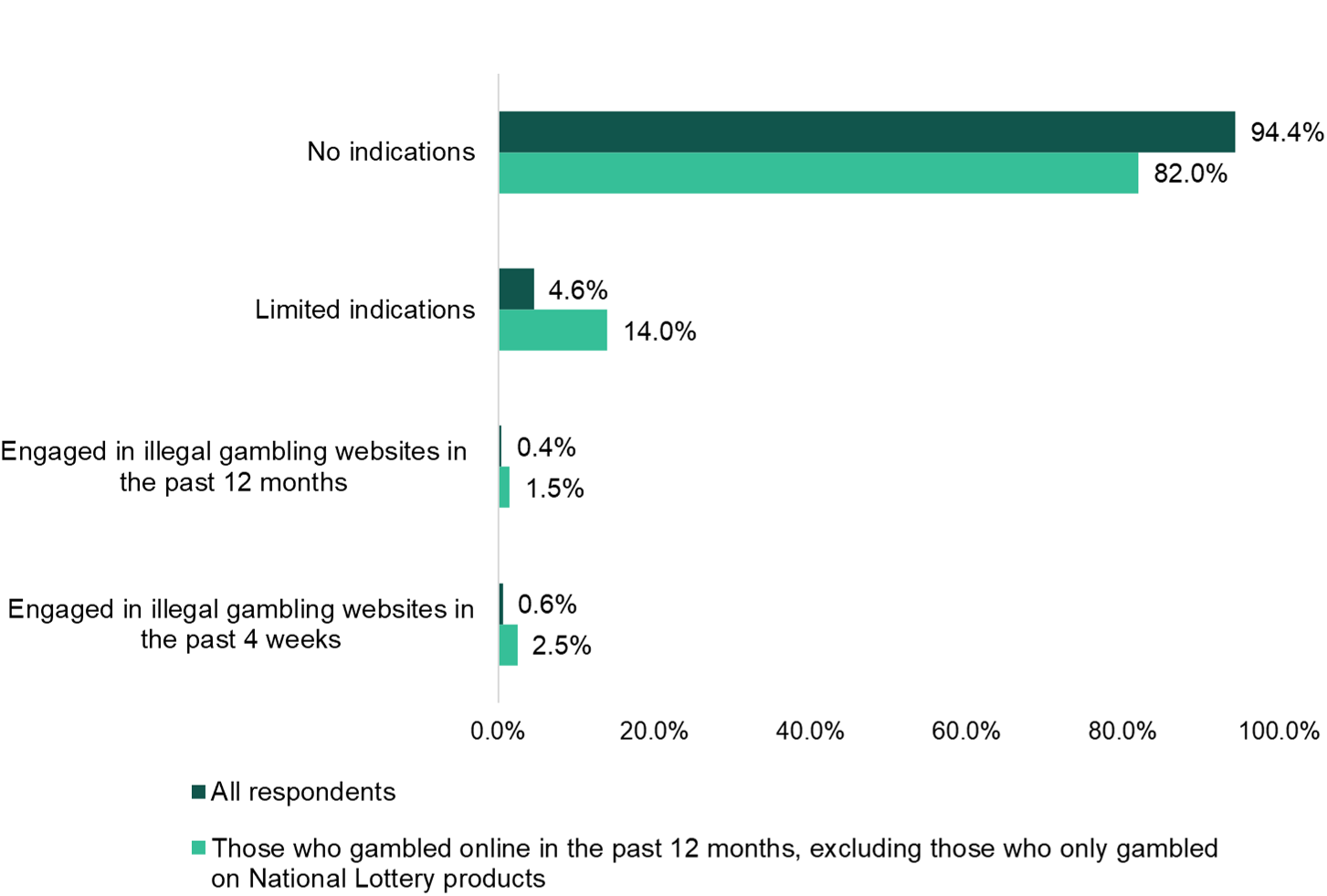
Findings estimate that the proportion of people using illegal gambling websites among the whole population (including those who do not gamble) is low, with most respondents showing no indication of using an illegal gambling website (94.4%). 0.6% of respondents have engaged with illegal gambling websites within the past 4 weeks and a further 0.4% in the past 12 months (but not in the past 4 weeks). 4.6% of respondents demonstrated limited indications of engagement, meaning that they have displayed some indications of engagement with illegal gambling websites in the past 12 months (or longer ago) but there is insufficient evidence to confidently categorise them as having used an illegal gambling website within the past 4 weeks or in the past 12 months.
Among those who gambled online in the past 12 months1, 2.5% had engaged with illegal gambling websites within the past 4 weeks, and 1.5% had engaged in the past 12 months2. Engagement with illegal gambling websites was higher amongst males than females, and tended to be more prevalent amongst younger adults in the past 12 months, particularly those aged 18 to 24. In contrast, engagement among 25 to 34-year-olds was more evident within the past 4 weeks.
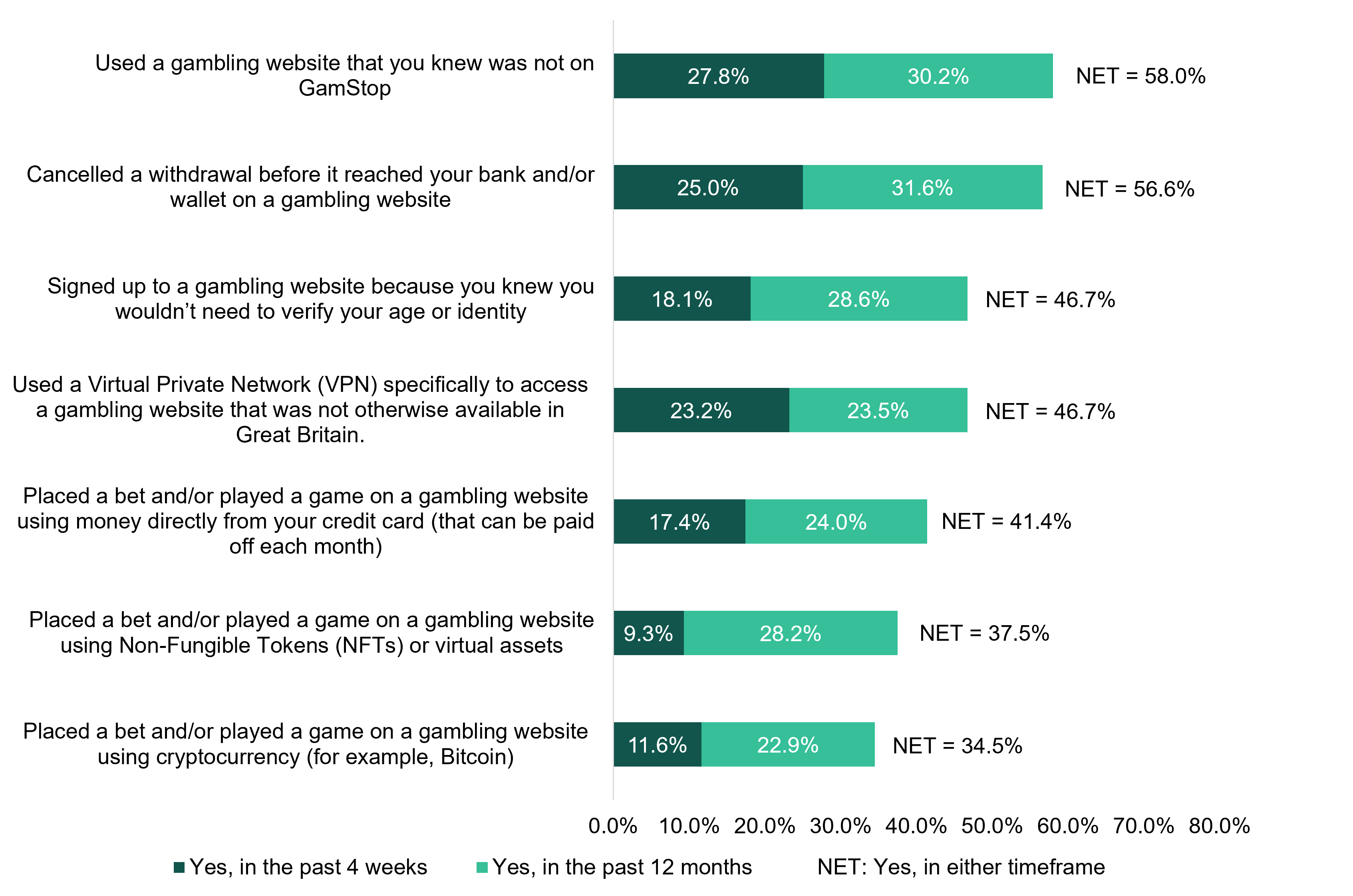
Among illegal gambling website users, the most common behavioural indicators reported within the past 12 months were using a gambling website known to not be registered with Gamstop’ (58.0%) and ‘cancelling a withdrawal before it reached a bank and/or wallet on a gambling website’ (56.5%).
Once larger sample sizes are acquired through future waves of data, it will be possible to undertake more detailed analysis of illegal gambling website users, including exploring associations with a wider range of variables within the Gambling Survey for Great Britain (GSGB). Upcoming work also includes the development of additional GSGB survey questions to provide the Commission with the capability to track the different persona groups identified in previous phases of the research, within the wider sample of illegal gambling website users. This will help the Commission develop a more complete understanding of participation in online illegal gambling.
1 Excluding those who only gambled on National Lottery Products. See the How to read this report section for further details.
2 Findings relating to engagement with illegal gambling websites within the past 4 weeks and past 12 months are mutually exclusive. Those who engaged in an illegal gambling website in the past 4 weeks were not included in the past 12-month category.
Background
The Gambling Act 2005 (opens in new tab) sets out 3 licensing objectives that must be met by all licensed gambling operators. One of these objectives is to prevent gambling from being linked to crime or disorder, or from being used to support crime. In line with this objective, the Gambling Commission’s Corporate Strategy 2024 to 2027 sets the goal of making it difficult to provide illegal gambling at scale to consumers in Great Britain. While illegal gambling takes place both online and in person, our work to date focuses on consumer engagement with illegal gambling websites.
As part of our Consumer Voice programme, the Commission appointed Yonder Consulting to undertake several phases of research to better understand the consumers who engage with illegal gambling websites and their underlying motivations and attitudes. This research has involved 4 phases, providing the Commission with a comprehensive understanding of consumer engagement with illegal gambling websites in Great Britain. The research contributes to the Commission’s Illegal gambling and crime Evidence Roadmap, supporting the development of a robust evidence base on participation in illegal online gambling in Great Britain.
A core aim of the research was to develop a means of measuring consumer engagement with illegal gambling websites. This involved the development of a suite of survey questions and an accompanying composite Illegal Gambling Index approach to support the Commission in tracking consumer engagement with illegal gambling websites through the Gambling Survey for Great Britain (GSGB).
This was developed using a robust, iterative approach which included:
Phase 1: Qualitative research to identify the core consumer personas engaging with illegal gambling websites.
Phase 2: Quantitative research to validate these personas and develop a suite of survey questions that contribute to a composite Illegal Gambling Index for tracking the engagement with illegal gambling websites.
Phase 3: A mixed-method study building on the findings from previous phases to develop an analytical methodology for quantifying persona composition and the primary 'push factors' contributing to consumer usage of illegal gambling websites.
Phase 4: A report presenting initial findings from the GSGB, alongside a technical report detailing the methodology underpinning the composite index.
How to read this report
This Phase 4 report presents initial findings from a new set of survey questions that have been incorporated into an Illegal Gambling Index, designed to provide an indication of engagement with illegal gambling websites. It should be read alongside the accompanying technical report, which:
- explains the development of a new set of ‘illegal gambling’ questions to be integrated into the Gambling Commission’s Gambing Survey of Great Britian (GSGB), accompanied by a transparent explanation of the methodology used to develop these questions
- outlines how the Commission could use these questions to track consumer engagement with illegal gambling websites over time, feeding into future monitoring and measurement of the impact of regulation
- offers recommendations on how to repeat and update the question, and the accompanying metrics, over time, to ensure it remains relevant and reflects the contemporary consumer reality3.
Findings on consumer engagement with illegal gambling websites are presented both as a proportion of all respondents, representative of the adult population (including those who do not gamble), and for respondents who reported gambling online in the past 12 months, excluding those who only gambled online on National Lottery products4,5. Throughout this report, 'those who gambled online' therefore refers to this subset of survey respondents.
Although questions were only asked to respondents who reported gambling online in the past 12 months, findings were rebased to all respondents who completed the GSGB online survey to estimate the proportion of people using illegal gambling websites among the whole population (including those who do not gamble).
Findings are based on the first year of available data made up of 4 quarterly waves. Statistical significance testing was conducted at the 95% confidence level (p value less than 0.05). Where differences were found to be statistically significant, this has been made explicit in the report. The minimum base size for significance testing was 50 respondents. Figures yielded from a base size of fewer than 50 cases or a cell size of 0 are not shown, but are indicated by '-' in data tables.
Findings relating to engagement with illegal gambling websites within the past 4 weeks and past 12 months are mutually exclusive. Those who engaged in an illegal gambling website in the past 4 weeks were not included in the past 12-month category.
3 This report focuses on the specific Index scoring approach currently being used within the GSGB.
4 Here, this includes individuals who reported gambling online in the last 4 weeks and individuals who reported gambling online in the last 12 months.
5 This approach of excluding those who only gamble online on National Lottery products is consistent with previous phases of the research, ensuring focus on consumers with experience of the wider online gambling market, where exposure to illegal gambling websites may occur.
Details and methodology
Statements and survey question
The Gambling Survey for Great Britain (GSGB) survey questions were developed iteratively throughout the previous phases of this research, informed by a combination of qualitative and quantitative evidence. This included focus groups, depth interviews, lived experience engagement, large-scale surveys of online gamblers, and expert workshops to identify, test, and refine indicators of consumer engagement with illegal gambling websites. The research produced 7 final statements that were assessed to be the key indicators of consumer engagement with illegal gambling websites. These statements were subsequently incorporated into a composite Illegal Gambling Index, with responses scored and aggregated to create an overall measure of consumer engagement.
Respondents who had gambled online in the past 12 months were asked if they had ever:
- used a Virtual Private Network (VPN) specifically to access a gambling website that was not otherwise available in Great Britain
- placed a bet and/or played a game on a gambling website using cryptocurrency (for example, Bitcoin)
- placed a bet and/or played a game on a gambling website using money directly from your credit card (that can be paid off each month)
- placed a bet and/or played a game on a gambling website using Non-Fungible Tokens (NFTs) or virtual assets
- signed up to a gambling website because you knew you wouldn’t need to verify your age or identity
- cancelled a withdrawal before it reached your bank and/or wallet on a gambling website
- used a gambling website that you knew was not on Gamstop.
Response options for each statement included:
- yes, in the past 4 weeks
- yes, in the past 12 months
- yes, more than 12 months ago
- no, never
- don’t know
- prefer not to say.
Further details on the survey questions can be found in the technical report.
An initial version of the Illegal Gambling Index contained an additional question asking respondents directly whether they had intentionally used an illegal gambling website. However, through initial analysis of the first 2 waves of the GSGB questions, it was determined that the other 7 indicators within the Index were sufficient to capture illegal gambling website users, leading to the intentionality question not being incorporated into the final Index scoring methodology6. More detail on this process can be found in the Commission modification of the Index section of the technical report.
6 Although not incorporated in the Index scoring methodology, this intentional question was retained on the GSGB as it will be used in the future to help the Commission differentiate between the 4 persona groups established in earlier phases of this research.
Data collection
The Gambling Survey for Great Britain (GSGB) is conducted via a push-to-web methodology, with data collected from adults aged 18 years and over living in Great Britain. Fieldwork is carried out in 4 waves running quarterly, with a combined annual sample of around 20,000 respondents. The new illegal gambling questions were first piloted in Wave 2 of the 2025 survey and have been included in all subsequent waves.
This report presents initial GSGB findings based on data collected across 4 waves between April 2025 and April 2026. Questions were asked only of respondents who gambled online in the past 12 months and were considered appropriate for inclusion on the online version of the survey. When excluding those who only gambled on National Lottery products, the remaining sample for those who gambled online in the past 12 months was 3,569. To estimate the proportion of people using illegal gambling websites among the whole population (including those who do not gamble), the data had also been rebased on all 14,257 respondents7 who completed the GSGB online survey.
7 Questions were asked online only, resulting in a sample size of approximately 14,000 respondents. Although the GSGB can be completed online or on paper, respondents who completed the paper questionnaire were excluded from the base for this analysis because the questions were not asked in the paper survey and online participants can differ in their characteristics from paper respondents. To improve representativeness, web weighting was applied to the online sample, adjusting the results to reflect the wider population.
The Illegal Gambling Index
The Index uses survey responses to 7 indicators that reflect behaviours associated with use of illegal gambling websites. To reflect differing levels of confidence that an indicator represents engagement with an illegal gambling website, each indicator was assigned a strength rating8.
‘Near Certain’ indicators
The following indicators were assigned a ‘Near Certain’ strength rating.
Used a gambling website that was not on Gamstop – This was deemed a near certain indicator because all online licensed gambling operators in Great Britain are required to participate in Gamstop. If a gambling website is not registered with Gamstop, it is operating illegally.
Signed up to a gambling website because you knew you wouldn’t need to verify your age or identity - Using a website that does not verify age or identity is a near certain indication that the website is not being run by a licensed operator, as age and identity verification are fundamental requirements for Gambling Commission licensed operators.
Cancelling a withdrawal before it reached their bank and/or wallet on a gambling website – This is a feature that can be available on illegal gambling websites. Remote Technical Standards (RTS) 14B, introduced in 2021 prohibited gambling operators from allowing customers to cancel withdrawal requests following evidence that this practice was associated with increased gambling-related harm. As the requirement has been in place for several years now, this was considered a near-certain indicator of engagement with an illegal gambling website.
‘Strong’ indicators
The following indicators were assigned a ‘Strong’ strength rating.
Used a Virtual Private Network (VPN) specifically to access a gambling website that was not otherwise available in Great Britain – This was considered a strong indicator because the use of a VPN to access a website that would otherwise be blocked in Great Britain, whether a website licensed by another country’s gambling regulator or an entirely illegal website, provides a strong indication of illegal gambling. It was classified as strong, rather than near certain, due to the possibility of inaccurate self-reporting by respondents who had used VPNs to access websites licensed within Great Britain (for example, to bypass workplace internet restrictions).
Placed a bet and/or played a game on a gambling website using cryptocurrency (for example, Bitcoin) and Placed a bet and/or played a game on a gambling website using Non-Fungible Tokens (NFTs) or virtual assets – These indicators were considered strong, rather than near certain because respondents confuse NFT or cryptocurrency trading with gambling, as evidenced in earlier phases of this research.
‘Weaker’ indicator
The following indicator was assigned a ‘Weaker’ strength rating.
Placed a bet and/or played a game on a gambling website using money directly from your credit card (that can be paid off each month) – It’s important to consider the legislative context for this indicator. In 2020, the Commission banned operators from allowing customers to deposit on a gambling website using a credit card, meaning that respondents reporting using a credit card to gamble, may be doing so on illegal gambling websites. However, it is important to acknowledge that respondents may have issues with recall of when they exhibited this behaviour, meaning it could have fallen in or outside of the window in which the behaviour is specifically indicative of usage of an illegal website. Additionally, it is possible that respondents could also be misunderstanding credit card versus debit card use. Research conducted by MoneySuperMarket (opens in new tab) found that as much as a quarter of British people do not know the difference between a credit and debit card. This could potentially lead to respondents misreporting their credit card depositing behaviours, decreasing the reliability of credit card usage as an indicator of illegal gambling.
Index scores are assigned in relationship to one another, based on strength. For calculating the Gambling Survey for Great Britain (GSGB) illegal gambling index:
- indicators rated as ‘Near Certain’ were assigned a score of 3
- indicators rated as ‘Strong’ were assigned a score of 2
- the indicator rated as ‘Weaker’ was assigned a score of 1.
To account for recall bias, scores are weighted according to when the behaviour was reported:
- within the past 4 weeks: 100% of assigned score
- within the past 12 months: 50% of the assigned score
- more than 12 months ago: 25% of assigned score
- never: 0.
Based on these strength ratings, the maximum feasible index score obtained when a respondent reports all 7 indicators in the past 4 weeks is 16 as shown in Table 1.
Table 1: Strength ratings given to indicators
| Indicator | Not on Gamstop | VPN | Crypto | Credit card | NFTs | Verification | Withdrawal cancellation |
|---|---|---|---|---|---|---|---|
| Strength | Near certain | Strong | Strong | Weaker | Strong | Near certain | Near certain |
| Past 4 weeks | 3 | 2 | 2 | 1 | 2 | 3 | 3 |
| Past 12 months | 1.5 | 1.0 | 1.0 | 0.5 | 1.0 | 1.5 | 1.5 |
| More than 12 months ago | 0.75 | 0.50 | 0.50 | 0.25 | 0.50 | 0.75 | 0.75 |
| Never | 0 | 0 | 0 | 0 | 0 | 0 | 0 |
To create an easy-to-comprehend, single metric ranging from 0 to 100, scores are multiplied by 6.25 (100 divided by 16). Consequently, a respondent reporting all 7 indicators within the past 4 weeks would receive the maximum index score of 100.
Given the strength ratings assigned and the maximum combination of these totaling 100, the index calculations are show in Table 2.
Table 2: Index calculations for the indicators
| Indicator | Not on Gamstop | VPN | Crypto | Credit card | NFTs | Verification | Withdrawal cancellation |
|---|---|---|---|---|---|---|---|
| Strength | Near certain | Strong | Strong | Weaker | Strong | Near certain | Near certain |
| Initial rating | 3 | 2 | 2 | 1 | 2 | 3 | 3 |
| Multiplication factor | 6.25 | 6.25 | 6.25 | 6.25 | 6.25 | 6.25 | 6.25 |
| Past 4 weeks | 18.75 | 12.50 | 12.50 | 6.25 | 12.50 | 18.75 | 18.75 |
| Past 12 months | 9.38 | 6.25 | 6.25 | 3.13 | 6.25 | 9.38 | 9.38 |
| More than 12 months ago | 4.69 | 3.13 | 3.13 | 1.57 | 3.13 | 4.69 | 4.69 |
| Never | 0.0 | 0.0 | 0.0 | 0.0 | 0.0 | 0.0 | 0.0 |
Based on the strength of the ratings, 4 categories can be developed from the scoring:
Those who have engaged with illegal gambling websites in the past 4 weeks - Respondents who demonstrate at least 1 ‘Near certain’ indicator or 2 ‘Strong’ indicators within the past 4 weeks. This corresponds to meeting an index score of 18.75 when considering the past 4 weeks’ responses only.
Those who engaged with illegal gambling websites in the past 12 months - Where the past 4 week threshold isn’t met, indicators reported within the past 12 months are incorporated at a progressively lower strength rating to reflect the reduced recency of the reported behaviour. Respondents whose score then reaches the index threshold of 18.75 are assigned to this qualifying timeframe.
Those demonstrating limited indications – This includes respondents who report 1 or more indicators, but whose combination of indicator strength and recency does not reach the qualifying criteria for being categorised as an illegal gambling website user in the past 4 weeks or past 12 months. This may reflect either a score of below the 18.75 index threshold, or indicators that are historic (more than 12 months ago).
No indications – Respondents with a score of 0 who demonstrate no indication of engaging with illegal gambling websites.
Note on limited indications category
Within the GSGB, respondents were offered a ‘More than 12 months ago’ response option to ensure that those whose behaviour occurred several years earlier had an appropriate response available. However, because these responses relate to less recent activity and are more susceptible to recall error, they should be treated with caution.
Additionally, some indicators related to regulatory changes for licensed gambling websites that occurred years ago, such as the banning of credit card gambling and customers being able to cancel withdrawals. These changes were introduced in 2020 and 2021 respectively, so some respondents may report engaging in these behaviours prior to the bans occurring. For example, a respondent who recalls using a credit card on a gambling website 10 years ago may select ‘More than 12 months ago’, but this behaviour would not necessarily indicate illegal gambling website use as it occurred before this capability was banned on licensed gambling websites.
Some respondents in this category may achieve the 18.75 index score threshold, even after accounting for the reduced weighting and timeframe of the indicators they reported. However, where all relevant indicators relate solely to behaviours that occurred more than 12 months ago, these respondents remain classified within this category and are not considered illegal gambling website users.
It is important to note that although the Commission will publish findings relating to those demonstrating limited indications of engagement with illegal gambling websites, this is primarily for completeness of reporting. Interpretation and discussion should focus on respondents who meet the threshold for likely illegal gambling website use, rather than those in the limited indications category.
Further details of the rationale for the survey questions and approach taken for the illegal gambling composite index (including strengths and limitations) can be found in the technical report technical report.
Strengths and limitations of the GSGB can also be found in the Gambling Survey for Great Britain technical report.
8 Strength ratings were assigned based on quantitative and qualitative insights, survey methodology expertise, and evidence on the limitations of self-reported behaviours, particularly where responses may reflect confusion or differing interpretations.
Initial findings
Participation estimates for engagement with illegal gambling websites
All respondents
Although questions were asked only of respondents who reported gambling online in the past 12 months, results were rebased to all respondents who completed the Gambling Survey for Great Britain (GSGB) online survey. This provides estimates for the proportion of the population who use illegal gambling websites (including those who do not gamble).
Findings estimate that the proportion of people using illegal gambling websites among the whole population (including those who do not gamble) is low, with most respondents showing no indications of using an illegal gambling website (94.4%). 0.6% of respondents have engaged with illegal gambling websites within the past 4 weeks and a further 0.4% in the past 12 months (but not in the past 4 weeks)(as shown in Figure 1). 4.6% of respondents demonstrated limited indicators, meaning that they have displayed some indications of engagement with illegal gambling websites in the past 12 months (or longer ago) but there is insufficient evidence to confidently categorise them as having used an illegal gambling website within the past 4 weeks or in the past 12 months.
Those who have gambled online in the past 12 months
Among those who reported gambling online in the past 12 months, 82.0% show no indications of using an illegal gambling website. 2.5% have engaged with illegal gambling websites in the past 4 weeks and a further 1.5% in the past 12 months (but not in the past 4 weeks). 14.0% of respondents demonstrated weaker indicators that provide low levels of confidence that engagement with an illegal gambling website had occurred in the past 12 months, as shown in Figure 1.
Figure 1: Participation estimates for engagement with illegal gambling websites
| Participation estimates for engagement with illegal gambling websites | Percentage of all respondents | Percentage of those who gambled online in the past 12 months |
|---|---|---|
| No indications | 94.4% | 82.0% |
| Limited indications | 4.6% | 14.0% |
| Engaged in illegal gambling websites in the past 12 months | 0.4% | 1.5% |
| Engaged in illegal gambling websites in the past 4 weeks | 0.6% | 2.5% |
Base: Adults aged 18 years and over (14,257 unweighted) and adults aged 18 years and over who reported gambling online in the past 12 months, excluding those who only gambled on National Lottery products (3,569 unweighted).
Demographics – among all respondents
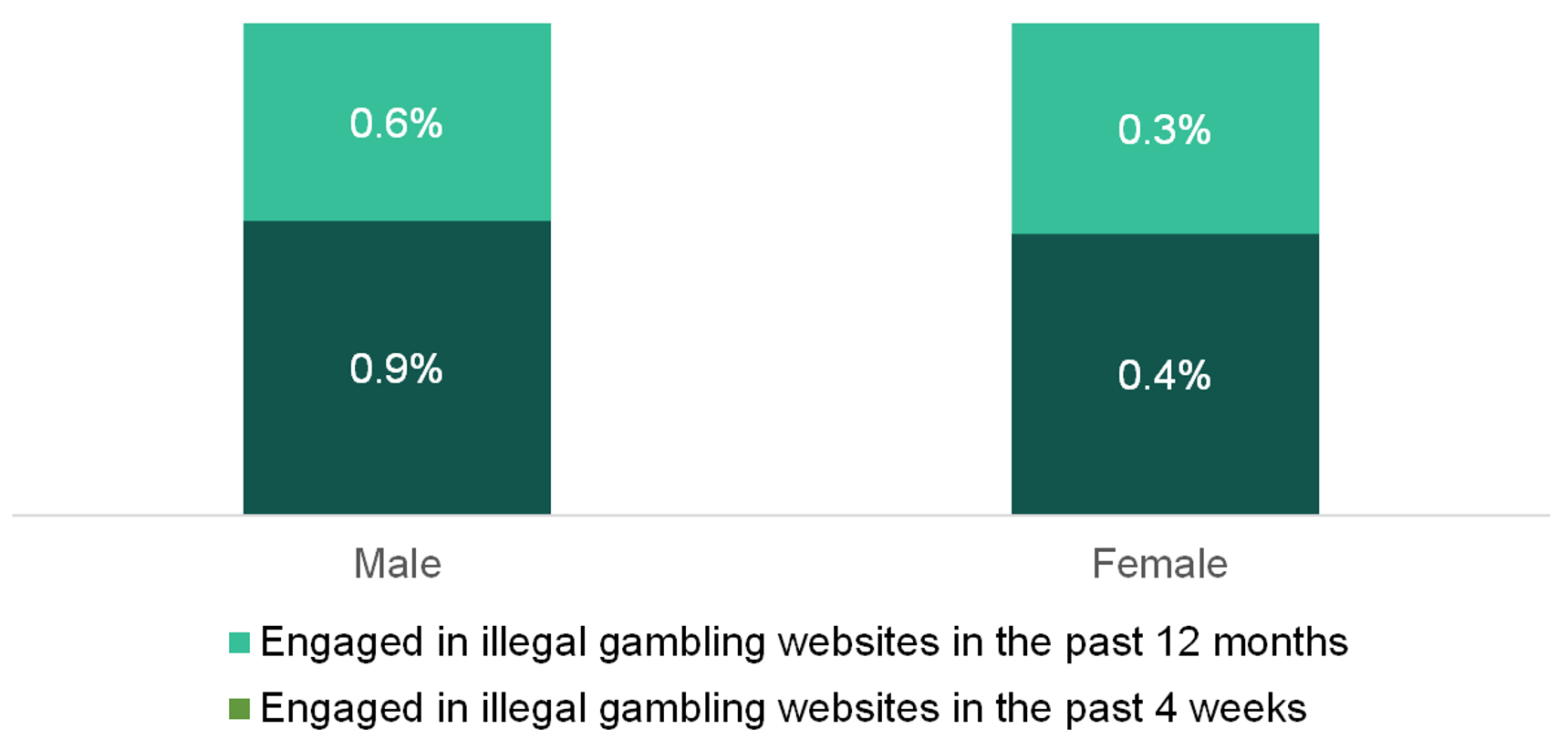
Male respondents (0.9%) were significantly more likely than female respondents (0.4%) to have engaged with illegal gambling websites in the past 4 weeks. This pattern was also consistent when looking at engagement in the past 12 months (0.6%, and 0.3%, respectively) as shown in Figure 2.
Figure 2: Engagement with illegal gambling websites, by sex
| Engagement with illegal gambling websites | Male (percentage) | Female (percentage) |
|---|---|---|
| Engaged in illegal gambling websites in the past 4 weeks | 0.9% | 0.4% |
| Engaged in illegal gambling websites in the past 12 months | 0.6% | 0.3% |
Base: Male and female respondents aged 18 years and over (Males: 6,361; Females: 7,886 unweighted)9.
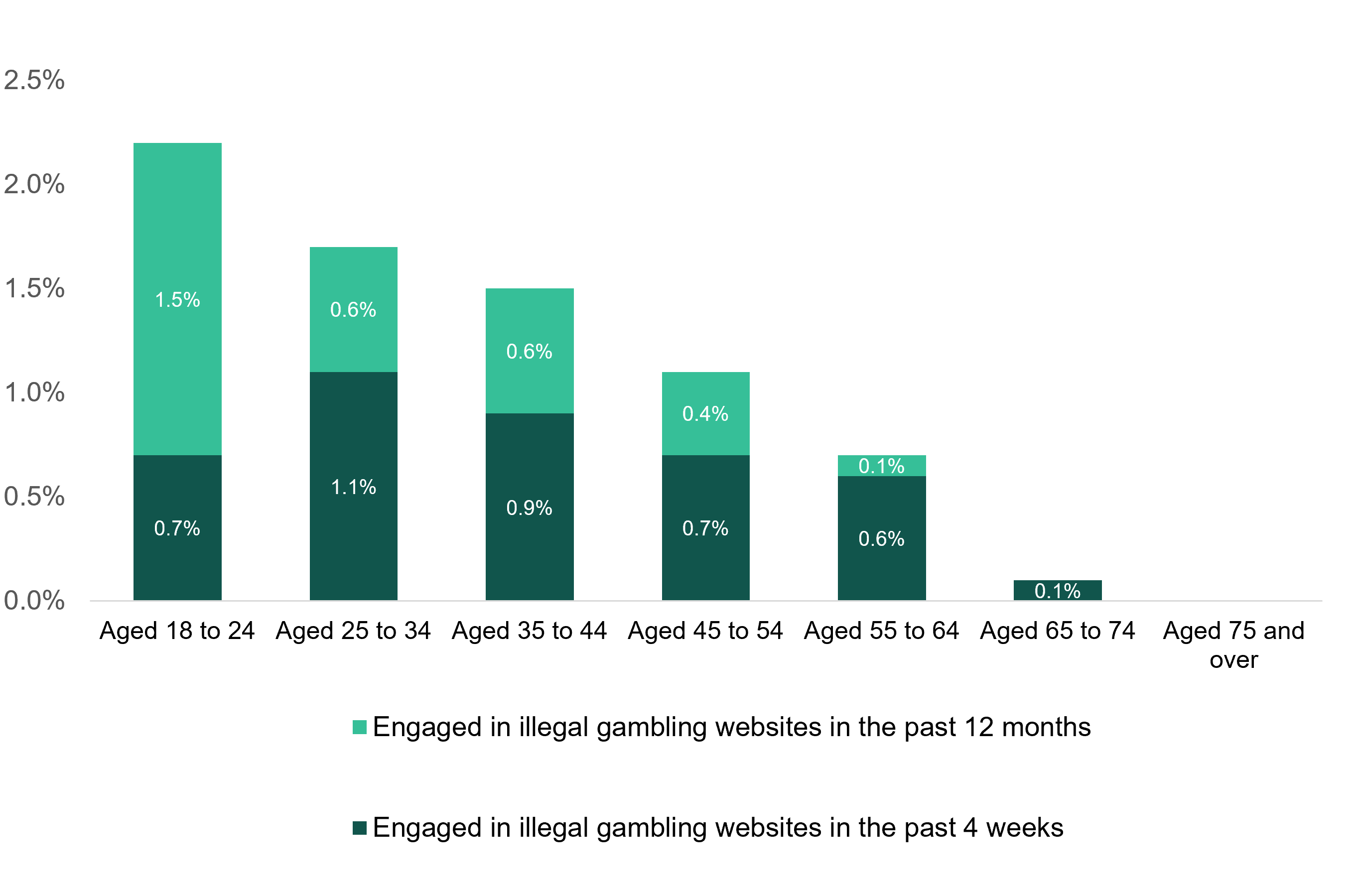
Engagement with illegal gambling websites in the past 4 weeks was similar across age groups (ranging from 0.6% to 1.1%), with engagement at its highest for those aged between 25 to 34 (1.1%). The only exception was for those aged 65 and above, where engagement with illegal gambling websites in the past 4 weeks was significantly lower than other age groups (0.1% for those aged between 65 to 74).
When looking at engagement with illegal gambling websites in the past 12 months, engagement amongst 18 to 24 year olds was significantly higher (1.5%) than other groups (ranging from 0.1% to 0.6%) as shown in Figure 3.
Although engagement with illegal gambling websites overall was higher for 18 to 24 year olds (2.2%), much of this engagement occurred within the past 12 months (1.5%) rather than the past 4 weeks (0.7%). In contrast, among 25 to 34 year olds, past 4-week engagement (1.1%) was reported at a higher rate to past 12-month engagement (0.6%)10. This could indicate more frequent engagement amongst this age group.
Figure 3: Engagement with illegal gambling websites, by age
| Engagement with illegal gambling websites | Aged 18 to 24 | Aged 25 to 34 | Aged 35 to 44 | Aged 45 to 54 | Aged 55 to 64 | Aged 65 to 74 | Aged 75 and over |
|---|---|---|---|---|---|---|---|
| Engaged in illegal gambling websites in the past 4 weeks | 1.5% | 0.6% | 0.6% | 0.4% | 0.1% | Nil | Nil |
| Engaged in illegal gambling websites in the past 12 months | 0.7% | 1.1% | 0.9% | 0.7% | 0.6% | 0.1% | Nil |
Base: Adults aged 18 years and over (18 to 24 years: 1,108; 25 to 34 years: 2,814; 35 to 44 years: 2,965; 45 to 54 years: 2,302; 55 to 64 years: 2,293; 65 to 74 years: 1,829: 75 and over: 946 unweighted).
Those who have engaged with illegal gambling websites
Illegal gambling website users are those who had engaged with illegal gambling websites, by meeting the Index scoring threshold ‘in the past 4 weeks’ or ‘in the last 12 months’ timeframes.
Among those identified as engaging with illegal gambling websites, 60.6% had done so in the past 4 weeks, while 39.4% had done so in the past 12 months.
Owing to the small sample size within this group (n=128), demographical breakdowns of this group cannot be reported at this stage. As further data is collected and sample sizes increase, more detailed demographic analysis can be conducted.
However, it is possible to explore the behavioural indicators associated with engagement with illegal gambling websites among this group. The indicators most reported by this group are presented within the next section.
9 Unweighted bases for sex categories do not add up to the total (14,257) due to ‘prefer not to answer’ being selected.
10 This demographic pattern was consistent when looking at those who gambled online, excluding those who only gambled on National Lottery products.
Indicators of engagement with illegal gambling websites
This section focuses on each indicator, in relation to those who have engaged with an illegal gambling website (that is, met the threshold to be categorised as engaging with an illegal gambling website in the past 4 weeks or 12 months).
Figure 4 shows the prevalence of indicators of engagement with illegal gambling websites among this group, within the past 4 weeks and past 12 months11.
Figure 4: Indicators of engagement with illegal gambling websites, of those who engaged with an illegal gambling website
| Indicators of engagement | Yes, in the past 4 weeks | Yes, in the past 12 months | NET: Yes, in either timeframe |
|---|---|---|---|
| Used a gambling website that you knew was not on Gamstop | 27.8% | 30.2% | 58.0% |
| Cancelled a withdrawal before it reached your bank and/or wallet on a gambling website | 25.0% | 31.6% | 56.6% | Signed up to a gambling website because you knew you wouldn’t need to verify your age or identity | 18.1% | 28.6% | 46.7% | Used a Virtual Private Network (VPN) specifically to access a gambling website that was not otherwise available in Great Britain | 23.2% | 23.5% | 46.7% | Placed a bet and/or played a game on a gambling website using money directly from your credit card (that can be paid off each month) | 17.4% | 24.0% | 41.4% | Placed a bet and/or played a game on a gambling website using Non-Fungible Tokens (NFTs) or virtual assets | 9.3% | 28.2% | 37.5% | Placed a bet and/or played a game on a gambling website using cryptocurrency (for example, Bitcoin) | 11.6% | 22.9% | 34.5% |
Base: Those who have engaged with an illegal gambling website in either the last 4 weeks or the last 12 months (127 to 128 unweighted).
Not on Gamstop
For those who had engaged with an illegal gambling website in either timeframe, one of the most commonly reported indicators, was ‘used a gambling website that you knew was not on Gamstop’ (58%). The most recent phase of this research has revealed that consumers searching for ‘not on Gamstop’ gambling websites has become a primary gateway to the illegal online gambling market. The term has evolved beyond its original meaning, and is now widely used as a shorthand for features associated with the illegal market.
Whilst research has shown that some users do deliberately use illegal gambling websites to circumvent Gamstop, this coded terminology suggests that others are also actively seeking out websites through specific and well-understood terms, creating a normalised and established pathway into illegal online gambling. Therefore, it is not surprising that this indicator was among one of the most prevalent for those engaging with illegal gambling websites.
Cancelling a withdrawal
One of the most reported indicators was cancelling a withdrawal (56.6% across both reported timeframes). This finding is consistent with earlier phases of this series of research, which identified this indicator as a reliable indicator of engagement with illegal gambling websites. However, the prevalence of this indicator among those who engaged with illegal gambling websites was higher than anticipated, as cancelling a withdrawal had originally been regarded as a relatively uncommon experience.
Avoiding verification processes
46.7% of those engaging with illegal gambling websites reported that they signed up to a gambling website because they wouldn’t need to verify their age or identity. 18.1% reported doing so in the past 4 weeks, while 28.6% reported doing so in the past 12 months. This variation is not unexpected, as age and identity verification requirements are typically encountered when first opening gambling accounts. As a result, respondents may have been more likely to report this indicator over a 12 month period, reflecting the occurrence that users continue to use their existing gambling accounts rather than regularly create new accounts.
Use of alternative payment methods
The least common indicators reported overall were ‘Placed a bet and/or played a game on a gambling website using Non-Fungible Tokens (NFTs) or virtual assets’ (37.5%) and ‘Placed a bet and/or played a game on a gambling website using cryptocurrency (for example, Bitcoin)’ (34.5%). Despite being the least prevalent indicators, more than a third of illegal gambling website users reporting use of these alternative payment methods suggesting that cryptocurrency, NFTs and other virtual assets may now form an established part of the illegal gambling ecosystem.
Furthermore, both indicators were more commonly reported for the past 12 months than in the past 4 weeks. This could suggest that gambling with NFTs, virtual assets or cryptocurrency is not a regular activity for many users, but instead occurs on a more occasional basis. Recent research suggests that some individuals are attracted to cryptocurrency because it is perceived as a way to stay up to date with an increasingly digital society.
Paying to gamble with a credit card
Of those engaging with illegal gambling websites, 41.4% reported that they placed a bet and/or played a game on a gambling website using money directly from their credit card . Although this indicator was reported at a slightly higher rate within the past 12 months (24.0%) than in the past 4 weeks (17.4%), this was not statistically significant. It is important to acknowledge that respondents may have issues with recall of when they exhibited this behaviour.
Additionally, the prevalence of this indicator could be potentially attributed to respondents misunderstanding credit card versus debit card use. Research conducted by MoneySuperMarket (opens in new tab) found that as much as a quarter of British people do not know the difference between a credit and debit card. This could potentially lead to respondents misreporting their credit card depositing behaviours, a factor that has been accounted for in the Index scoring approach for determining engagement with illegal gambling websites.
11 Responses relating to any experiences of indicators that occurred more than 12 months ago are not included in the findings presented in this section.
Conclusion and next steps
These initial findings provide an early view of how we will be able to monitor consumer engagement with illegal gambling websites using the Gambling Survey for Great Britain (GSGB). The findings show that a small proportion of people are engaging with illegal gambling websites, and that those engaging in illegal gambling websites are more likely to be male and younger, a pattern consistent with the profile of those who gamble online more generally12. The majority of respondents show no indications of having ever used an illegal gambling website.
The composite Illegal Gambling Index scoring approach has been used to identify whether someone has engaged with an illegal gambling website. The Index may evolve over time as further evidence and data becomes available. This iterative approach will help ensure that the index remains robust, relevant, and capable of accurately capturing consumer engagement with illegal websites.
Among those categorised as engaging with an illegal gambling website, ‘used a gambling website that you knew was not on Gamstop’ and ‘cancelled a withdrawal before it reached your bank and/or wallet on a gambling website’ were among the most commonly reported behavioural indicators. As further waves of data are collected, the Gambling Commission will also aim to conduct further demographic analyses of those who engage with illegal gambling websites.
As part of our ongoing work to monitor engagement with illegal gambling websites, the Commission aims to track the different audience groups that engage with these websites. These audience groups were identified and developed through previous phases of the research. Building on the existing illegal gambling questions, an additional suite of questions will be incorporated into wave 1 of the GSGB in 2027. This will enable estimates of the proportion of respondents within each audience group who engage with illegal gambling websites.
12 Excluding those who only gambled on National Lottery products.